


In short ⚡
Lash Barges are specially designed lighter vessels loaded onto LASH mother ships (Lighter Aboard Ship) for integrated river-ocean transport. This system revolutionized cargo handling by eliminating port congestion through direct barge-to-ship loading, enabling seamless multimodal logistics for inland and coastal destinations.Introduction
Many shippers face critical delays when cargo must transition between river transport and ocean shipping. Traditional port operations require double handling, creating bottlenecks that inflate costs and extend transit times. The LASH barge system emerged in the 1960s as an innovative solution to this persistent challenge.
This transport method fundamentally changed how cargo moves from inland waterways to international markets. By treating barges as modular cargo units themselves, the system bypasses conventional port infrastructure entirely. The concept remains relevant today for specific trade routes where port congestion or shallow-water access presents obstacles.
Key characteristics of LASH barges include:
- Standardized dimensions – Typically 61.5 feet long, 31 feet wide, with 400-ton capacity
- Crane-loadable design – Equipped with lifting points for mother ship gantry systems
- Shallow draft capability – Operate in rivers and channels inaccessible to ocean vessels
- Self-contained cargo holds – Function as independent floating warehouses
- Multimodal compatibility – Integrate seamlessly with river tug operations
Understanding this system proves essential for logistics managers handling agricultural bulk cargo, manufactured goods, or containerized freight requiring river-to-ocean transitions without intermediate warehousing.
LASH System Operations & Technical Architecture
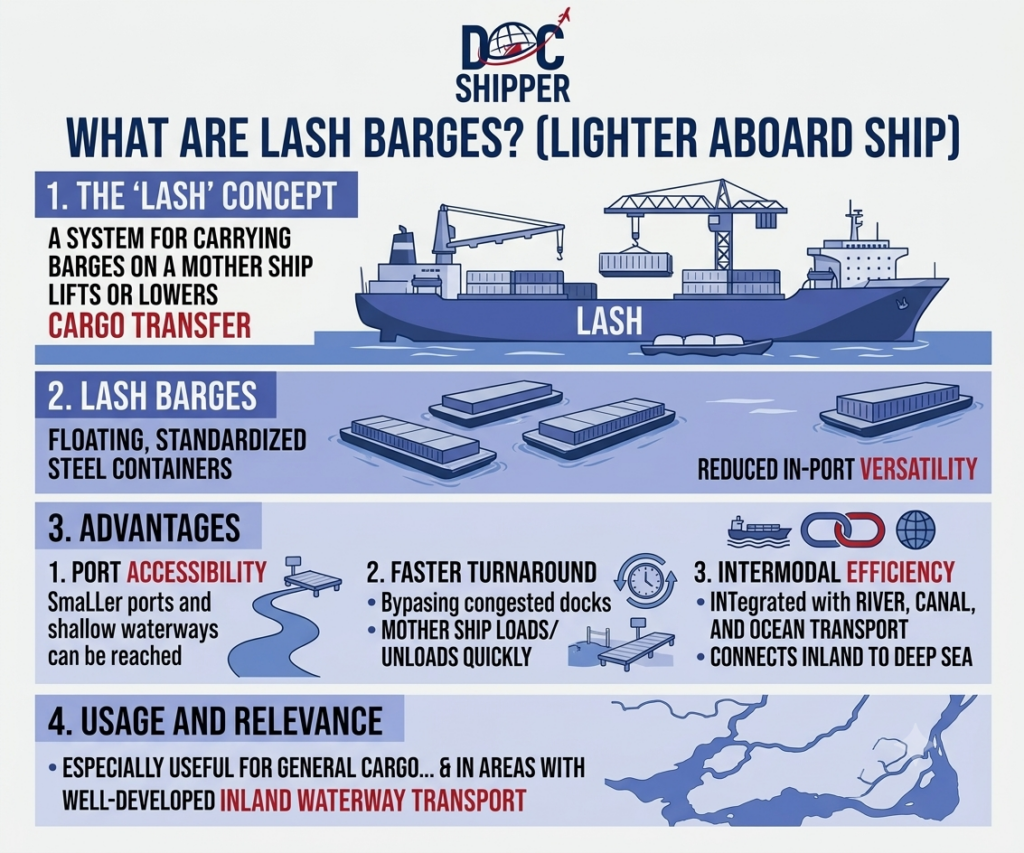
The LASH system operates through a sophisticated mother ship equipped with a massive gantry crane capable of lifting fully loaded barges directly from water. This engineering marvel eliminates traditional dock requirements, allowing cargo operations in open anchorages or river mouths.
The mother ship typically carries 73 to 89 barges in multi-tier configurations. Each barge floats independently to its inland origin point, gets loaded by conventional means, then rendezvous with the mother ship at a designated transfer location. The crane lifts each 400-ton unit aboard in approximately 15 minutes, stacking them in the ship’s hold and on deck.
This process reverses at destination ports. The mother ship anchors offshore, lowers barges individually, and local tugs distribute them to final delivery points. The regulatory framework governing LASH operations falls under IMO SOLAS regulations for cargo securing and stability, with specific requirements for barge stowage and seafastening.
Operationally, the system offers three critical advantages. First, port independence reduces demurrage costs associated with berth waiting times. Second, direct inland penetration eliminates transshipment expenses at river-sea interfaces. Third, flexible scheduling allows barges to be loaded while the mother ship completes its previous voyage.
At DocShipper, we evaluate LASH barge suitability during route planning, particularly for clients shipping from Mississippi River tributaries or West African waterways where port infrastructure remains limited. Our logistics coordinators verify barge certifications and coordinate mother ship schedules to optimize your supply chain timeline.
The system does present challenges. Limited vessel availability restricts service to specific trade lanes. Weather sensitivity impacts crane operations in open water. Capital intensity discourages new fleet investments. However, for bulk agricultural exports or project cargo requiring river access, LASH barges remain an unmatched solution.
Concrete Examples & Operational Data
Real-world LASH operations demonstrate the system’s practical advantages. Consider a grain export scenario from Arkansas to West Africa. Traditional routing requires trucking to New Orleans, port handling, ocean vessel loading, discharge at Lagos, and local distribution. LASH barges eliminate three handling steps.
| Transport Method | Handling Points | Transit Time | Cost per Ton |
|---|---|---|---|
| Conventional Container | 5 transfers | 28-32 days | $185-220 |
| LASH Barge System | 2 transfers | 24-26 days | $140-165 |
A documented case from 2019 involved machinery exports from Pittsburgh to Brazil. The shipper utilized LASH barges down the Ohio and Mississippi Rivers, meeting a mother ship at the Gulf of Mexico. The operation achieved 22% cost savings compared to trucking to East Coast ports, while reducing carbon emissions by eliminating 1,400 miles of road transport.
Operational capacity data reveals system efficiency:
- Mother ship capacity – 43,000 to 89,000 deadweight tons across 73-89 barges
- Loading speed – 12-18 barges per hour in optimal conditions
- Fuel efficiency – 30-40% better than equivalent container ship/truck combinations
- Port time reduction – Anchored loading eliminates 3-5 day berth waiting periods
- Damage rates – Less than 0.3% for properly secured barge cargo
The most active LASH routes historically connected U.S. Gulf ports with West African destinations, Southeast Asian river systems, and South American waterways. Current operations concentrate on specialized cargo where cost advantages offset limited vessel availability.
For project cargo managers, LASH barges solve unique challenges. A 2021 infrastructure project in Nigeria utilized the system to transport construction equipment directly from manufacturing facilities on the Tennessee River to inland job sites, bypassing Lagos port congestion entirely. The operation reduced project timeline by six weeks.
Conclusion
LASH barges represent a specialized but highly effective solution for cargo requiring seamless river-to-ocean transitions. While vessel availability limits widespread adoption, the system delivers unmatched efficiency and cost savings for specific trade lanes and cargo types.
Need expert guidance on multimodal transport options for your shipments? Contact DocShipper for customized logistics solutions tailored to your supply chain requirements.
📚 Quiz
Test Your Knowledge: LASH Barges
What is the primary function of LASH barges in the logistics system?
What is a key advantage that distinguishes LASH systems from conventional port operations?
A grain exporter in Arkansas ships to West Africa. According to operational data, which statement about LASH barge transport is correct?
🎯 Your Result
📞 Free Quote in 24hFAQ | Lash Barges: Definition, Operations & Concrete Examples
LASH barges feature standardized dimensions (61.5' x 31'), reinforced lifting points for crane handling, and specific seafastening requirements for ocean transport. Standard river barges lack these specifications and cannot be loaded onto mother ships. LASH units also maintain higher structural integrity standards to withstand open-water conditions during transit.
Each LASH barge typically holds 370 to 450 tons of cargo, depending on configuration and cargo density. The standard capacity is 400 tons with a volume of approximately 11,500 cubic feet. Actual payload varies based on draft restrictions in origin waterways and mother ship stability calculations. Oversized barges exist but remain uncommon due to crane capacity limitations.
Active LASH operations concentrate on U.S. Gulf Coast to West Africa routes, Mississippi River system exports, and select Southeast Asian connections. Historical routes included South American river systems and Mediterranean services. The system works best where river access reaches production areas and destination ports face chronic congestion. Route availability fluctuates with mother ship fleet deployment.
LASH systems eliminate double handling at river-ocean interfaces, reducing labor costs by 30-40%. Port demurrage drops significantly through anchored loading operations. Inland trucking expenses decrease when loading occurs directly at riverside facilities. The system also reduces packaging requirements since cargo remains in the same barge throughout transit, cutting material costs by 15-20% for bulk shipments.
Yes, LASH barges accommodate containers when properly secured with twist locks and lashing equipment. A standard barge holds approximately 8 TEU in single-tier configuration. However, the system proves most cost-effective for bulk cargo, breakbulk goods, or oversized equipment that benefits from barge's open deck space. Container efficiency remains higher on conventional cellular vessels for port-to-port movements.
Mother ship crane operations require wave heights below 1.5 meters and wind speeds under 25 knots. Heavy rain reduces visibility but doesn't necessarily halt operations if safety protocols are maintained. Fog delays commence when visibility drops below 500 meters. Lightning within 10 nautical miles triggers immediate suspension. Operational windows average 75-80% in tropical regions, higher in temperate zones.
A full loading cycle for 73 barges typically requires 48-72 hours under optimal conditions. This includes barge positioning, crane lifting (15 minutes per unit), stowage, and seafastening. Discharge operations proceed slightly faster at 36-60 hours. Weather delays, barge arrival sequencing, and cargo inspection requirements can extend timelines. Partial loadings complete proportionally faster based on barge count.
LASH barges fall under dual regulatory frameworks. River operations comply with inland waterway regulations (USCG for U.S. waters). Once loaded aboard mother ships, they're governed by IMO SOLAS requirements for cargo securing and stability. Barges must maintain current classification society certificates and undergo periodic surveys. Seafastening must meet CSS Code specifications to prevent shifting during ocean transit.
Lifting incidents trigger immediate damage assessment protocols. Minor structural damage may allow continued transport with enhanced securing. Significant compromise requires barge discharge and cargo transshipment. Insurance coverage under marine cargo policies typically addresses these events. Prevention focuses on proper lifting point maintenance, crane operator certification, and pre-lift inspections. Incident rates remain below 0.1% for certified operations.
Yes, shallow draft capability is a core LASH advantage. Loaded barges draw 8-9 feet, allowing navigation in rivers and channels where ocean vessels cannot operate. This enables cargo loading at inland manufacturing facilities, agricultural collection points, and mining operations. Unloaded barges draw just 2-3 feet, facilitating repositioning through restricted waterways. Seasonal water level variations may still impact specific routes.
LASH transport reduces carbon emissions by 25-35% compared to truck-to-port-to-ship routing through eliminated handling and direct water transport. Fuel efficiency per ton-mile exceeds conventional multimodal chains by 30-40%. The system minimizes packaging waste since cargo remains in the same unit throughout transit. However, limited vessel availability and niche market focus prevent widespread environmental impact. Route optimization remains critical for maximizing sustainability benefits.
Required documents include standard bills of lading, commercial invoices, packing lists, and certificates of origin. Additionally, LASH operations require barge loading plans, stability calculations, and seafastening certifications. Customs documentation follows destination country requirements. Hazardous cargo needs proper IMO declarations and barge compatibility certificates. Mother ship operators provide barge receipt documentation upon loading, serving as custody transfer proof for insurance purposes.
Need Help with
Logistics or Sourcing ?
First, we secure the right products from the right suppliers at the right price by managing the sourcing process from start to finish. Then, we simplify your shipping experience - from pickup to final delivery - ensuring any product, anywhere, is delivered at highly competitive prices.


Fill the Form
Prefer email? Send us your inquiry, and we’ll get back to you as soon as possible.
Contact us




