



In short ⚡
Last Updated refers to the most recent date and time when information, data, or documentation was modified or revised. In international logistics, this timestamp ensures supply chain transparency, regulatory compliance, and real-time decision-making by tracking changes to shipment status, customs documents, inventory records, and carrier information.
Introduction
How often have you checked a shipment tracking page only to wonder if the displayed information reflects the current reality? This uncertainty stems from unclear or outdated “Last Updated” timestamps. In global trade, where containers cross continents and goods clear multiple checkpoints, knowing when data was last refreshed can mean the difference between proactive problem-solving and costly delays.
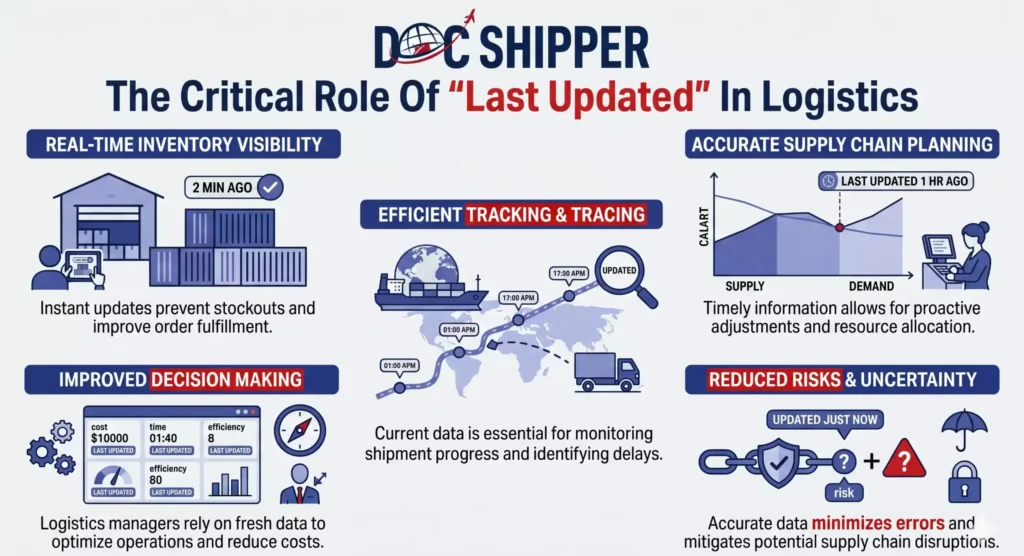
The “Last Updated” marker serves as the digital heartbeat of supply chain visibility. It confirms data freshness across documentation systems, tracking platforms, and compliance databases. Without accurate timestamps, logistics professionals risk making decisions based on obsolete information.
Key functions of the Last Updated timestamp include:
- Data integrity verification: Confirms that system records reflect the latest modifications
- Compliance documentation: Proves when customs declarations or certificates were last amended
- Supply chain synchronization: Aligns real-time updates across freight forwarders, carriers, and clients
- Audit trail establishment: Creates chronological records for regulatory inspections
- Stakeholder communication: Provides transparency on information currency for all parties
Technical Mechanisms & Compliance
The Last Updated timestamp operates through automated logging systems that capture modification events at database level. When a freight forwarder updates a Bill of Lading or a customs broker revises an import declaration, backend systems register the exact moment of change, typically in UTC format to ensure global standardization.
From a regulatory perspective, accurate timestamping aligns with international standards. The World Customs Organization requires electronic customs systems to maintain detailed audit logs, including modification timestamps. This ensures that post-clearance audits can verify when specific tariff classifications or value declarations were entered or amended.
In practical logistics operations, the Last Updated field appears across multiple document types. Commercial invoices track revisions when pricing or product descriptions change. Packing lists display update times after quantity corrections. Certificates of Origin show modification dates if supplier information requires amendment. Each timestamp creates a forensic record that protects all parties during disputes.
Technology platforms implement varying refresh rates. Real-time tracking systems may update every 15 minutes when containers pass RFID checkpoints, while manual documentation systems might show daily timestamp changes. Understanding these refresh cycles helps logistics professionals interpret data accuracy correctly.
At DocShipper, we integrate automated timestamp validation into our document management systems, ensuring clients always access the most current shipment information. Our platform cross-references update times across carrier portals, customs databases, and warehouse management systems to flag any synchronization discrepancies immediately.
Practical Examples & Data
Consider a pharmaceutical shipment requiring temperature-controlled transport from Switzerland to Singapore. The tracking portal shows “Last Updated: 14:32 UTC.” If this timestamp is 6 hours old during a critical transit phase, it signals potential system delays or communication gaps requiring immediate carrier contact.
Comparative analysis of timestamp strategies across industries reveals significant operational differences:
| Industry Sector | Update Frequency | Typical Delay Tolerance | Critical Timestamp Events |
|---|---|---|---|
| Perishable Goods | Every 30 minutes | 1-2 hours | Temperature readings, location checkpoints |
| High-Value Electronics | Real-time (15 min) | 4 hours | Security seals, customs clearance |
| General Merchandise | Daily | 24 hours | Port arrivals, warehouse receipts |
| Hazardous Materials | Every hour | 2 hours | MSDS updates, handling certifications |
A practical scenario demonstrates the impact of timestamp precision: An importer receives notification that customs clearance documents were updated at “08:15 Local Time” without UTC specification. The shipment faces potential demurrage charges starting at 09:00. The 45-minute ambiguity regarding timezone interpretation could cost thousands in storage fees if response is delayed.
Industry data reveals that 23% of supply chain disputes involve disagreements over when information was communicated or documentation modified. Precise Last Updated timestamps provide irrefutable evidence during arbitration proceedings, particularly when parties operate across multiple time zones.
DocShipper’s document management platform implements blockchain-verified timestamps for critical trade documents, creating immutable records that satisfy both commercial and legal requirements. This technology eliminates disputes over modification timing while ensuring regulatory compliance.
Conclusion
The Last Updated timestamp transcends simple record-keeping to become a strategic visibility tool in international logistics. It enables proactive management, regulatory compliance, and stakeholder trust through transparent information currency tracking.
Need expert guidance on implementing robust timestamp protocols in your logistics operations? Contact DocShipper for tailored solutions that ensure data accuracy across your supply chain.
📚 Quiz
Test Your Knowledge: Last Updated
What is the primary function of a "Last Updated" timestamp in international logistics?
Which statement correctly distinguishes "Last Updated" from "Last Modified"?
A pharmaceutical shipment's tracking portal shows "Last Updated: 14:32 UTC" but the timestamp is 6 hours old during critical transit. What action is most appropriate?
🎯 Your Results
📞 Free Quote in 24hFAQ | Last Updated: Definition, Usage & Practical Examples in Logistics
While often used interchangeably, "Last Updated" typically refers to any data change including automatic system refreshes, whereas "Last Modified" specifically indicates human-initiated edits to content. In logistics systems, Last Updated may change when carrier APIs push new tracking events, while Last Modified only changes when a user manually alters document fields.
Timezone discrepancies create significant confusion without standardized formatting. Best practice requires displaying all Last Updated timestamps in UTC with local time conversion provided separately. This prevents misinterpretation when parties in New York, Shanghai, and Rotterdam coordinate on the same shipment. Modern logistics platforms automatically convert UTC timestamps to user-local time while maintaining UTC in backend databases.
Yes, timestamp authenticity can be questioned during audits or disputes. Customs authorities may require proof that system clocks were accurately synchronized and that modification logs haven't been tampered with. This is why blockchain-based timestamp verification is gaining adoption for critical trade documents, providing cryptographic proof of modification timing that satisfies legal evidentiary standards.
Missing timestamps create liability ambiguities and can delay customs clearance. Authorities may reject documents lacking clear modification dates, particularly for amendments to value declarations or product classifications. Importers should immediately request properly timestamped replacements and document any delays caused by this omission for potential demurrage charge disputes.
Refresh frequency depends on cargo sensitivity and operational requirements. Critical shipments (pharmaceuticals, hazardous materials) require 15-30 minute updates. Standard freight can operate with 2-4 hour refresh cycles. Manual documentation should show clear timestamps whenever amendments occur. Over-frequent updates (every minute) can overwhelm systems without providing meaningful additional value.
While not universally mandatory, timestamps are required for electronic customs declarations under most jurisdictions' single-window systems. Commercial documents benefit from timestamps for dispute resolution, even if not legally required. Key documents requiring timestamps include customs declarations, certificates of origin, bills of lading amendments, and cargo insurance modifications.
Automated systems trigger timestamp updates when specific events occur: GPS coordinates change beyond defined thresholds, RFID readers detect container passage, EDI messages arrive from carriers, or temperature sensors report readings. Each event writes to a database transaction log with microsecond precision, creating an audit trail linking each update to its triggering source.
Absolutely. Professional freight forwarders should provide detailed timestamp logs upon request, particularly when investigating delays or preparing for audits. These logs should show document creation dates, all subsequent modifications, and system access records. Reputable providers maintain immutable logs that can be independently verified through third-party timestamp authorities.
Inventory systems rely on Last Updated timestamps to maintain stock accuracy across warehouses. When multiple locations update quantities simultaneously, timestamp sequencing determines which update takes precedence. Without precise timestamps, inventory counts can become desynchronized, leading to stock-outs or overselling. Modern warehouse management systems use atomic clocks for microsecond-level synchronization.
Retention requirements vary by jurisdiction but typically align with customs audit periods of 3-7 years. EU regulations require 3 years for standard trade documents, while some jurisdictions mandate 5-10 years for controlled goods. Companies handling hazardous materials or pharmaceuticals often maintain permanent timestamp archives. Best practice involves automated archival systems that preserve complete audit trails.
ISO 8601 provides the international standard for timestamp representation (YYYY-MM-DDTHH:MM:SSZ). UN/CEFACT recommends this format for all electronic trade documents. However, legacy systems may still use regional date formats, creating interoperability challenges. Modern logistics platforms automatically convert between formats while maintaining ISO 8601 in backend databases for consistency.
Timestamps establish critical timelines during claims investigation. Insurance adjusters compare damage report timestamps against tracking updates to determine where and when damage occurred. Discrepancies between carrier-reported updates and actual inspection timestamps can affect liability assignment. Accurate timestamps from all parties strengthen claims processing and accelerate settlements.
Need Help with
Logistics or Sourcing ?
First, we secure the right products from the right suppliers at the right price by managing the sourcing process from start to finish. Then, we simplify your shipping experience - from pickup to final delivery - ensuring any product, anywhere, is delivered at highly competitive prices.


Fill the Form
Prefer email? Send us your inquiry, and we’ll get back to you as soon as possible.
Contact us




