


In short ⚡
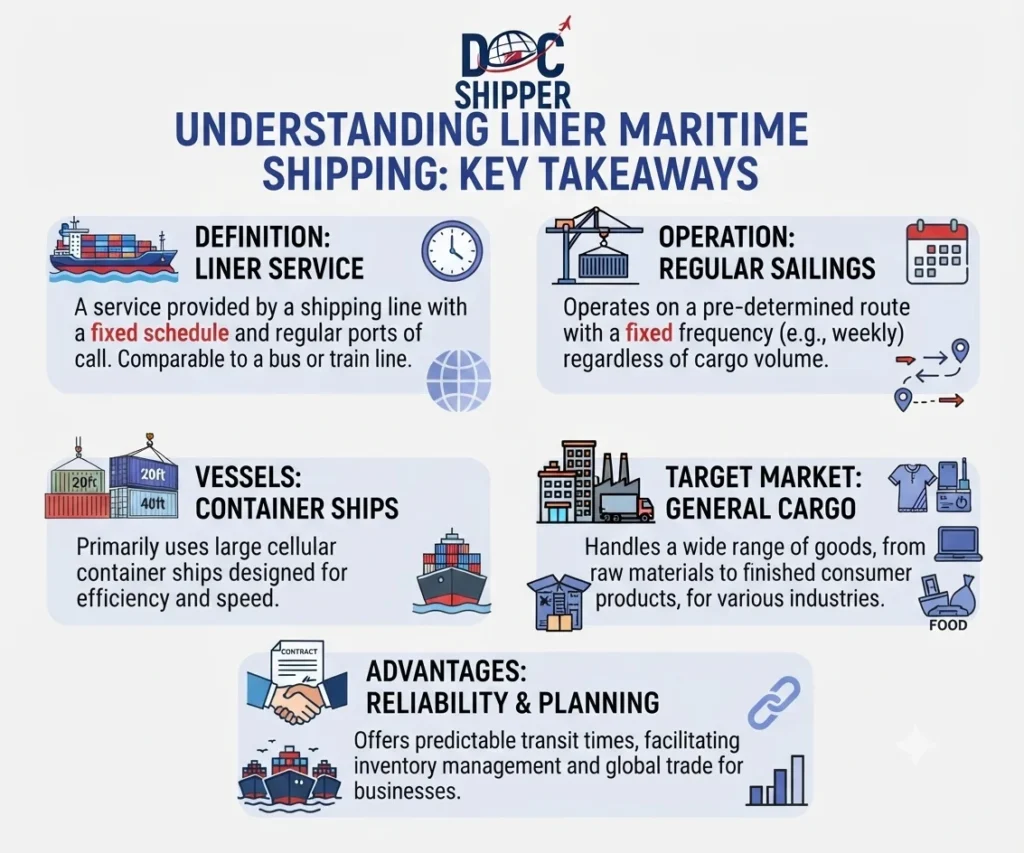
A liner is a shipping company operating vessels on fixed, regular routes with published schedules and standard freight rates. Unlike tramp shipping, liners follow predetermined itineraries and accept cargo from multiple shippers, ensuring predictable transit times and reliable service for international trade.
Introduction
In international logistics, businesses often struggle to distinguish between shipping service types—leading to mismatched expectations, delays, and budget overruns. The term “liner” represents a fundamental category in maritime transport, yet its implications for cargo booking, pricing, and supply chain planning remain misunderstood.
Liner shipping forms the backbone of global containerized trade. Unlike charter or tramp vessels that operate on-demand, liners provide structured, scheduled services connecting major ports worldwide. This predictability makes them essential for manufacturers, retailers, and exporters requiring consistent shipping windows.
Key characteristics of liner services include:
- Fixed schedules: Weekly or bi-weekly departures regardless of cargo volume
- Published routes: Predetermined port rotations announced in advance
- Standard tariffs: Transparent freight rates accessible to all shippers
- Multi-shipper cargo: Vessels carry goods from numerous customers simultaneously
- Common carrier status: Legal obligation to accept cargo within capacity and regulatory limits
Understanding liner operations is crucial for import/export decision-making. Misjudging service types can result in booking errors, unexpected costs, or supply chain disruptions. At DocShipper, we help clients select appropriate shipping modes and optimize their liner bookings to balance cost and transit time.
The Liner System: Structure & Operations
The liner system operates through shipping alliances and vessel sharing agreements, enabling carriers to offer expansive route networks without owning every ship on every route. Major alliances like 2M, Ocean Alliance, and THE Alliance control over 80% of global container capacity, coordinating schedules to maximize efficiency.
Liner companies employ hub-and-spoke networks. Large vessels service primary routes between major hubs (e.g., Shanghai-Rotterdam), while smaller feeder vessels distribute cargo to regional ports. This model optimizes vessel utilization and frequency while maintaining service to secondary markets.
Pricing in liner shipping follows tariff-based structures published in freight schedules. Base rates vary by commodity, container type (20′ vs 40′), and trade lane. Additional charges include bunker adjustment factors (BAF), currency adjustment factors (CAF), and terminal handling charges (THC). Understanding these components is essential for accurate landed cost calculations.
The bill of lading issued by liners serves as both receipt and contract of carriage. Unlike charter party bills of lading, liner B/Ls are negotiable documents that can be transferred to facilitate payment through letters of credit. According to ICC Uniform Customs and Practice, liner B/Ls must meet specific documentary credit requirements.
Liner services operate under common carrier obligations, meaning they cannot arbitrarily refuse cargo that meets their service parameters. This legal framework, governed by international conventions like the Hague-Visby Rules, provides shippers with recourse in case of loss or damage, differentiating liners from private contract carriers.
At DocShipper, we verify liner schedules, negotiate volume discounts, and ensure documentation compliance for FCL and LCL shipments. Our expertise prevents common pitfalls like incorrect Incoterms application or overlooked surcharges that can inflate final costs by 15-30%.
Concrete Examples & Industry Data
To illustrate liner operations, consider a manufacturer exporting electronics from Shenzhen to Hamburg. A liner company like Maersk or MSC offers weekly departures, with published transit times of 28-32 days. The shipper books space at $2,800 per 40′ container (base rate), plus BAF ($450), THC ($180), and documentation fees ($75)—totaling $3,505.
Contrast this with tramp shipping: A bulk commodity exporter might charter an entire vessel for a single voyage from Santos to Rotterdam. The charterer pays a negotiated lump sum (e.g., $1.2M) but controls routing, timing, and cargo mix. This flexibility suits large-volume shippers but lacks the frequency and predictability of liner services.
Industry statistics reveal liner dominance in containerized trade:
| Metric | Liner Shipping | Tramp/Charter |
|---|---|---|
| Global container volume | 98% of containerized cargo | 2% (specialized/project cargo) |
| Schedule reliability (2024) | 68% on-time arrival | Varies by contract |
| Typical booking lead time | 7-14 days before departure | 30-90 days (charter negotiation) |
| Price transparency | Published tariffs, surcharges disclosed | Negotiated rates, confidential |
A practical use case involves an e-commerce retailer importing goods from Ningbo to Los Angeles. By selecting a liner service with express routing (14-day transit via transpacific direct call), the retailer pays a 25% premium over slower services but avoids air freight costs that would be 400% higher. This demonstrates how liner flexibility accommodates varying urgency and budget constraints.
Another scenario: A European automotive supplier needs weekly shipments of components from Yokohama to Bremerhaven. Liner services provide consistent sailing schedules, enabling just-in-time inventory management. Attempting this with tramp shipping would require chartering multiple vessels annually—economically unfeasible for mid-volume shippers.
According to UNCTAD’s Review of Maritime Transport, liner shipping accounts for $14 trillion in global trade value annually, underscoring its role in supply chain infrastructure. Disruptions like the 2021 Suez Canal blockage highlighted liner networks’ vulnerability yet demonstrated their capacity to reroute and recover.
Conclusion
Liner shipping represents the most reliable and accessible maritime transport option for businesses engaged in international trade. Its combination of fixed schedules, published rates, and global connectivity makes it indispensable for supply chain predictability. Understanding liner structures, pricing mechanisms, and operational constraints enables better logistics decision-making and cost control.
Need expert assistance with liner bookings, documentation, or freight optimization? Contact DocShipper for tailored logistics solutions.
📚 Quiz
Test Your Knowledge: Liner Shipping
What defines a liner shipping service in maritime transport?
Which statement correctly describes liner pricing structures?
An automotive supplier needs weekly component shipments from Asia to Europe for just-in-time manufacturing. Which service best meets their requirements?
🎯 Your Result
📞 Free Quote in 24hFAQ | Liner: Definition, Role & Concrete Examples in Maritime Shipping
A liner operates on fixed routes with published schedules and accepts cargo from multiple shippers at standard rates. A tramp vessel operates on-demand, chartered by a single entity for specific voyages without predetermined routes. Liners prioritize schedule adherence; tramps prioritize cargo volume and routing flexibility. Most containerized goods move via liners, while bulk commodities often use tramps.
Standard practice requires booking 7-14 days before departure for most trade lanes. High-demand routes (e.g., Asia-Europe during peak season) may need 3-4 weeks' notice. Last-minute bookings are possible but incur premium rates and risk space unavailability. DocShipper recommends booking upon order confirmation to secure optimal rates and departure slots.
Published tariffs serve as base rates, but volume shippers can negotiate contract rates offering 15-40% discounts. Negotiations consider annual volume commitments, consistency, and trade lane competitiveness. Small shippers typically pay tariff rates unless working through freight forwarders who consolidate volumes. Surcharges (BAF, CAF) are generally non-negotiable as they reflect operational costs.
Liners rarely compensate for delays unless gross negligence is proven. Most bills of lading include "expected" rather than "guaranteed" arrival dates. Delays averaging 2-5 days occur due to weather, port congestion, or equipment issues. Shippers concerned with time sensitivity should choose express services or consider contractual penalties for critical shipments.
Yes, liners accept dangerous goods if properly declared and packaged per IMDG Code regulations. Shippers must provide Material Safety Data Sheets (MSDS) and use UN-approved containers. Additional fees apply, and space availability is limited. False declarations risk cargo rejection, fines, and legal liability. DocShipper manages DG documentation to ensure compliance.
Less than Container Load (LCL) services allow multiple shippers to share container space. Freight forwarders consolidate small shipments at origin, then deconsolidate at destination. This reduces costs for shippers with insufficient volume for a full container. Transit times increase due to consolidation/deconsolidation, typically adding 5-10 days versus FCL.
Alliances expand route coverage and frequency without increasing individual carrier fleets. Shippers benefit from more departure options and competitive pricing. However, alliances reduce overall market competition, potentially limiting negotiation leverage. Understanding alliance structures helps identify alternative routings when primary services are fully booked or experiencing delays.
Common surcharges include Bunker Adjustment Factor (fuel costs), Currency Adjustment Factor (exchange rate fluctuations), Terminal Handling Charges (port operations), Peak Season Surcharge (high demand periods), and War Risk Surcharge (conflict zones). Total surcharges can add 30-50% to base rates. Always request all-inclusive quotations to avoid billing surprises.
Standard containers support maximum weights of 28-30 tons and dimensions of 40' x 8' x 8.6'. Oversized cargo requires flat rack or open-top containers, subject to availability and higher rates. Super-heavy items may need break-bulk shipping rather than containerized liner service. Always provide exact dimensions and weights during booking to avoid equipment mismatches.
Industry data shows 60-70% schedule reliability, meaning 30-40% of vessels arrive late. Factors include port congestion, adverse weather, and equipment shortages. Major carriers publish real-time tracking, but prudent shippers build 3-5 day buffers into supply chain planning. Critical shipments may warrant premium express services with better on-time performance.
Essential documents include Commercial Invoice, Packing List, Bill of Lading, and Certificate of Origin. Additional requirements vary by commodity and destination (e.g., phytosanitary certificates, import licenses). Incomplete or inaccurate documentation causes customs delays and demurrage charges. DocShipper verifies all paperwork before shipment to ensure smooth clearance.
Evaluate transit time, frequency, transshipment points, carrier reputation, and total cost (including surcharges). Direct services cost more but reduce handling risks. Multi-transshipment routes offer lower rates but longer transit and higher loss/damage risk. Balance urgency against budget, and consider using freight forwarders who maintain relationships with multiple carriers for optimal routing.
Need Help with
Logistics or Sourcing ?
First, we secure the right products from the right suppliers at the right price by managing the sourcing process from start to finish. Then, we simplify your shipping experience - from pickup to final delivery - ensuring any product, anywhere, is delivered at highly competitive prices.


Fill the Form
Prefer email? Send us your inquiry, and we’ll get back to you as soon as possible.
Contact us




