


In short ⚡
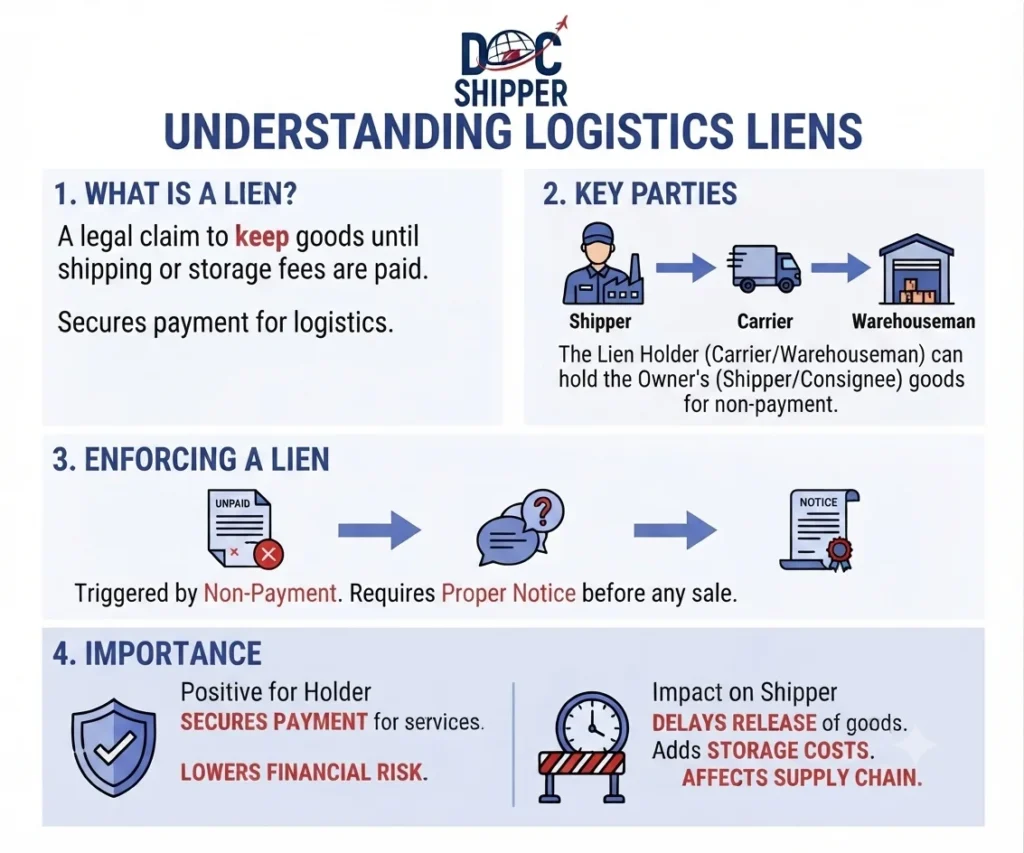
Lien is a French legal term meaning "lien" or "link" in logistics contexts. It refers to a legal claim or right held by one party over goods belonging to another, typically to secure payment for services rendered. In international trade, liens protect carriers, freight forwarders, and warehouse operators by granting them the right to retain cargo until outstanding debts are settled.
Introduction
Shippers frequently misunderstand their vulnerability when cargo is held at ports or warehouses due to unpaid invoices. This confusion stems from insufficient knowledge about legal retention rights that logistics providers possess worldwide.
In international supply chains, liens represent a critical legal protection mechanism. They balance commercial relationships between service providers and clients while ensuring operational sustainability across maritime, air, and ground transportation networks.
Key characteristics of liens in logistics include:
- Possessory nature: The holder must physically control the goods
- Debt correlation: The lien must relate directly to services provided for those specific goods
- Legal framework variation: Rights differ significantly across jurisdictions and transport modes
- Priority status: Liens often take precedence over other creditor claims
- Time limitations: Most jurisdictions impose statutory deadlines for exercising lien rights
Legal Mechanisms & Industry Applications
Liens in logistics operate under distinct legal frameworks depending on the transport mode and jurisdiction. Maritime liens, governed by international conventions like the 1993 Maritime Liens and Mortgages Convention, grant ship owners and carriers privileged claims against cargo for unpaid freight charges.
The possessory lien remains the most common form in freight forwarding. This mechanism allows warehouse operators, trucking companies, and freight forwarders to retain goods until receiving full payment for services rendered. According to ICC Incoterms guidelines, responsibility for payment often determines who bears the risk of lien enforcement.
The contractual lien extends beyond immediate possession. Parties may negotiate terms granting retention rights even after cargo delivery, provided proper documentation exists. These arrangements frequently appear in warehousing agreements and long-term freight contracts.
General average liens specifically apply to maritime transport when vessels sacrifice cargo to save the ship during emergencies. All cargo owners must contribute proportionally before retrieving their goods—a principle dating back to Roman maritime law.
At DocShipper, we systematically review lien clauses in service contracts to protect our clients from unexpected cargo retention. Our compliance team verifies payment schedules and legal terms before goods reach critical control points, minimizing disruption risks.
The enforcement process typically follows strict legal procedures. Service providers must notify cargo owners formally, allow reasonable settlement periods, and in many jurisdictions, obtain court approval before selling retained goods. U.S. Uniform Commercial Code Article 7 provides detailed frameworks that many countries have adapted into their commercial legislation.
Practical Examples & Case Studies
Understanding lien mechanisms becomes clearer through real-world scenarios that illustrate their financial and operational impact on international trade operations.
Comparative Lien Scenarios
| Scenario | Service Provider | Outstanding Amount | Cargo Value | Resolution Time |
|---|---|---|---|---|
| Port Storage Lien | Container Terminal | $8,400 | $125,000 | 14 days |
| Freight Forwarder Lien | International Logistics Co. | $15,200 | $89,000 | 21 days |
| Carrier Lien (Maritime) | Ocean Shipping Line | $32,700 | $450,000 | 45 days |
| Customs Broker Lien | Clearance Agency | $4,800 | $67,000 | 7 days |
Case Study: Electronics Shipment Retention
A German electronics manufacturer shipped €180,000 worth of components to a U.S. distributor via Rotterdam. The freight forwarder incurred €5,400 in additional charges for container demurrage and customs examination fees not covered in the original quote.
When the importer disputed these charges, the forwarder exercised their possessory lien at the New Jersey warehouse facility. The standoff lasted 28 days, during which:
- The manufacturer faced €12,000 in lost sales due to stock-outs
- Storage fees accumulated an additional €2,100
- Legal consultation costs reached €3,800
- The distributor’s production line experienced 6 days of downtime
Resolution came through negotiated payment of the original €5,400 plus 40% of accumulated storage costs. The total economic impact exceeded €23,000—more than four times the initial disputed amount.
Key Prevention Strategies
- Pre-shipment contract review: Identify all potential additional charge clauses
- Payment guarantee instruments: Letters of credit or bank guarantees covering 120% of quoted costs
- Clear Incoterms selection: Define precisely who bears responsibility for each leg
- Regular communication protocols: Establish 48-hour response requirements for all cost notifications
- Contingency fund allocation: Budget 15-20% above quoted costs for high-risk corridors
Conclusion
Liens represent essential legal instruments that maintain equilibrium in logistics service relationships. Understanding their mechanisms, jurisdictional variations, and enforcement procedures helps companies avoid costly cargo retention scenarios while ensuring fair compensation for service providers.
Need expert guidance on lien clauses in your supply chain contracts? Contact DocShipper for comprehensive contract review and risk mitigation strategies tailored to your specific trade routes.
📚 Quiz
Test Your Knowledge: Logistics Liens
What is the fundamental legal nature of a lien in logistics?
Which statement about possessory liens is correct?
A freight forwarder holds your €180,000 electronics shipment for €5,400 in disputed demurrage fees. Based on the case study, what is the most likely total economic impact if this dispute extends 28 days?
🎯 Your Result
📞 Free Quote in 24hFAQ | Lien in Logistics: Definition, Types & Practical Applications
A lien specifically refers to a legal claim allowing cargo retention until debt payment, while right of retention (droit de rétention in French law) is broader and may apply to various contract types beyond logistics. In practical terms, logistics liens are specialized forms of retention rights governed by transport-specific regulations like the CMR Convention for road freight or the Hague-Visby Rules for maritime transport.
Generally, no. Lien rights typically extend only to services the lien holder directly provided. However, if the freight forwarder contracted the third-party service as principal and the client agreed to pay through the forwarder, contractual lien clauses may provide coverage. This varies significantly by jurisdiction and requires explicit contractual language establishing the forwarder's right to recover subcontracted costs.
Time limits vary by jurisdiction and transport mode. Maritime liens may persist for one to three years depending on the country. Warehouse liens typically last 90 to 180 days before requiring court proceedings. Most commercial jurisdictions require service providers to initiate legal action within reasonable timeframes (often 60-90 days) or risk losing priority status over other creditors.
Enforceability depends on applicable law clauses in contracts and international conventions. Maritime liens enjoy broader recognition through conventions like the 1993 MLM Convention. However, a lien established in one country may not automatically transfer authority to another jurisdiction. Service providers often require local legal action in the country where goods are physically located to enforce retention rights effectively.
Most legal systems recognize the special nature of perishable cargo and allow accelerated lien enforcement procedures. Service providers must act reasonably to preserve goods but may sell them quickly with minimal notice periods—sometimes as short as 48-72 hours. Proceeds cover outstanding debts, storage costs, and sale expenses, with any surplus returned to the cargo owner. Documentation requirements remain strict even in expedited processes.
Standard cargo insurance typically excludes losses arising from commercial disputes, including lien enforcement. However, specialized trade disruption insurance or credit insurance policies may provide coverage. These policies usually require pre-approval and cover only situations where the insured party acted in good faith. Policy terms should explicitly address lien scenarios to ensure coverage applies.
Incoterms determine cost responsibility but don't directly establish lien liability. Under FOB terms, buyers assume responsibility after loading, making them vulnerable to destination liens. With DDP terms, sellers remain responsible through delivery, exposing them to lien risks. The critical factor is identifying which party contracted with the service provider holding the lien, as contractual relationships determine liability regardless of Incoterms.
Valid lien claims require: (1) proof of service provision through bills of lading, warehouse receipts, or service invoices; (2) evidence of debt through unpaid invoices with clear payment terms; (3) confirmation of cargo possession through inventory records; (4) contractual documentation establishing lien rights; and (5) formal notification to the cargo owner. Missing any element may invalidate the lien in legal proceedings.
Yes, but priority rules determine which claims take precedence. Maritime liens generally rank highest, followed by warehouse liens, then general creditor claims. Within the same category, timing often determines priority—earlier services typically receive preference. When cargo value is insufficient to cover all liens, lower-priority holders may receive partial payment or nothing, making lien ranking crucial in insolvency situations.
Cargo owners may seek legal remedies including: immediate court injunctions to release goods, damages for economic losses caused by wrongful retention, compensation for cargo deterioration during improper holding, and recovery of legal costs. Successful claims typically require proving the service provider lacked valid debt grounds, violated procedural requirements, or acted in bad faith. Time sensitivity is critical—delays may result in irreversible cargo damage or loss.
Digital platforms create complexity by introducing intermediaries between traditional service providers and cargo owners. Smart contracts may automate payment releases, reducing lien scenarios. However, disputes over platform fees, service quality, or contract interpretation still arise. Most jurisdictions apply existing lien principles to digital transactions, though questions about which entity—platform or actual service provider—holds enforceable lien rights remain evolving legal issues.
Liens often survive bankruptcy as secured claims, giving holders priority over unsecured creditors. However, bankruptcy trustees may challenge liens lacking proper documentation or filed after bankruptcy petition dates. Maritime liens typically maintain super-priority status even in bankruptcy. Service providers must file formal claims quickly and prove their lien's validity through comprehensive documentation to preserve rights against competing creditor claims during insolvency proceedings.
Need Help with
Logistics or Sourcing ?
First, we secure the right products from the right suppliers at the right price by managing the sourcing process from start to finish. Then, we simplify your shipping experience - from pickup to final delivery - ensuring any product, anywhere, is delivered at highly competitive prices.


Fill the Form
Prefer email? Send us your inquiry, and we’ll get back to you as soon as possible.
Contact us




