


In short ⚡
A Letter of Credit (LOC) is a financial guarantee issued by a bank on behalf of a buyer, ensuring payment to the seller upon presentation of compliant documents. This payment security instrument mitigates risk in international trade by eliminating trust barriers between parties who may have never conducted business together before.Introduction
Many importers face a common dilemma: suppliers demand payment before shipment, yet buyers need proof of delivery before releasing funds. This creates a deadlock that can paralyze international transactions. The Letter of Credit eliminates this impasse by acting as a neutral third party—the bank—that guarantees payment compliance with agreed terms.
In global supply chains, LOCs serve as the backbone of trust between distant trading partners. They protect exporters from non-payment risks while assuring importers that funds will only be released when contractual obligations are met. This dual protection makes LOCs essential for high-value shipments and first-time transactions.
Key characteristics of Letters of Credit include:
- Bank guarantee: Issuing bank commits to pay regardless of buyer’s financial situation
- Documentary compliance: Payment triggered only when seller presents specified documents (invoice, bill of lading, certificates)
- Irrevocability: Most LOCs cannot be modified without consent from all parties
- Independence principle: LOC transaction is separate from underlying sales contract
- Standardized rules: Governed by ICC Uniform Customs and Practice (UCP 600)
How Letters of Credit Work: Mechanisms & Expertise
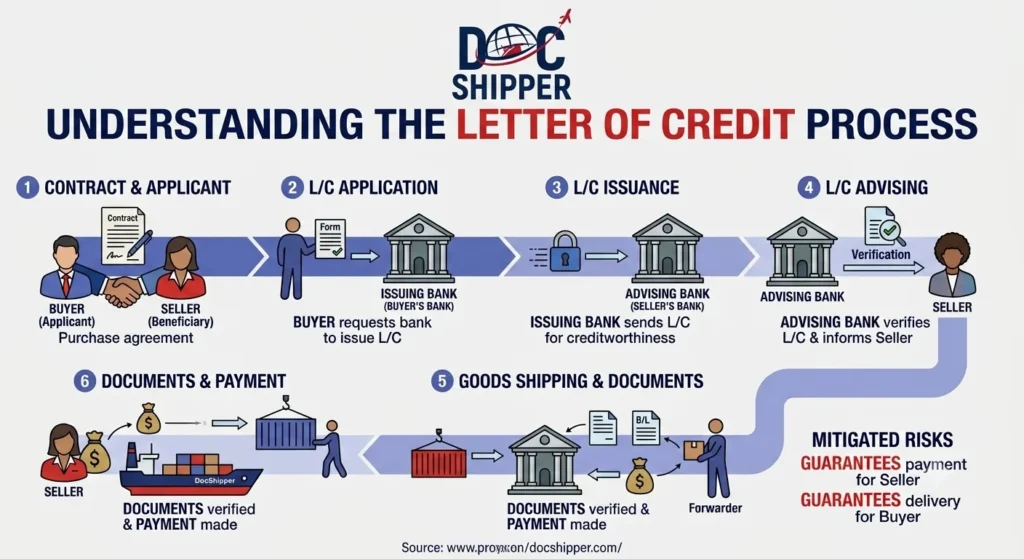
The LOC process involves four primary parties: the applicant (buyer/importer), the beneficiary (seller/exporter), the issuing bank (buyer’s bank), and the advising/confirming bank (seller’s bank). Understanding their interconnected roles is crucial for smooth transactions.
The operational sequence begins when the buyer requests their bank to issue an LOC in favor of the seller. The issuing bank evaluates the buyer’s creditworthiness and may require collateral or margin deposits—typically 10-30% of the LOC value. Once approved, the bank transmits the LOC to the seller’s bank, which notifies the beneficiary.
The seller then ships goods and prepares documentation according to the exact specifications in the LOC. Critical documents typically include commercial invoice, packing list, certificate of origin, insurance certificate, and bill of lading. The seller presents these to their bank, which examines them for strict compliance—a process called documentary examination.
According to ICC Banking Commission data, approximately 70% of initial document presentations contain discrepancies. Even minor errors—misspelled company names, inconsistent quantities, or expired documents—can lead to rejection. This underscores why meticulous preparation is non-negotiable.
Upon successful verification, the advising bank forwards documents to the issuing bank, which performs its own examination. If compliant, the issuing bank debits the buyer’s account and transfers funds to the seller. The buyer receives the documents and uses them to claim the goods from the carrier. At DocShipper, we systematically verify all LOC documentation before submission, reducing rejection rates and preventing costly shipment delays.
Several LOC variations exist for different scenarios. A confirmed LOC adds the advising bank’s payment guarantee, providing extra security when the issuing bank’s country carries political or economic risk. A standby LOC functions as a backup guarantee, activated only if the buyer defaults. Revolving LOCs cover multiple shipments over time, ideal for ongoing supplier relationships.
Practical Examples & Data-Driven Scenarios
Consider a U.S. electronics retailer importing $500,000 worth of smartphones from a Chinese manufacturer. With no prior business relationship, the supplier insists on guaranteed payment before production begins. The retailer’s bank issues an irrevocable LOC valid for 90 days.
The LOC specifies shipment via ocean freight to Los Angeles, with documents including a commercial invoice, full set of clean on-board bills of lading, SGS inspection certificate, and certificate of origin. The manufacturer completes production, arranges inspection, and ships the goods. Upon presenting compliant documents to their Shanghai bank, they receive payment within 5 business days—without waiting for the buyer’s payment or goods arrival.
Comparative analysis reveals significant cost and risk differences across payment methods:
| Payment Method | Seller Risk | Buyer Risk | Typical Cost | Best For |
|---|---|---|---|---|
| Prepayment | Very Low | Very High | Wire fee (~$50) | Established trust |
| Open Account | Very High | Very Low | Wire fee (~$50) | Long-term partners |
| Documentary Collection | Moderate | Moderate | $150-$300 | Medium-value trades |
| Letter of Credit | Low | Low | 0.75-1.5% of value | High-value/new partners |
Real-world data from the International Chamber of Commerce shows LOC costs vary by region and transaction complexity. For a $100,000 shipment, typical fees include:
- Issuance fee: $750-$1,500 (0.75-1.5% of LOC amount)
- Advising bank fee: $150-$300 flat rate
- Amendment fee: $100-$200 per change (avoid through precise initial terms)
- Confirmation fee: Additional 0.5-1% if added
- Discrepancy handling: $50-$150 per occurrence
A machinery exporter to Nigeria opted for a confirmed LOC due to currency volatility concerns. Despite paying an extra 0.8% for confirmation, they eliminated the risk of naira devaluation between shipment and payment—a protection that proved valuable when the currency dropped 12% during the 60-day LOC validity period.
Another scenario involves a pharmaceutical supplier using a transferable LOC to purchase raw materials from multiple sub-suppliers. The original LOC for $800,000 was divided into three portions—$350,000, $250,000, and $200,000—allowing each sub-supplier to receive direct payment upon fulfilling their portion. This structure maintained confidentiality about the final buyer while ensuring seamless supply chain financing.
Conclusion
The Letter of Credit remains the gold standard for risk mitigation in international trade, balancing protection for both buyers and sellers through bank-mediated guarantees. Its documentary rigor demands precision but delivers unparalleled security for high-stakes transactions.
Need assistance structuring your LOC requirements or navigating documentary compliance? Contact DocShipper for expert guidance on payment terms and trade finance solutions.
📚 Quiz
Test Your Knowledge: Letter of Credit (LOC)
What is the primary function of a Letter of Credit in international trade?
According to ICC data, what percentage of initial LOC document presentations typically contain discrepancies?
A U.S. importer receives an LOC from their Chinese supplier requiring payment before shipment. What is the correct interpretation?
🎯 Your Result
📞 Free Quote in 24hFAQ | Letter of Credit (LOC): Definition, Mechanisms & Practical Examples
Need Help with
Logistics or Sourcing ?
First, we secure the right products from the right suppliers at the right price by managing the sourcing process from start to finish. Then, we simplify your shipping experience - from pickup to final delivery - ensuring any product, anywhere, is delivered at highly competitive prices.


Fill the Form
Prefer email? Send us your inquiry, and we’ll get back to you as soon as possible.
Contact us




:%20Definition,%20Mechanisms%20&%20Practical%20Examples)