


In short ⚡
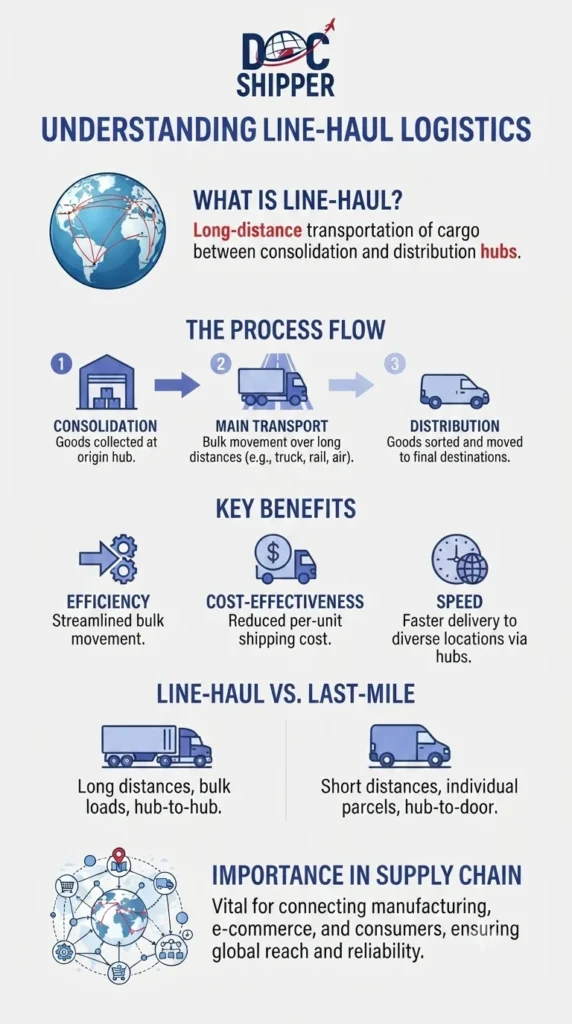
Line-haul refers to the long-distance transportation of goods between major hubs or terminals, excluding first and last-mile delivery. It represents the core intercity or interstate freight movement, typically involving full truckloads (FTL), intermodal containers, or bulk shipments along established routes. This middle-leg segment accounts for 40-60% of total logistics costs in international trade operations.Introduction: Why Line-Haul Matters in Global Trade
Many importers confuse line-haul with complete door-to-door shipping, leading to budget discrepancies and delays. In reality, line-haul covers only the trunk route between distribution centers or ports—not warehousing, customs clearance, or final delivery.
Understanding line-haul economics is critical for optimizing supply chain costs. In cross-border operations, this segment involves carrier negotiations, route optimization, and regulatory compliance across jurisdictions. For companies shipping 10+ containers monthly, efficient line-haul management can reduce overall freight expenses by 15-25%.
Key characteristics of line-haul operations include:
- Scheduled routes: Fixed corridors between major logistics nodes (e.g., Shanghai-Los Angeles, Rotterdam-Warsaw)
- Consolidated loads: FTL shipments or intermodal containers maximizing vehicle capacity
- Carrier specialization: Dedicated fleets for highway, rail, or ocean segments
- Cost predictability: Rate structures based on distance, weight, and fuel surcharges
- Regulatory complexity: Compliance with interstate commerce laws, cabotage rules, and driver hour limits
Operational Mechanics & Logistics Expertise
Line-haul operations function through hub-and-spoke networks where cargo consolidates at origin terminals, travels via primary corridors, then deconsolidates at destination hubs. Carriers optimize routes using load-matching algorithms to minimize empty backhaul miles—a critical factor since deadhead trips increase costs by 30-40%.
The three core line-haul modes include over-the-road (OTR) trucking for 200-800 mile distances, rail intermodal for 500+ mile hauls with lower per-mile costs, and drayage-supported ocean/air line-haul for international legs. Each mode has distinct cost structures: trucking averages $1.50-$2.80/mile, rail $0.12-$0.18/ton-mile, and ocean $0.01-$0.03/ton-mile.
Regulatory frameworks govern line-haul operations strictly. In the U.S., the Federal Motor Carrier Safety Administration enforces Hours of Service (HOS) rules limiting drivers to 11 hours daily, directly impacting transit times. EU cabotage restrictions prevent non-EU carriers from domestic line-haul within member states, complicating cross-border operations.
Fuel surcharges (FSC) represent 15-20% of line-haul costs, fluctuating with diesel prices. Carriers calculate FSC using benchmark indices like the U.S. Department of Energy’s weekly diesel prices. A 10% fuel price increase typically raises line-haul rates by 1.5-2%. At DocShipper, we negotiate fixed FSC caps in annual contracts to protect clients from volatility.
Advanced line-haul planning uses Transportation Management Systems (TMS) that analyze historical data, real-time traffic, and weather patterns. These systems reduce empty miles by 18-25% through dynamic route optimization and collaborative load-sharing between shippers. Integration with warehouse systems enables just-in-time arrivals, cutting dock detention fees by $50-$150 per occurrence.
Concrete Examples & Cost Data
Line-haul pricing varies significantly by lane density and equipment type. Consider a 53-foot dry van FTL shipment from Chicago to Atlanta (715 miles): standard rates range $1,300-$1,800 excluding FSC. The same lane via intermodal rail costs $900-$1,200 but adds 1-2 days transit time.
| Route | Distance | Mode | Cost Range | Transit Time |
|---|---|---|---|---|
| Los Angeles – Dallas | 1,435 mi | OTR Trucking | $2,200-$3,100 | 2-3 days |
| Shanghai – Rotterdam | 11,850 nm | Ocean (20′ container) | $800-$1,400 | 28-35 days |
| New York – Miami | 1,280 mi | Rail Intermodal | $1,100-$1,600 | 4-5 days |
| Paris – Warsaw | 1,370 km | FTL Trucking | €900-€1,250 | 2-3 days |
Use Case: A textile manufacturer imports 15 containers monthly from Vietnam to distribution centers in Memphis and Columbus. By switching 60% of volume from all-truck to rail line-haul for the Memphis route (1,200 miles), they reduce annual line-haul costs by $84,000 despite slower transit. The savings fund upgraded inventory systems that compensate for extended lead times.
Peak season impacts line-haul economics dramatically. During Q4 (October-December), North American truckload rates increase 25-40% due to e-commerce demand. Shippers with contracted rates locked before August avoid $400-$700 surcharges per load. European automotive corridors see similar spikes during IAA Frankfurt or Paris Motor Show periods.
Line-haul efficiency metrics reveal operational quality. Industry benchmarks show top-quartile carriers achieve 96-98% on-time delivery, <2% cargo claims ratios, and 85%+ loaded mile percentages. At DocShipper, we audit partner carriers quarterly using these KPIs to maintain service consistency across 35+ international lanes.
Emerging technologies reshape line-haul operations. Autonomous trucking pilots demonstrate 10-15% fuel savings through platooning and optimized acceleration. Electric Class 8 tractors reduce per-mile costs by $0.20-$0.35 on routes under 300 miles. Blockchain-enabled smart contracts automate payment releases when GPS confirms delivery milestones, cutting administrative costs by 30-45%.
Conclusion
Mastering line-haul dynamics enables importers to control their largest variable cost while maintaining supply chain velocity. Strategic mode selection, carrier partnerships, and technology adoption differentiate efficient operations from reactive logistics.
Need expert guidance on optimizing your line-haul strategy? Contact DocShipper for a customized freight analysis.
📚 Quiz
Test Your Knowledge: Line-Haul
What does line-haul transportation specifically cover in the logistics chain?
A shipper believes line-haul rates always include comprehensive cargo insurance coverage. Is this correct?
A company ships 15 containers monthly from Vietnam to Memphis (1,200 miles inland). Which line-haul strategy would optimize costs?
🎯 Your Result
📞 Free Personalized QuoteFAQ | Line-Haul: Definition, Calculation & Concrete Examples
Need Help with
Logistics or Sourcing ?
First, we secure the right products from the right suppliers at the right price by managing the sourcing process from start to finish. Then, we simplify your shipping experience - from pickup to final delivery - ensuring any product, anywhere, is delivered at highly competitive prices.


Fill the Form
Prefer email? Send us your inquiry, and we’ll get back to you as soon as possible.
Contact us




