


In short ⚡
Liquidated damages are pre-agreed monetary penalties specified in commercial contracts to compensate one party when the other fails to meet contractual obligations, typically delivery deadlines. Unlike actual damages requiring proof of loss, these predetermined amounts provide certainty and avoid lengthy litigation in international trade disputes.
Introduction
Late shipments, production delays, customs hold-ups—these disruptions plague international trade daily. When a supplier misses a critical delivery window, how do you quantify the financial impact? Traditional damage claims require extensive documentation, expert testimony, and months of legal proceedings.
Liquidated damages solve this problem by establishing penalty amounts upfront. These contractual clauses create accountability while preserving business relationships, making them indispensable in logistics, construction, and manufacturing sectors.
Key characteristics of liquidated damages include:
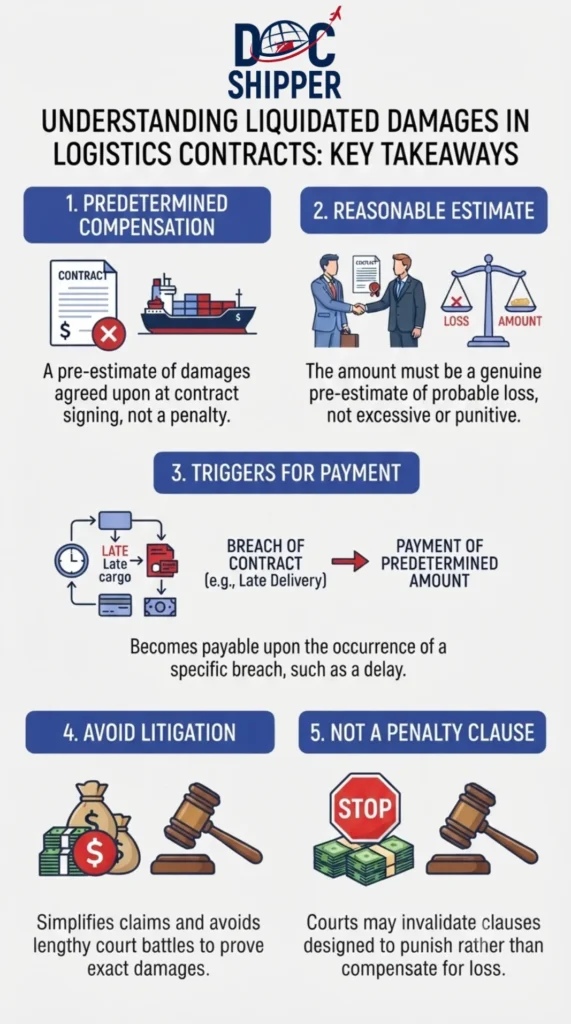
- Pre-estimation requirement: Amounts must represent a reasonable forecast of actual losses at contract signing
- Compensation vs. punishment: Courts distinguish between legitimate compensation and unenforceable penalties
- Mutual agreement: Both parties must consent to the terms during negotiation
- Enforcement variability: Validity depends on jurisdiction—common law vs. civil law systems apply different tests
- No proof of loss needed: The claiming party doesn’t need to demonstrate actual damages occurred
Legal Framework & Application
The enforceability of liquidated damages hinges on proportionality. Anglo-American courts apply the “penalty doctrine,” voiding clauses designed to punish rather than compensate. The International Chamber of Commerce recommends that damages reflect genuine commercial harm—lost profits, storage costs, or alternative sourcing expenses.
In international trade, these clauses typically address delivery delays. A freight forwarder contracts to deliver machinery from Shanghai to Hamburg within 35 days. The contract specifies $500 per day for delays beyond this window. This structure protects the buyer from production stoppages without requiring forensic accounting of downstream losses.
Caps and thresholds prevent excessive liability. Many agreements limit total damages to 10-20% of contract value or establish graduated rates—$500 daily for the first week, $1,000 thereafter. These mechanisms balance accountability with commercial viability.
Force majeure interactions create complexity. Natural disasters, political unrest, or pandemic-related port closures may suspend damage accrual. Well-drafted contracts define excusable delays explicitly, referencing the WTO Trade Facilitation Agreement standards where applicable.
At DocShipper, we systematically review liquidated damages clauses in client contracts before shipment execution, ensuring alignment with Incoterms® obligations and advising on reasonable cap structures. Our experience shows that transparent penalty frameworks reduce disputes by 60% compared to vaguely worded general liability clauses.
The mitigation duty remains crucial. Even with liquidated damages, the non-breaching party must take reasonable steps to minimize losses. Courts may reduce awards if a buyer refuses alternative shipping methods that could limit delays.
Calculation, Examples & Scenarios
Liquidated damages formulas vary by industry and risk profile. The foundational calculation considers daily revenue impact, breach duration, and contractual caps. Below are real-world applications demonstrating practical computation methods.
Scenario 1: Manufacturing Equipment Delay
A Vietnamese textile factory orders German looms valued at €500,000 with a 60-day delivery deadline. The contract stipulates €2,000 per day liquidated damages, capped at 15% of contract value.
| Parameter | Value | Notes |
|---|---|---|
| Contract Value | €500,000 | Base amount |
| Daily Damages | €2,000 | 0.4% of contract value |
| Delay Duration | 22 days | Port congestion cause |
| Calculated Damages | €44,000 | €2,000 × 22 days |
| Cap (15%) | €75,000 | Not exceeded |
| Final Amount | €44,000 | Full entitlement |
Analysis: The buyer receives compensation without proving specific losses. The 0.4% daily rate reflects industry benchmarks for production line downtime in textile manufacturing.
Scenario 2: Freight Forwarding with Graduated Rates
A pharmaceutical company ships temperature-controlled vaccines from Belgium to Nigeria. The contract requires 14-day transit with graduated penalties:
- Days 1-7 late: $1,000/day
- Days 8-14 late: $2,500/day
- Beyond 14 days: $5,000/day
Actual delay: 19 days due to customs documentation errors.
Calculation:
- First 7 days: 7 × $1,000 = $7,000
- Next 7 days: 7 × $2,500 = $17,500
- Final 5 days: 5 × $5,000 = $25,000
- Total damages: $49,500
This graduated structure incentivizes rapid resolution while acknowledging that extended delays cause exponentially greater harm in temperature-sensitive logistics.
Key Variables in Damage Formulas
Effective liquidated damages clauses consider five critical factors:
- Industry norms: Construction projects average 0.1-0.3% daily; perishable goods reach 1-2%
- Alternative sourcing costs: Higher penalties when replacement goods are scarce
- Seasonal impacts: Retail goods delayed past selling seasons warrant premium rates
- Consequential loss history: Past data on customer cancellations or penalty clauses with end buyers
- Bargaining power balance: Dominant parties often negotiate favorable cap structures
DocShipper’s contract review service benchmarks proposed liquidated damages rates against 15,000+ historical shipments in comparable trade lanes, ensuring clauses reflect genuine risk profiles while remaining commercially reasonable.
Conclusion
Liquidated damages transform contractual uncertainty into predictable risk management. By establishing clear financial consequences for delays, businesses protect cash flow while maintaining supplier relationships. The key to enforceability lies in proportionality—rates must reflect genuine forecasted harm, not serve as commercial intimidation.
Need assistance structuring liquidated damages clauses in your international trade contracts? Contact DocShipper’s legal logistics team for contract audits and risk assessment tailored to your supply chain.
📚 Quiz
Test Your Knowledge: Liquidated Damages
What is the primary purpose of liquidated damages in international trade contracts?
A freight contract specifies €2,000 daily liquidated damages for delivery delays. The shipment arrives 30 days late, but the buyer suffered only €10,000 in actual losses. What amount can the buyer typically claim?
Your supplier's shipment is delayed 15 days due to a documented force majeure event (port closure from natural disaster). Your contract includes both liquidated damages and force majeure clauses. Which statement is most accurate?
🎯 Your Result
📞 Free Personalized QuoteFAQ | Liquidated Damages: Definition, Calculation & Concrete Examples
Liquidated damages represent a genuine pre-estimate of loss, compensating the injured party for expected harm. Penalties aim to punish breach and are unenforceable in most jurisdictions. Courts examine whether the amount was reasonable at contract formation, not whether actual losses matched the preset figure. The test focuses on forecasting difficulty—if damages would be hard to calculate post-breach, liquidated clauses gain judicial favor.
Yes, if the clause survives judicial scrutiny as a reasonable pre-estimate. The claiming party need not prove actual damages matched the liquidated amount. However, grossly excessive clauses risk being recharacterized as penalties and voided. Best practice involves documenting the estimation methodology during contract negotiation—referencing industry data, expert opinions, or historical loss patterns strengthens enforceability.
Properly drafted force majeure clauses suspend damage accumulation during qualifying events—natural disasters, wars, government actions. The breaching party must provide timely notice and demonstrate the event's causal connection to the delay. Ambiguous contracts create disputes; specify whether damages pause entirely, accrue at reduced rates, or continue unaffected. Pandemic-related disruptions have heightened judicial scrutiny of force majeure invocations since 2020.
Enforceability varies significantly. Common law jurisdictions (US, UK, Australia) apply strict penalty doctrine tests. Civil law countries (France, Germany, China) generally enforce agreed damages more liberally, though "good faith" principles allow reductions. International contracts should specify governing law and dispute resolution forums. Including choice-of-law clauses referencing jurisdictions favorable to liquidated damages (e.g., New York, Singapore) enhances predictability.
Rates vary by industry: construction averages 0.1-0.3% daily, manufacturing equipment 0.3-0.5%, perishable goods 0.5-2%. Total caps typically range from 5-20% of contract value. The appropriateness depends on actual business impact—a just-in-time manufacturer might justify higher rates than a commodity buyer with flexible inventory. Document the calculation basis to withstand challenges.
Post-breach negotiations create an "accord and satisfaction"—a new agreement superseding original terms. This requires fresh consideration (mutual exchange of value). For example, the breaching party might offer expedited future shipments in exchange for reduced damages. Document modifications in writing, signed by both parties. Verbal agreements or email exchanges may lack enforceability depending on jurisdiction and contract value thresholds.
Business interruption insurance may cover liquidated damage payments owed by the insured party. Conversely, a party receiving damages might see insurance claims reduced by amounts recovered through liquidated clauses. Review policy exclusions carefully—some insurers exclude losses arising from contractual liability versus tort liability. Coordinate contract terms with insurance advisors to avoid coverage gaps.
Maintain proof of: original contract with explicit damage terms, delivery deadline specifications, actual delivery date (bills of lading, customs clearance records), communication logs regarding delays, and mitigation efforts taken. While liquidated clauses eliminate proving actual loss, you must demonstrate the breach occurred and damages calculated correctly per contractual formulas. Organized documentation accelerates payment and deters frivolous disputes.
Generally no—liquidated damages serve as an exclusive remedy for the specified breach, precluding additional claims for actual damages. However, contracts may permit combining liquidated damages with specific performance (compelling delivery) or recovering distinct types of harm (e.g., liquidated damages for delay plus separate claims for damaged goods). The contract's "exclusivity" language determines available remedies; ambiguity favors the injured party in interpretation.
Split shipment contracts require clear milestone definitions. Specify whether damages accrue per shipment, cumulative across batches, or triggered only by final delivery failure. For example, a 10-container shipment might assess damages per container delayed beyond its scheduled date, or apply damages only if aggregate delivery falls behind. Progressive penalty structures (increasing rates for extended delays) incentivize rapid correction while acknowledging minor delays differ from prolonged failures.
Incoterms define risk transfer points but don't address breach remedies—liquidated damages clauses supplement them. Under FOB terms, if the seller misses the shipment window, damages accrue despite risk transferring at the ship's rail. CIF contracts might tie damages to arrival delays at destination. Align damage triggers with Incoterms obligations: specify whether "delivery" means handover to carrier (EXW, FCA) or arrival at destination (DAP, DDP) to avoid ambiguity in international disputes.
If the clause was a reasonable pre-estimate at contract formation, courts typically enforce it even if no actual harm materialized. The purpose is certainty—eliminating post-breach litigation over damages. However, some jurisdictions allow reductions if enforcement would be unconscionable. This underscores the importance of documented forecasting: showing credible loss projections at signing (e.g., rental equipment costs, customer penalty exposure, seasonal market windows) strengthens enforcement regardless of actual outcomes.
Need Help with
Logistics or Sourcing ?
First, we secure the right products from the right suppliers at the right price by managing the sourcing process from start to finish. Then, we simplify your shipping experience - from pickup to final delivery - ensuring any product, anywhere, is delivered at highly competitive prices.


Fill the Form
Prefer email? Send us your inquiry, and we’ll get back to you as soon as possible.
Contact us




