


In short ⚡
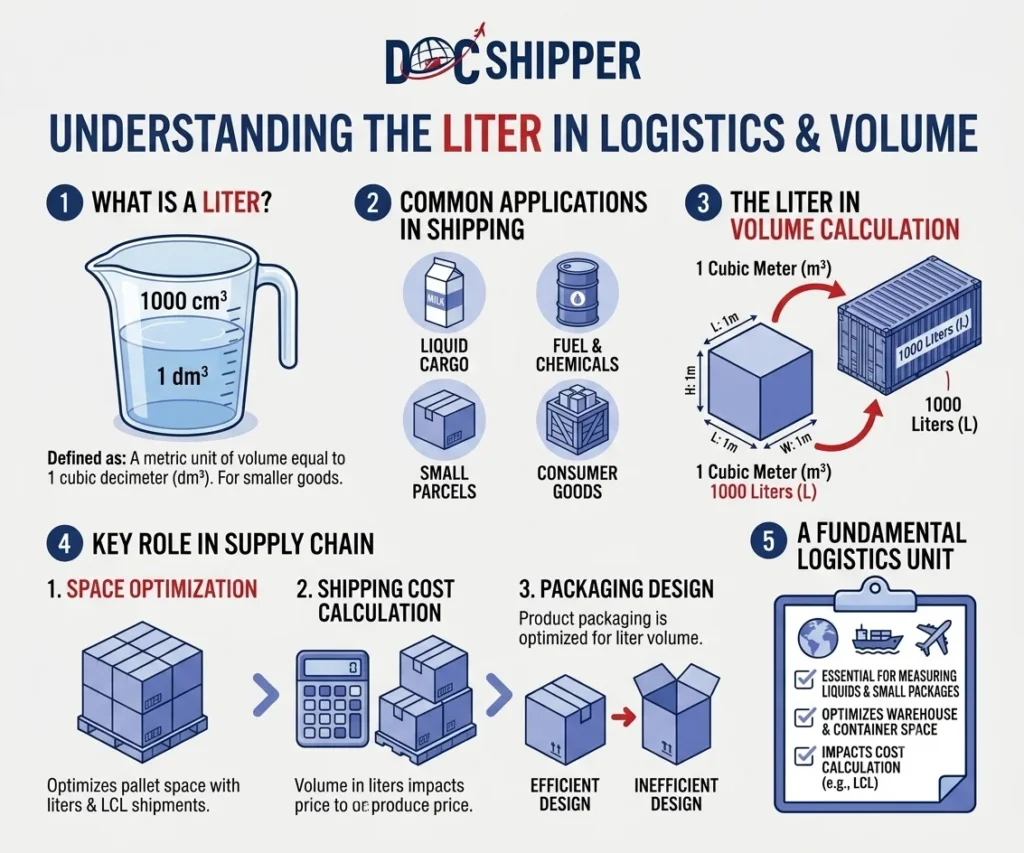
The liter is a metric unit of volume equal to one cubic decimeter (1 dm³), widely used in international trade to measure liquid and bulk cargo. It serves as a standard reference for freight calculations, customs declarations, and transport documentation across global supply chains.
Introduction
Confusion between volume measurements causes costly errors in freight booking and customs valuation. A shipment declared in gallons instead of liters can trigger delays, penalties, or incorrect freight charges. The liter provides a universal metric standard eliminating conversion ambiguity.
In international logistics, the liter directly impacts:
- Volumetric weight calculations for air and express freight pricing
- Dangerous goods declarations requiring precise liquid quantities
- Container optimization for bulk liquid commodities
- Customs duties on products taxed per volume (alcohol, chemicals, perfumes)
- Load planning for tankers, IBCs, and flexitanks
Understanding the Liter in Freight Operations
The liter operates as both a physical measurement and a regulatory standard. Defined by the International System of Units (SI), it equals exactly 1000 cubic centimeters. This precision matters when calculating chargeable weight, where volume dimensions convert to kilograms using the formula: (Length × Width × Height in cm) ÷ 6000 for air freight.
For liquid bulk cargo, liters determine tank container selection. A standard ISO tank holds 21,000 to 26,000 liters, while smaller intermediate bulk containers (IBCs) range from 500 to 1,250 liters. Accurate volume data prevents overfilling risks and ensures compliance with UN dangerous goods regulations.
Customs valuation for excise goods like wine or spirits requires liter-based declarations. European Union customs codes mandate volume reporting in liters for HS chapters 22 (beverages) and 27 (mineral oils). Incorrect conversions from gallons or barrels trigger audit flags.
In pharmaceutical logistics, temperature-controlled shipments of vaccines or biosamples measure capacity in liters to match insulated container specifications. A 20-liter cryo-shipper differs significantly from a 47-liter vapor-phase unit in handling capacity and transit duration limits.
At DocShipper, we systematically verify volume declarations in liters during pre-shipment inspections to prevent freight charge disputes and ensure customs documents match physical cargo specifications.
Conversion Examples & Industry Applications
Understanding liter conversions prevents operational errors. The table below shows common freight scenarios requiring accurate volume measurements:
| Unit | Liters Equivalent | Common Use |
|---|---|---|
| 1 Cubic Meter (CBM) | 1,000 liters | FCL container volume calculations |
| 1 US Gallon | 3.785 liters | Chemical shipments from North America |
| 1 Imperial Gallon | 4.546 liters | UK petroleum product exports |
| 1 Barrel (oil) | 158.987 liters | Crude oil and refined fuel trading |
| 20ft ISO Tank | 21,000-26,000 liters | Bulk liquid container transport |
Case Study: Wine Export Optimization
A French vineyard ships 12,000 bottles (750 ml each) to Singapore. Total volume: 12,000 × 0.75 = 9,000 liters. Using standard pallet dimensions (120×100×150 cm), the shipment occupies 1.8 CBM. Air freight charges based on volumetric weight: (180×100×150) ÷ 6000 = 450 kg chargeable weight, despite actual weight being 13,200 kg.
For customs, excise duty applies per liter of alcohol content. At 13% ABV, dutiable volume = 9,000 × 0.13 = 1,170 liters of pure alcohol. Singapore’s duty rate of SGD 88 per liter yields SGD 102,960 in excise charges.
Key Operational Points:
- LCL consolidation: Liters determine freight class for liquid shipments under NMFC codes
- Flexitank capacity: Standard 20ft container flexitanks hold 16,000-24,000 liters depending on liquid density
- Hazmat placarding: UN portable tank instructions specify maximum liter capacity per T-code
- Reefer containers: Temperature-sensitive liquids require volume-to-cooling ratio calculations
- Insurance valuation: Marine cargo policies use liter-based commodity rates for liquid goods
Conclusion
The liter functions as the backbone of volume-based logistics calculations, from freight pricing to customs compliance. Mastering conversions and regulatory applications prevents costly shipment errors and delays.
Need expert guidance on volume declarations or freight optimization? Contact DocShipper for tailored logistics solutions.
📚 Quiz
Test Your Knowledge: Liter in Logistics
What is the primary definition of a liter in international logistics?
For air freight volumetric weight calculation, how many liters convert to chargeable kilograms?
A client ships 500 US gallons of industrial chemicals. What volume should appear on customs documents?
🎯 Your Result
📞 Free Quote in 24hFAQ | Liter: Definition, Conversion & Practical Examples in Logistics
Airlines calculate chargeable weight using volumetric conversion: cubic centimeters divided by 6,000 equals kilograms. A shipment of 500 liters (500,000 cm³) results in 83.3 kg chargeable weight, even if actual weight is lower. Always compare volumetric versus gross weight to determine billing basis.
One cubic meter equals 1,000 liters. Ocean freight quotes use CBM (cubic meters) for container space, while liquid cargo documents specify liters. Converting helps verify container utilization: a 20ft container (33 CBM capacity) holds approximately 33,000 liters maximum.
Only specific HS chapters use liter-based duties, primarily alcoholic beverages (HS 22), oils (HS 27), and certain chemicals (HS 29). Most goods face ad valorem rates (percentage of value). Check the Harmonized Tariff Schedule for your destination country's specific requirements.
Yes, using intermediate bulk containers (IBCs), drums, or flexitanks. Flexitanks accommodate 16,000-24,000 liters in a 20ft container. For hazardous liquids, UN portable tanks with certified liter capacities ensure compliance with IMDG Code regulations.
IATA and IMDG regulations require exact volumes for Class 3 flammables and Class 8 corrosives. Variations exceeding 5% trigger inspections. Use calibrated measuring equipment and include temperature references, as liquid volume changes with thermal expansion.
Most freight forwarders provide conversion calculators. For manual calculations: US gallons × 3.785 = liters; Imperial gallons × 4.546 = liters. Always specify gallon type in communications to avoid the 20% measurement difference between US and UK standards.
Yes. GDP (Good Distribution Practice) compliance mandates precise volume recording for temperature mapping. Biologics shipments reference liter capacity on validation certificates to match container thermal profiles with product stability requirements.
Density (kg per liter) determines actual weight versus volumetric weight. Water at 1 kg/L makes 1,000 liters equal 1,000 kg. Denser liquids like sulfuric acid (1.84 kg/L) result in 1,840 kg for the same volume, increasing freight costs when actual weight exceeds volumetric weight.
The metric system (including liters) applies in 95% of countries. The US accepts liters but also recognizes gallons. Always use liters for international shipments to comply with WCO (World Customs Organization) data harmonization standards.
Under 1,000 liters typically qualifies as LCL (less-than-container-load). Between 1,000-10,000 liters suits IBC or drum consolidation. Above 10,000 liters requires dedicated equipment like ISO tanks or flexitanks for efficient FCL (full-container-load) transport.
Yes. Liquids expand approximately 0.1-0.3% per 10°C increase. High-value chemicals require temperature-corrected volumes. Customs brokers recommend declaring volumes at standard temperature (15°C or 20°C) and noting temperature conditions on bills of lading.
A 20ft container offers 33 CBM (33,000 liters) total capacity, but usable space depends on packaging. Drums waste 15-20% space versus flexitanks. Calculate liter-per-CBM ratios to optimize freight costs: higher ratios indicate better space utilization and lower per-liter shipping costs.
Need Help with
Logistics or Sourcing ?
First, we secure the right products from the right suppliers at the right price by managing the sourcing process from start to finish. Then, we simplify your shipping experience - from pickup to final delivery - ensuring any product, anywhere, is delivered at highly competitive prices.


Fill the Form
Prefer email? Send us your inquiry, and we’ll get back to you as soon as possible.
Contact us




