


In short ⚡
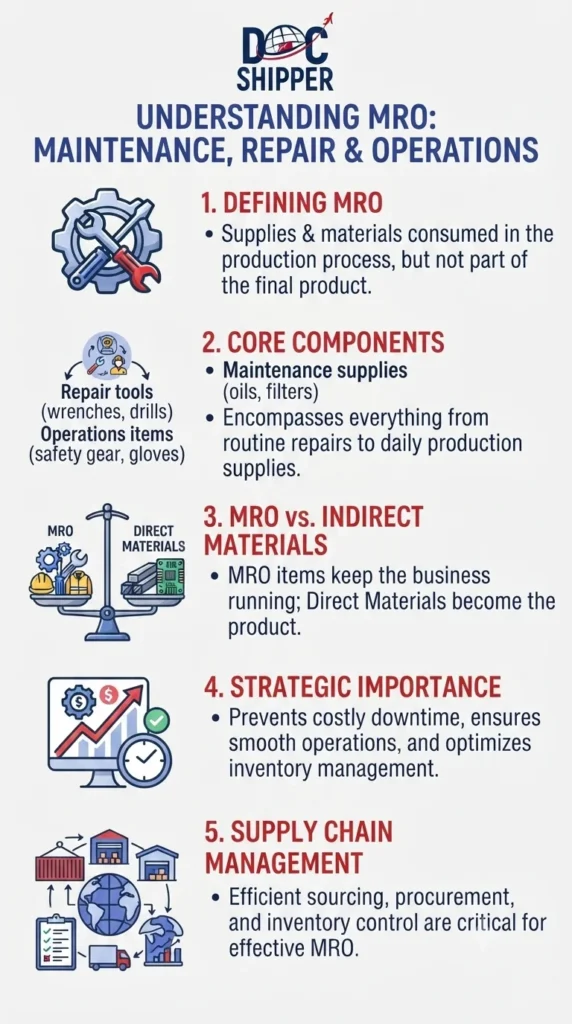
MRO (Maintenance, Repair, and Operating Supplies) refers to materials and products used to support production and operations without becoming part of the final product. These supplies include tools, spare parts, safety equipment, cleaning products, and consumables essential for maintaining equipment functionality and ensuring continuous industrial operations.
Introduction
Many companies struggle to distinguish between production materials and operational supplies. This confusion leads to inventory mismanagement, unexpected downtime, and inflated procurement costs. MRO items represent a hidden cost center that can account for up to 40% of a manufacturing facility’s purchasing budget.
In international logistics and supply chain management, MRO procurement presents unique challenges. These items don’t directly generate revenue but are absolutely critical for maintaining operational continuity. A missing spare part can halt an entire production line, creating cascade effects throughout the supply chain.
Understanding MRO procurement is essential for:
- Cost optimization through strategic inventory management and supplier consolidation
- Operational reliability by ensuring critical supplies are available when needed
- Regulatory compliance particularly for safety equipment and hazardous materials
- Customs classification as MRO items require specific HS codes and documentation
- Supply chain resilience through diversified sourcing and risk mitigation strategies
MRO Categories & Strategic Importance
MRO supplies fall into three primary categories that serve distinct operational functions. Understanding these classifications helps companies optimize procurement strategies and inventory management systems.
Maintenance supplies include preventive and predictive maintenance items such as lubricants, filters, belts, bearings, and testing equipment. These items prevent equipment failure and extend asset lifespan. According to industry standards, companies implementing structured maintenance programs reduce unplanned downtime by up to 50%.
Repair supplies encompass spare parts, replacement components, welding materials, and tools needed for corrective maintenance. These items are typically stored on-site or available through rapid delivery agreements. The challenge lies in balancing inventory costs against the risk of stockouts during critical failures.
Operating supplies support daily operations without being incorporated into finished products. This category includes safety equipment, cleaning products, office supplies, uniforms, and consumables. While individually inexpensive, these items represent significant cumulative costs and require systematic procurement approaches.
From a customs and import perspective, MRO items present specific challenges. They typically require detailed technical documentation, certificates of conformity, and specific HS code classification. For regulated industries, safety equipment must comply with destination country standards (CE marking in Europe, OSHA requirements in the United States).
At DocShipper, we systematically verify MRO documentation and classification to prevent customs delays. Our expertise covers everything from initial supplier identification to final delivery, ensuring compliance with both origin and destination regulations. We handle complex certifications, dangerous goods declarations, and specialized packaging requirements common to industrial supplies.
The strategic importance of MRO management has evolved significantly. Modern approaches include vendor-managed inventory (VMI), consignment arrangements, and digital procurement platforms. Companies are increasingly consolidating MRO suppliers to reduce administrative burden and negotiate volume discounts. ISO 55000 Asset Management standards provide frameworks for optimizing MRO strategies within broader asset lifecycle management.
Concrete Examples & Industry Data
Understanding MRO requirements varies dramatically across industries. Here’s a comparative analysis of MRO procurement patterns in three major sectors:
| Industry | Primary MRO Categories | Average Annual Spend | Critical Challenges |
|---|---|---|---|
| Manufacturing | Machine parts, lubricants, cutting tools, safety gear | 3-5% of revenue | Minimizing downtime, managing SKU complexity |
| Oil & Gas | Valves, pipes, pumps, drilling supplies, PPE | 5-8% of revenue | Remote locations, critical safety compliance |
| Healthcare | Sterilization supplies, HVAC filters, building maintenance | 2-4% of revenue | Regulatory compliance, contamination prevention |
| Aviation | Aircraft parts, ground equipment, hangar tools | 6-10% of revenue | Certification requirements, traceability demands |
Use Case: Automotive Manufacturer MRO Optimization
A European automotive parts manufacturer faced annual MRO costs of €2.3 million across three facilities. The company struggled with decentralized purchasing, resulting in duplicate inventories and missed volume discounts. Their analysis revealed:
- SKU proliferation: Over 15,000 MRO items with 40% redundancy across sites
- Supplier fragmentation: 230 MRO suppliers with 80% providing less than €5,000 annually
- Emergency purchases: 35% of MRO acquisitions classified as urgent, incurring premium costs
- Inventory carrying costs: €340,000 in excess stock due to poor visibility and planning
- Administrative burden: 4.5 FTE dedicated solely to processing MRO purchase orders
Implementation of a centralized MRO strategy with supplier consolidation, VMI agreements, and digital catalog integration achieved 23% cost reduction within 18 months. The company reduced suppliers to 35 strategic partners, eliminated 6,000 redundant SKUs, and decreased emergency purchases to 12% of total MRO spend.
From an international sourcing perspective, companies increasingly source MRO items globally to access competitive pricing. However, this introduces complexity around lead times, minimum order quantities, and import compliance. Smart companies balance global sourcing for high-volume, standardized items while maintaining local suppliers for critical, time-sensitive components.
Conclusion
Effective MRO management directly impacts operational efficiency, cost control, and supply chain resilience. Companies that treat MRO strategically rather than reactively achieve significant competitive advantages through reduced downtime, optimized inventory, and streamlined procurement processes.
Need assistance with international MRO sourcing, customs compliance, or logistics optimization? Contact DocShipper for expert guidance on managing complex supply chains.
📚 Quiz
Test Your Knowledge: MRO (Maintenance, Repair, and Operating Supplies)
1. What is the primary characteristic that distinguishes MRO supplies from direct materials?
2. A facility manager believes all low-cost consumables should be ordered on-demand to minimize inventory carrying costs. Which statement best reflects the proper approach to MRO management?
3. Your manufacturing plant urgently needs replacement bearings for critical equipment. Which procurement scenario correctly applies MRO principles?
🎯 Your Result
📞 Free Quote in 24hFAQ | MRO (Maintenance, Repair, and Operating Supplies): Definition, Categories & Concrete Examples
Direct materials become part of the finished product and are directly traceable to production output. MRO supplies support operations and maintenance but are not incorporated into the final product. For example, steel used in manufacturing car frames is a direct material, while the lubricant for production machinery is an MRO item. This distinction affects accounting classification, inventory management, and procurement strategies.
MRO spending typically ranges from 2% to 10% of total revenue, varying significantly by industry. Manufacturing facilities average 3-5%, while heavy industries like oil and gas or mining may spend 6-10%. Service industries typically fall at the lower end. However, the focus should be on optimization rather than arbitrary targets. Companies should benchmark against industry peers and measure MRO spend as a percentage of asset value for more meaningful insights.
The primary challenges include demand unpredictability (maintenance needs are often irregular), SKU proliferation (thousands of low-volume items), determining optimal stock levels (balancing carrying costs against stockout risks), managing obsolescence (especially for aging equipment), and supplier fragmentation. Additionally, lack of standardization across facilities creates duplicate inventories and missed consolidation opportunities. Modern solutions involve predictive analytics, condition-based monitoring, and centralized procurement systems.
MRO items require accurate HS code classification, which varies by product type and intended use. Many MRO products fall under regulated categories requiring certificates of conformity, safety certifications, or hazardous materials documentation. Incorrect classification can result in customs delays, penalties, or rejected shipments. Additionally, some countries offer duty exemptions or reduced rates for specific MRO items used in manufacturing. Working with experienced customs brokers ensures proper documentation and compliance.
VMI is an arrangement where the supplier manages inventory levels at the customer's location. The supplier monitors consumption, forecasts demand, and automatically replenishes stock to agreed-upon levels. For MRO applications, VMI reduces administrative burden, minimizes stockouts, optimizes inventory levels, and transfers carrying costs to the supplier. This model works best for high-consumption, standardized items with predictable usage patterns. Typical VMI agreements include consignment terms where ownership transfers only upon consumption.
The optimal approach typically combines centralized strategic sourcing with decentralized tactical purchasing. Centralization enables supplier consolidation, volume discounts, standardization, and compliance oversight. However, complete centralization can reduce responsiveness to local needs. Best practice involves centralized contracts and catalogs with local authority for emergency purchases within defined parameters. Digital procurement platforms bridge this gap by providing centralized visibility with distributed access.
Effective cost reduction strategies include supplier consolidation (negotiating volume discounts with fewer vendors), standardization (reducing SKU variety), implementing preventive maintenance programs (reducing emergency repairs), utilizing e-procurement systems (lowering transaction costs), establishing VMI agreements (optimizing inventory levels), and improving demand forecasting through data analytics. Focus should be on total cost of ownership rather than unit price alone, as the cheapest option may increase downtime costs.
Modern MRO management increasingly relies on digital solutions including e-procurement platforms, inventory management systems, IoT sensors for predictive maintenance, mobile applications for work order management, and AI-powered demand forecasting. These technologies provide real-time visibility, automate replenishment, reduce manual processes, and enable data-driven decision making. Integration with ERP systems ensures seamless workflows from requisition through payment.
Multi-site MRO management requires balancing standardization with local requirements. Strategies include establishing global framework agreements with regional pricing, creating standardized catalogs with approved substitutions, implementing shared inventory pools for critical items, utilizing regional distribution centers for common supplies, and maintaining local suppliers for emergency needs. Cultural and regulatory differences across countries necessitate flexible approaches while maintaining central oversight and strategic control.
Critical spare parts are components whose failure would cause significant production downtime, safety hazards, or environmental risks. These typically have long lead times, single-source suppliers, or high replacement costs. Management strategies include maintaining safety stock, establishing expedited supply agreements, implementing condition-based monitoring to predict failures, qualifying alternative suppliers, and considering consignment arrangements. Risk assessment should evaluate failure probability, consequence severity, and replacement complexity to prioritize inventory investments.
Regulated industries like pharmaceuticals, aerospace, food processing, and oil and gas face additional MRO compliance requirements. These include traceability demands (documented chain of custody), certification requirements (material certifications, calibration records), qualified supplier lists (approved vendors only), change control procedures (formal approval for substitutions), and audit trails (complete documentation of procurement decisions). Non-compliance can result in production shutdowns, regulatory penalties, or safety incidents, making proper MRO management mission-critical.
Consolidating MRO suppliers from hundreds to dozens of strategic partners delivers multiple benefits: volume-based pricing discounts, reduced transaction costs through streamlined processes, improved service levels through strategic relationships, simplified compliance management, enhanced visibility into total spend, and reduced administrative burden. However, consolidation requires careful supplier selection to ensure adequate product range, geographic coverage, technical support capabilities, and financial stability. The goal is optimization rather than minimization of supplier count.
Need Help with
Logistics or Sourcing ?
First, we secure the right products from the right suppliers at the right price by managing the sourcing process from start to finish. Then, we simplify your shipping experience - from pickup to final delivery - ensuring any product, anywhere, is delivered at highly competitive prices.


Fill the Form
Prefer email? Send us your inquiry, and we’ll get back to you as soon as possible.
Contact us




:%20Definition,%20Categories%20&%20Concrete%20Examples)