


In short ⚡
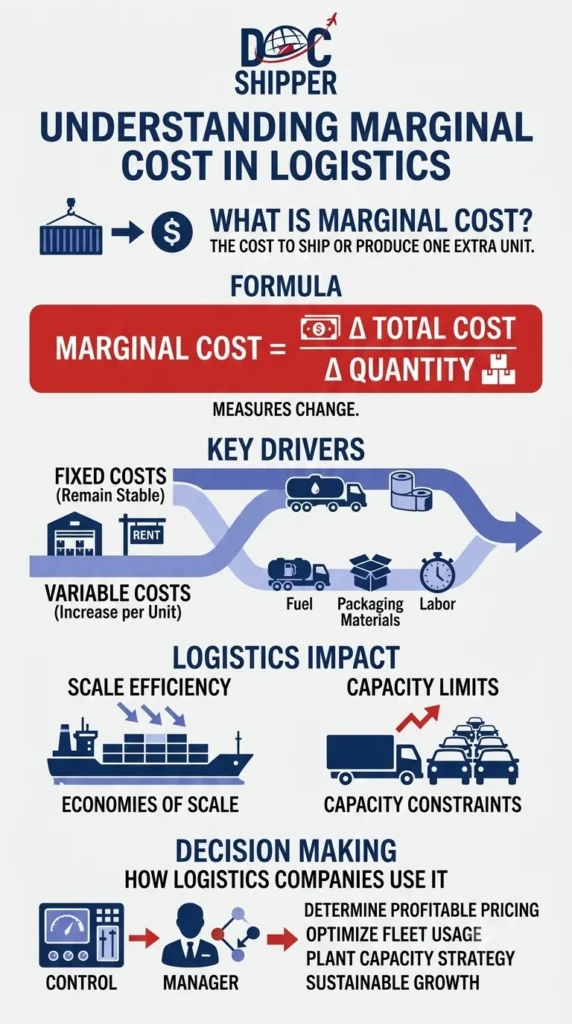
Marginal cost is the additional expense incurred to produce one more unit of a product or service. In international logistics, it represents the incremental cost of shipping, handling, or storing one additional unit within a supply chain operation, crucial for optimizing pricing strategies and capacity utilization.
Introduction
Many importers confuse total shipping costs with marginal costs per unit, leading to flawed pricing decisions and missed profit opportunities. When adding 100 units to an existing container shipment, should you charge the full per-unit rate or just the incremental cost?
Understanding marginal cost becomes essential in international trade when optimizing container loads, negotiating freight rates, or deciding whether to consolidate shipments. This metric directly impacts your competitive positioning and profit margins.
- Variable nature: Marginal costs fluctuate based on capacity utilization and economies of scale
- Decision-making tool: Determines profitability thresholds for additional orders or shipments
- Optimization indicator: Reveals when adding volume becomes unprofitable
- Strategic pricing: Enables competitive pricing while protecting margins
- Capacity planning: Guides warehouse and transport resource allocation
Understanding Marginal Cost Mechanics in Logistics
The marginal cost concept distinguishes between fixed costs that remain constant regardless of volume and variable costs that increase with each additional unit. In freight forwarding, the container rental represents a fixed cost, while customs processing fees per declaration represent variable costs.
When calculating shipping marginal costs, you must isolate incremental expenses tied specifically to that additional unit. If a 20-foot container costs $3,000 and holds 500 boxes, adding 10 more boxes doesn’t add $60 in transport costs—it adds nearly zero if capacity exists.
The capacity threshold effect creates non-linear marginal cost curves in logistics. Once you exceed container capacity, marginal cost jumps dramatically as you must book additional space. At DocShipper, we systematically analyze these thresholds to maximize consolidation opportunities for our clients.
From a regulatory perspective, customs duties and taxes typically scale linearly with volume, making them pure marginal costs. The European Commission Customs Authority provides detailed frameworks for calculating these incremental costs across EU member states.
The marginal cost formula in logistics contexts is: MC = (Total Cost at Volume N+1) – (Total Cost at Volume N). This simple calculation reveals whether accepting additional cargo improves or erodes profitability, particularly when negotiating spot rates with carriers.
Practical Calculations & Real-World Data
Consider a real-world scenario from textile imports: You’ve booked a 40-foot container from Vietnam to Rotterdam for $5,200, planning to ship 800 cartons. A client requests adding 50 more cartons.
| Cost Element | 800 Cartons | 850 Cartons | Marginal Cost |
|---|---|---|---|
| Ocean Freight | $5,200 | $5,200 | $0 |
| Customs Processing | $320 (1 declaration) | $320 (1 declaration) | $0 |
| Import Duties (12%) | $2,880 | $3,060 | $180 |
| Handling & Delivery | $1,200 | $1,275 | $75 |
| Total Cost | $9,600 | $9,855 | $255 ($5.10/carton) |
The marginal cost per additional carton is $5.10, dramatically lower than the average cost of $12.00 per carton ($9,600 ÷ 800). This demonstrates why utilizing existing capacity creates competitive pricing opportunities.
However, if the request were for 100 additional cartons exceeding container capacity, you’d trigger a step-function increase. Booking a second container would add approximately $5,200 in fixed costs, making the marginal cost per carton jump to $52 for those 100 units.
Industry data from global freight analysis shows that shippers who optimize marginal cost decisions achieve 15-22% better profit margins on consolidated shipments compared to those using average cost pricing models.
At DocShipper, we leverage proprietary algorithms to calculate real-time marginal costs across multiple carriers and routes, ensuring our clients never leave capacity underutilized or accept unprofitable additional cargo.
Key Marginal Cost Principles for Logistics:
- Capacity utilization: Marginal costs remain minimal until reaching capacity thresholds
- Fixed cost allocation: Never include already-committed fixed costs in marginal calculations
- Volume-sensitive fees: Duties, handling charges, and some documentation fees scale with quantity
- Break-even analysis: Compare marginal cost to marginal revenue for profitability decisions
- Route-specific variations: Marginal costs differ significantly between air, ocean, and land transport modes
Conclusion
Mastering marginal cost analysis transforms how you price services, accept orders, and optimize supply chain capacity. Understanding the difference between fixed and variable costs prevents both overpricing that loses business and underpricing that erodes profitability.
Need expert guidance on optimizing your shipping costs and capacity utilization? Contact DocShipper for a customized logistics analysis tailored to your trade routes and volumes.
📚 Quiz
Test Your Knowledge: Marginal Cost
What does marginal cost represent in international logistics?
A 20-foot container costs $3,000 and holds 500 boxes. What is the marginal transport cost of adding 10 more boxes if capacity exists?
When should you use marginal cost pricing for accepting additional cargo?
🎯 Your Result
📞 Free Quote in 24hFAQ | Marginal Cost: Definition, Calculation & Concrete Examples
Average cost divides total expenses by total units shipped, while marginal cost measures only the additional expense of shipping one more unit. In logistics, marginal cost is typically much lower when you have unused container or truck capacity, making it the better metric for accepting additional orders or consolidating shipments.
Economies of scale reduce marginal costs up to capacity limits. A full container load costs the same whether you ship 80% or 100% capacity, so marginal cost per additional unit decreases as you approach full utilization. Beyond capacity, diseconomies of scale occur as you must book additional transport, dramatically increasing marginal costs.
Use marginal cost pricing when you have committed fixed costs (booked container, scheduled shipment) and spare capacity. This approach maximizes revenue from incremental volume without cannibalizing existing margins. Never price below marginal cost unless strategically accepting loss-leaders for market penetration or client retention.
Primary variable costs include customs duties and taxes calculated on declared value, per-unit handling charges at terminals, documentation fees scaling with shipment complexity, insurance premiums based on cargo value, and certain inspection or compliance fees. Fixed costs include container rental, base freight rates, and standard customs brokerage fees.
Calculate total cost of the original shipment, then recalculate total cost with additional units included. Subtract the original cost from the new total cost. Divide this difference by the number of added units. Remember to include only truly variable costs like additional duties, increased handling fees, or extra documentation requirements.
The threshold occurs when adding one more unit requires booking additional transport capacity. For a 20-foot container holding 500 cartons, the 501st carton triggers a dramatic marginal cost increase as you must rent another container. Identifying these thresholds allows strategic consolidation and prevents unprofitable volume acceptance.
In rare cases, yes. When carriers offer volume discounts retroactively applied to entire shipments, adding units can reduce the per-unit cost of previous units, creating negative marginal cost. Similarly, achieving minimum weight thresholds for preferential freight rates can generate negative marginal costs for triggering units.
Air freight marginal costs scale more linearly with weight and volume due to precise dimensional pricing. Ocean freight shows dramatic step-function increases at container capacity limits but minimal marginal costs within capacity. Air freight rarely has the same fixed-cost structure, making marginal cost calculations simpler but offering less optimization opportunity.
Customs authorities may scrutinize declared values that seem inconsistent with marginal cost economics. If you declare unusually low per-unit values for incremental shipments, customs may challenge whether proper allocation of fixed costs occurred. Maintaining transparent marginal cost documentation supports valuation defenses and demonstrates legitimate pricing methodology.
Warehouse fees typically combine fixed costs (minimum monthly charges, facility access) and variable costs (per-pallet storage, handling per unit). Marginal cost of storing one additional pallet includes only incremental storage fees and handling, not the fixed facility costs. During contracted periods, marginal warehouse costs may approach zero if capacity exists.
Transparency depends on your business model and client relationships. Sharing marginal cost logic can demonstrate value when offering discounted rates for consolidation opportunities, building trust and encouraging volume commitments. However, revealing exact marginal costs may pressure you to price at or near cost, eliminating profit margins on incremental business.
Recalculate marginal costs whenever fixed cost structures change (new carrier contracts, facility leases), when capacity utilization shifts significantly, or when regulatory changes affect variable cost components like duties or fees. Many sophisticated forwarders use dynamic marginal cost models updated weekly or with each rate negotiation to maintain competitive pricing accuracy.
Need Help with
Logistics or Sourcing ?
First, we secure the right products from the right suppliers at the right price by managing the sourcing process from start to finish. Then, we simplify your shipping experience - from pickup to final delivery - ensuring any product, anywhere, is delivered at highly competitive prices.


Fill the Form
Prefer email? Send us your inquiry, and we’ll get back to you as soon as possible.
Contact us




