


In short ⚡
Accessorial charges are additional fees applied by freight carriers beyond the standard transportation rate. These charges cover extra services such as liftgate delivery, residential pickup, inside delivery, detention, or fuel surcharges. Understanding these costs is essential for accurate shipping budgets and avoiding unexpected expenses in international logistics.Introduction
Many importers and exporters face invoice surprises when accessorial charges suddenly inflate their shipping costs by 20% to 40%. These fees often appear as line items without prior warning, creating budget overruns and operational friction.
In global supply chains, accessorial charges represent the gap between standard door-to-door service and the actual requirements of your shipment. Whether it’s a residential address, limited access facility, or special handling needs, these charges compensate carriers for services beyond basic transportation.
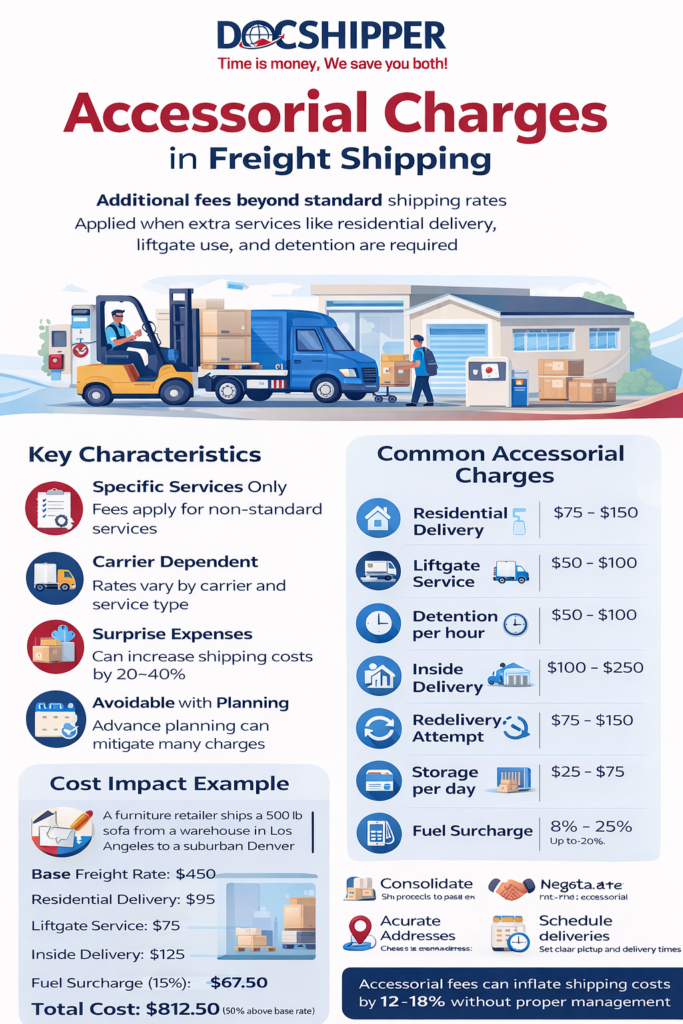
Key characteristics of accessorial charges include:
- Service-specific: Applied only when special services are required or requested
- Carrier-dependent: Rates and types vary significantly between freight forwarders and carriers
- Often avoidable: Proper planning and documentation can eliminate many unnecessary fees
- Cumulative impact: Multiple accessorials on one shipment can substantially increase total costs
- Contractually defined: Terms should be clearly outlined in shipping agreements
Understanding Accessorial Charges in Freight Operations
Accessorial charges exist because standard freight rates assume ideal conditions: commercial addresses with loading docks, normal business hours, straightforward pickup and delivery, and standard handling requirements. When reality deviates from these assumptions, carriers apply additional fees.
The legal framework for accessorial charges is established through carrier tariffs and contractual agreements. In the United States, the Department of Transportation requires carriers to publish their rates and accessorial fees, though enforcement varies by mode of transport. International shipments follow similar principles under conventions like the CMR for road transport in Europe.
Detention and demurrage represent time-based accessorials. Detention applies when a carrier’s equipment is held beyond free time at a shipper or consignee location. Demurrage occurs when containers remain at ports or terminals past the allowed period. These charges typically range from $50 to $200 per day, escalating after initial grace periods.
Residential delivery charges compensate carriers for navigating non-commercial areas with limited access, narrow streets, and absence of loading equipment. This fee typically adds $75 to $150 per shipment, as residential deliveries require smaller vehicles and more time per stop.
Liftgate service becomes necessary when neither shipper nor consignee has a loading dock or forklift. The carrier provides hydraulic equipment to lower freight to ground level, charging $50 to $100 per use. This accessorial is common in e-commerce and small business deliveries.
Redelivery and storage fees occur when delivery attempts fail due to incorrect addresses, closed facilities, or refusal to accept freight. Carriers charge for additional delivery attempts ($75-$150) and daily storage ($25-$50) until the situation resolves.
At DocShipper, we conduct pre-shipment assessments to identify potential accessorial triggers, ensuring our clients receive accurate cost projections before committing to transportation contracts. This proactive approach eliminates 70% of surprise charges in our managed shipments.
Common Accessorial Charges & Cost Examples
Understanding the financial impact of accessorial charges requires examining real-world scenarios. The following data reflects current market rates across major freight corridors and carrier networks.
| Accessorial Type | Typical Cost Range | When Applied |
|---|---|---|
| Residential Delivery | $75 – $150 | Non-commercial address without dock |
| Liftgate Service | $50 – $100 | No loading dock available |
| Inside Delivery | $100 – $250 | Freight delivered beyond threshold |
| Limited Access | $75 – $200 | Schools, churches, prisons, construction sites |
| Detention (per hour) | $50 – $100 | After 2 hours free time |
| Redelivery Attempt | $75 – $150 | Failed first delivery attempt |
| Storage (per day) | $25 – $75 | After failed delivery or customs hold |
| Fuel Surcharge | 8% – 25% of base rate | Variable based on fuel prices |
Case Study: E-commerce Fulfillment Scenario
A furniture retailer ships a 500 lb sofa from a warehouse in Los Angeles to a residential customer in suburban Denver. The base freight rate is $450. However, the final invoice includes:
- Base freight: $450
- Residential delivery: $95
- Liftgate service: $75
- Inside delivery (living room): $125
- Fuel surcharge (15%): $67.50
- Total cost: $812.50 (80.5% above base rate)
Mitigation strategies that reduce accessorial exposure include: consolidating shipments to commercial addresses, negotiating flat-rate accessorial packages with carriers, providing accurate delivery information upfront, scheduling appointments to avoid detention, and using freight forwarders who absorb certain accessorials in their all-inclusive pricing.
Industry data shows that accessorial charges account for 12-18% of total freight spend in domestic US markets and 8-15% in international shipments. Companies without accessorial management programs pay 30-40% more than those with structured monitoring and optimization processes.
DocShipper’s pricing model includes transparent accessorial disclosure during quotation, with pre-negotiated rates across our carrier network. We also provide delivery site surveys for high-value shipments to identify potential accessorial triggers before goods leave origin.
Conclusion
Accessorial charges represent a significant yet manageable component of international logistics costs. Proactive planning, accurate documentation, and carrier relationship management transform these fees from budget surprises into predictable line items.
Need expert guidance on minimizing accessorial charges in your supply chain? Contact DocShipper for a comprehensive freight cost analysis and optimization strategy.
DocShipper Platform
Cut logistics costs. Not corners.
See exactly where your logistics costs are bleeding — and how to fix it. Book your expert demo.

📚 Quiz
Accessorial Charges
Q1 — What are accessorial charges in freight logistics?
Q2 — What is the key difference between detention and demurrage?
Q3 — A furniture retailer ships a sofa to a residential customer with no loading dock. The base freight rate is $450. Which of the following best reflects the realistic total cost?
🎯 Your Result
📞 Free Quote in 24hFAQ | Accessorial Charges: Definition, Calculation & Concrete Examples
Base freight rates cover standard point-to-point transportation under ideal conditions. Accessorial charges apply when special services, equipment, or circumstances require additional carrier resources beyond normal operations. Base rates assume commercial locations with loading docks and straightforward access.
Yes, especially for high-volume shippers. Many carriers offer discounted or capped accessorial rates in exchange for guaranteed shipping volumes. Some provide flat-rate accessorial packages that bundle common fees. Negotiation leverage increases with consistent shipping patterns and long-term contracts.
Ship to commercial addresses whenever possible, such as business offices or freight terminals. Some carriers waive residential fees if the consignee operates a business from their home address with proper documentation. Alternatively, use consolidation centers that accept freight and provide local delivery.
Limited access fees apply to locations with restricted entry or special requirements: military bases, schools, hospitals, prisons, construction sites, trade shows, churches, and secured facilities. These locations require additional documentation, security clearances, or special delivery procedures that increase carrier operational costs.
Yes, fuel surcharges are accessorial fees that adjust for fluctuating diesel prices. Carriers publish weekly or monthly fuel surcharge tables based on the Department of Energy's national diesel average. These surcharges typically range from 8% to 25% of the base freight rate.
Review your bill of lading and delivery receipt for documented services. Contact the carrier's billing department within 30 days with supporting evidence. If the charge was not disclosed in your rate agreement or the service wasn't provided, request removal. Document all communications and escalate through your account representative if needed.
Detention applies to carrier equipment held at shipper or consignee facilities beyond free time (typically 2 hours). Demurrage refers to containers remaining at ports or rail terminals past allowed periods. Both are time-based charges that escalate daily, but detention involves trucking equipment while demurrage involves ocean containers or rail cars.
International shipments include additional accessorials like customs clearance fees, terminal handling charges, documentation fees, and inspection costs. Ocean freight adds port congestion surcharges and peak season surcharges. Air freight includes security fees and dimensional weight charges. Each mode and trade lane has specific accessorial structures.
Many carriers and freight forwarders offer "all-in" pricing that includes anticipated accessorials. This requires providing complete shipment details upfront: exact addresses, special requirements, and delivery constraints. Prepaid accessorial packages provide budget certainty but may cost slightly more than pay-as-you-go if some services aren't ultimately needed.
Inside delivery to specific rooms, trade show delivery with strict time windows, and white glove service (unpacking and assembly) rank among the costliest, often exceeding $300 per shipment. Hazardous materials handling, temperature-controlled service, and high-value cargo insurance also generate significant accessorial fees.
Accessorial charges directly increase delivered cost and must be factored into total landed cost (TLC) calculations. Failure to account for accessorials can underestimate TLC by 15-25%, affecting pricing strategies, margin calculations, and competitiveness. Accurate TLC requires comprehensive accessorial forecasting based on delivery requirements.
Yes, expedited service itself is an accessorial charge, typically adding 30-100% to base rates. Additional accessorials may apply if expedited delivery requires special routing, dedicated equipment, or after-hours service. Guaranteed delivery by specific dates or times incurs premium accessorials with penalty clauses if carriers miss deadlines.
Need Help with
Logistics or Sourcing ?
First, we secure the right products from the right suppliers at the right price by managing the sourcing process from start to finish. Then, we simplify your shipping experience - from pickup to final delivery - ensuring any product, anywhere, is delivered at highly competitive prices.


Fill the Form
Prefer email? Send us your inquiry, and we’ll get back to you as soon as possible.
Contact us




