


In short ⚡
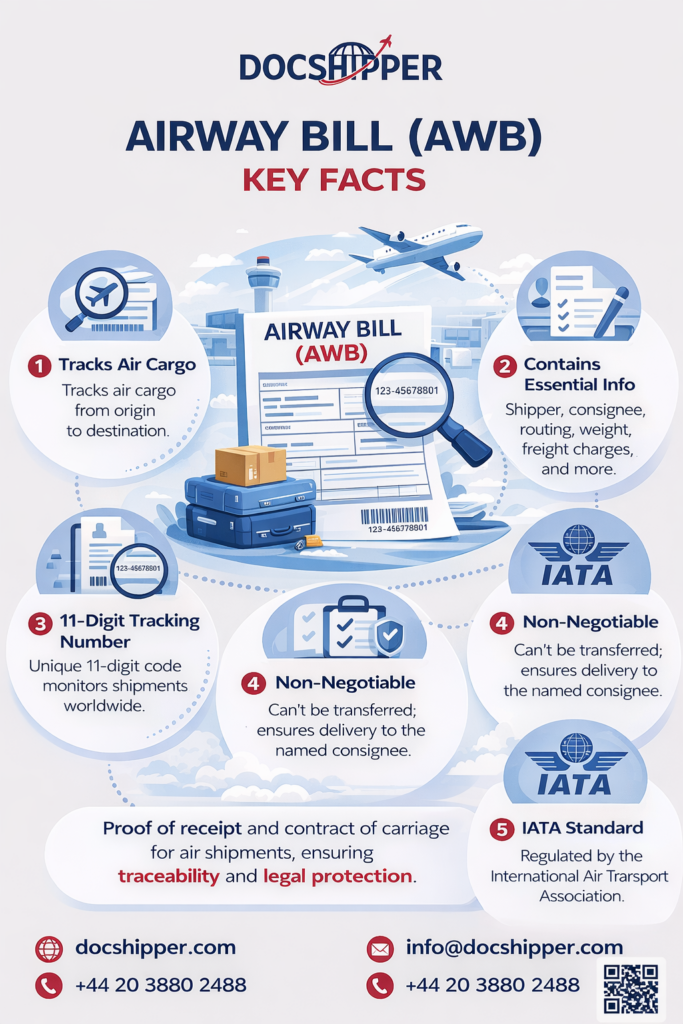
An Airway Bill (AWB) is a non-negotiable transport document issued by an air carrier or freight forwarder, serving as proof of receipt of goods and contract of carriage for air freight shipments. It tracks cargo throughout the air transport chain and contains essential information about the shipper, consignee, routing, and freight charges.
Introduction
Many importers confuse the Airway Bill with a Bill of Lading, creating unnecessary complications during customs clearance. Unlike ocean freight documents, the AWB is not a title document and cannot be transferred to third parties.
In international air cargo operations, the AWB serves as the backbone of shipment tracking and accountability. It accompanies goods from origin to destination, providing critical data for customs authorities, insurance claims, and delivery verification.
Key characteristics of an Airway Bill include:
- Unique 11-digit tracking number enabling real-time cargo monitoring across global networks
- Non-negotiable nature meaning goods are delivered exclusively to the named consignee
- Standardized format regulated by IATA (International Air Transport Association)
- Multi-copy structure with specific copies for carrier, consignee, shipper, and delivery receipt
- Proof of contract establishing terms and conditions between shipper and air carrier
Understanding AWB Mechanics & Legal Framework
The Airway Bill operates under the Montreal Convention and Warsaw Convention, which establish international rules for air cargo liability. These conventions limit carrier liability to approximately 22 SDR (Special Drawing Rights) per kilogram unless higher value is declared and additional charges paid.
The AWB structure consists of three original copies and multiple additional copies. The Original 1 (green) is for the issuing carrier, Original 2 (pink) accompanies the goods to the consignee, and Original 3 (blue) is signed by the carrier and returned to the shipper as proof of acceptance.
Critical information fields on an AWB include the shipper and consignee details, airport of departure and destination, goods description, weight and dimensions, freight charges, and special handling instructions. Any discrepancies in these fields can trigger customs delays or rejection.
The 11-digit AWB number comprises a 3-digit airline prefix (assigned by IATA) followed by an 8-digit serial number. This unique identifier enables global tracking through airline systems and third-party logistics platforms.
For customs purposes, the AWB serves as a preliminary declaration document in many jurisdictions. At DocShipper, we systematically verify AWB accuracy before shipment departure to prevent clearance complications and ensure seamless delivery to final destination.
Additional resources: IATA e-AWB Guidelines
Practical Examples & Data Analysis
Understanding AWB application through concrete scenarios clarifies its operational importance in international logistics.
Use Case: Electronics Shipment from China to Germany
A German retailer imports 500 kg of smartphones from Shenzhen. The freight forwarder issues AWB 180-12345678 (Lufthansa Cargo prefix). The shipment includes:
- Chargeable weight: 520 kg (volumetric calculation: 2.1 m³ × 167 kg/m³ = 350.7 kg, but actual weight prevails)
- Freight rate: €3.20 per kg = €1,600
- Fuel surcharge: 25% = €400
- Security surcharge: €0.15 per kg = €78
- Total air freight cost: €2,078
The AWB declares a customs value of €45,000, triggering mandatory customs inspection. The consignee uses the AWB number to track the shipment through Frankfurt hub and coordinate warehouse delivery.
Comparative Analysis: Master vs. House AWB
| Criterion | Master AWB (MAWB) | House AWB (HAWB) |
|---|---|---|
| Issuer | Air carrier | Freight forwarder |
| Coverage | Consolidated shipment | Individual consignment within consolidation |
| Contract Party | Forwarder (as shipper) | Actual shipper/consignee |
| Customs Recognition | Primary document | Supporting document |
| Typical Use | LCL air freight | Multiple buyers in single flight |
DocShipper Platform
One platform. Your entire supply chain
Sourcing, freight, customs & documents — all centralised, all visible, 24/7.
Key Data Points for AWB Management
- Processing time: Electronic AWB (e-AWB) reduces documentation time by 40% compared to paper versions
- Error rate: Manual AWB preparation shows 8-12% data entry errors; automated systems reduce this to under 2%
- Adoption rate: e-AWB penetration reached 78% globally in 2023, with Asia-Pacific leading at 85%
- Cost savings: Paperless AWB processes save approximately $6.50 per shipment in handling costs
- Delivery accuracy: Shipments with complete AWB information show 95% on-time delivery versus 73% for incomplete documentation
Conclusion
The Airway Bill remains the fundamental document in air cargo operations, ensuring traceability, legal protection, and efficient customs processing. Proper AWB management directly impacts delivery speed and cost control in international supply chains.
Need assistance with air freight documentation or customs procedures? Contact DocShipper for expert guidance on optimizing your international shipping operations.
📚 Quiz
Test Your Knowledge: Airway Bill (AWB)
Q1 — What best defines an Airway Bill (AWB)?
Q2 — In a consolidated air freight shipment, who issues the House AWB (HAWB)?
Q3 — A shipper discovers an error in the consignee's address on the AWB after customs clearance has already been initiated. What is the most likely outcome?
🎯 Your Result
📞 Free Quote in 24hFAQ | Airway Bill (AWB): Definition, Calculation & Concrete Examples
An AWB is non-negotiable and used for air transport, while a Bill of Lading is negotiable and used for ocean freight. The AWB delivers goods only to the named consignee, whereas a Bill of Lading can be transferred.
Yes, the 11-digit AWB number allows real-time tracking through airline websites, freight forwarder portals, and third-party tracking platforms. Enter the complete number without spaces or dashes.
The air carrier or their authorized agent (freight forwarder) issues the AWB. In consolidated shipments, forwarders issue House AWBs while carriers issue Master AWBs.
Incorrect AWB data can cause customs delays, delivery refusals, or additional inspection fees. Corrections require amendment requests to the issuing carrier, potentially delaying shipment release by 24-72 hours.
Yes, the e-AWB has the same legal standing as paper AWB under IATA regulations and the Montreal Convention. Over 78% of global air cargo now uses electronic documentation.
Retain AWB copies for minimum 3 years for tax and customs audit purposes. Some jurisdictions require 7-year retention for commercial invoicing records.
Standard liability is approximately 22 SDR per kilogram (about $30 USD) under the Montreal Convention. Higher coverage requires declared value and additional insurance fees.
Consignee changes require formal amendment requests before customs clearance. After clearance initiation, changes become extremely difficult and may require shipment return to origin.
A neutral AWB uses a standard IATA prefix (e.g., 999) instead of a specific airline code, allowing freight forwarders flexibility in carrier selection until actual booking confirmation.
Express courier services (DHL, FedEx, UPS) issue their own proprietary waybills that function similarly to AWBs but under their specific terms and conditions rather than IATA standards.
Mandatory fields include shipper/consignee names and addresses, airport codes, goods description, weight, dimensions, declared value, and applicable freight charges. Missing data triggers processing delays.
The first 3 digits represent the airline prefix assigned by IATA, followed by 8 serial digits. The final digit is a check digit calculated through a modulo 7 algorithm to verify number validity.
Need Help with
Logistics or Sourcing ?
First, we secure the right products from the right suppliers at the right price by managing the sourcing process from start to finish. Then, we simplify your shipping experience - from pickup to final delivery - ensuring any product, anywhere, is delivered at highly competitive prices.


Fill the Form
Prefer email? Send us your inquiry, and we’ll get back to you as soon as possible.
Contact us




:%20Definition%20&%20Guide%20for%202026)