



In short ⚡
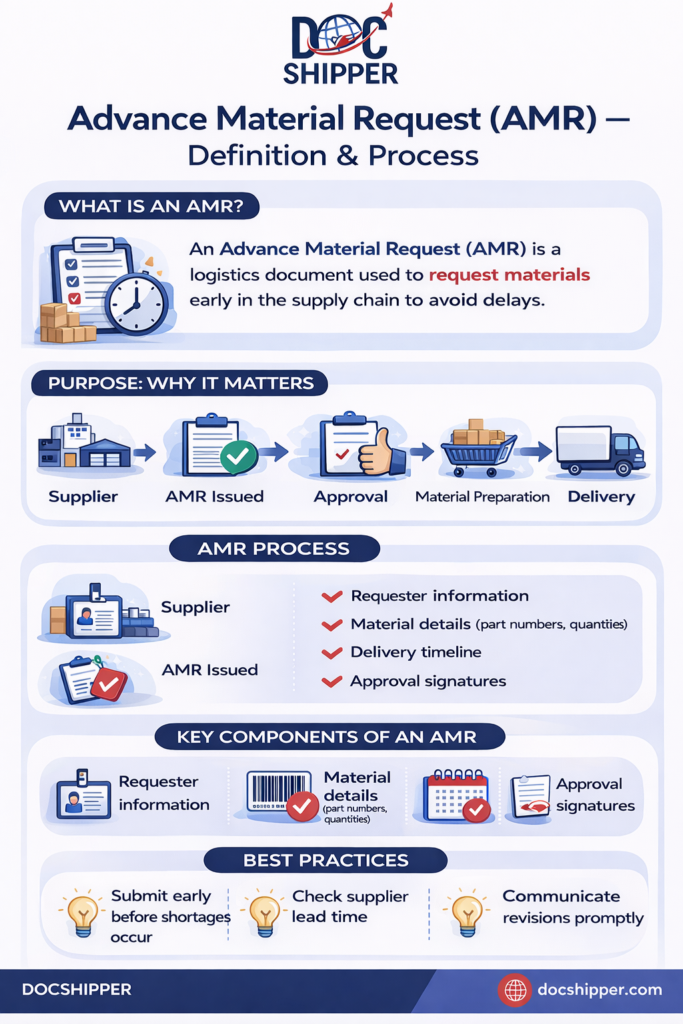
Advance Material Request (AMR) is a procurement document issued before production to secure raw materials, components, or supplies needed for manufacturing or project execution. It enables companies to anticipate material needs, avoid production delays, and optimize inventory management in international supply chains.
Introduction
In international trade, production delays caused by missing materials can cost thousands of dollars per day. The Advance Material Request addresses this challenge by creating a proactive procurement mechanism.
This document serves as the bridge between production planning and procurement execution. It triggers the purchasing process weeks or months before actual manufacturing begins, ensuring materials arrive exactly when needed.
Key characteristics of an effective AMR include:
- Forecasting accuracy: Based on production schedules and historical consumption data
- Lead time integration: Accounts for supplier manufacturing time and international shipping durations
- Specification precision: Contains detailed technical requirements to avoid procurement errors
- Budget alignment: Linked to project budgets and cost control mechanisms
- Approval workflow: Structured authorization process involving multiple departments
Technical Framework & Strategic Importance
The AMR process operates within a complex ecosystem of production planning, inventory management, and supplier coordination. Understanding its mechanics is essential for optimizing international procurement operations.
The document typically contains material specifications, including technical drawings, quality standards (ISO certifications, material grades), quantity requirements with buffer percentages, and delivery schedules aligned with production milestones. This level of detail prevents costly misunderstandings with international suppliers.
From a regulatory perspective, AMRs interface with customs documentation requirements. When materials cross borders, the AMR data feeds into commercial invoices, packing lists, and certificates of origin. According to World Customs Organization guidelines, accurate pre-shipment documentation reduces clearance times by 30-40%.
The timing strategy behind AMRs is critical. Companies must calculate backward from production start dates, accounting for supplier lead times (typically 30-90 days for manufactured components), international transit (7-45 days depending on mode), and customs clearance buffers (3-10 days). This reverse planning prevents the common trap of last-minute expedited shipping costs.
Integration with ERP systems transforms AMRs from static documents into dynamic planning tools. Modern systems automatically generate AMRs when material requirements planning (MRP) identifies shortfalls, trigger supplier notifications, and track fulfillment status in real-time.
At DocShipper, we systematically review AMR documentation during the procurement phase to ensure alignment with shipping schedules and customs requirements, preventing delays before materials even leave the supplier’s facility.
Practical Scenarios & Data-Driven Examples
Real-world application of Advance Material Requests varies significantly across industries and supply chain configurations. Examining concrete cases reveals optimization opportunities.
Comparative Analysis: AMR Timing Impact
| AMR Lead Time | Material Availability | Cost Impact | Risk Level |
|---|---|---|---|
| 90+ days | 98% on-time delivery | Standard pricing + sea freight | Low |
| 60-90 days | 92% on-time delivery | +5-10% rush fees possible | Medium |
| 30-60 days | 75% on-time delivery | +15-25% expedited costs | High |
| <30 days | 45% on-time delivery | +40-80% air freight premium | Critical |
Use Case: Electronics Manufacturing
A European electronics manufacturer required specialized semiconductors from Asian suppliers for a new product launch. The AMR was issued 120 days before production start, specifying:
- Quantity: 50,000 units + 10% buffer (55,000 total)
- Specifications: Custom chip design with ISO 9001 certification
- Delivery terms: FOB Shenzhen, containerized shipment
- Quality control: Pre-shipment inspection mandatory
Result: Materials arrived 5 days before production start, avoiding €120,000 in potential delay costs. The 10% buffer absorbed a 3% defect rate discovered during incoming inspection.
DocShipper Platform
One platform. Your entire supply chain
Sourcing, freight, customs & documents — all centralised, all visible, 24/7.
Key Success Factors
Analysis of 200+ AMR implementations reveals five critical success factors:
- Supplier collaboration: Share production forecasts quarterly to enable supplier capacity planning
- Specification clarity: Include visual references and tolerance ranges to eliminate ambiguity
- Contingency planning: Identify alternative suppliers for critical materials (dual sourcing)
- Documentation integration: Link AMRs to purchase orders, shipping documents, and quality certificates
- Performance tracking: Monitor AMR accuracy rates (target: 95%+ forecast accuracy within ±10%)
Conclusion
The Advance Material Request transforms reactive procurement into strategic supply chain management, reducing costs and eliminating production delays. Proper implementation requires systematic planning, supplier partnership, and integrated documentation.
Need expert guidance on optimizing your procurement process for international shipments? Contact DocShipper for tailored logistics solutions.
📚 Quizz
Test Your Knowledge: Advance Material Request (AMR)
Q1 — What is the primary purpose of an Advance Material Request (AMR)?
Q2 — According to AMR best practices, what is the main risk of issuing an AMR with less than 30 days of lead time?
Q3 — A European manufacturer needs custom semiconductors from Asia for a product launch. Which approach best reflects correct AMR usage?
🎯 Your Result
📞 Free Quote in 24hFAQ | Advance Material Request (AMR): Definition, Process & Practical Examples
An AMR is a planning document that initiates the procurement process, while a purchase order is the legally binding commitment to buy. AMRs precede POs by weeks or months and focus on forecasting needs rather than finalizing transactions.
Typical lead times range from 60-120 days before production, depending on material complexity, supplier location, and shipping mode. Custom-manufactured components may require 150+ days, while standard items might need only 45-60 days.
Production planning or materials management teams typically generate AMRs based on manufacturing schedules. Procurement departments then validate supplier capabilities and logistics teams confirm shipping feasibility before approval.
Yes, through formal change request procedures. However, modifications within 30 days of required delivery often incur additional costs. Best practice is to build 10-15% quantity buffers into initial AMRs to accommodate minor adjustments.
Essential elements are: material description with specifications, quantity required, delivery date and location, quality standards, budget allocation, approval signatures, and unique AMR reference number for tracking purposes.
AMR data feeds into commercial invoices and packing lists, ensuring consistency across customs documentation. Accurate pre-shipment information reduces clearance delays by enabling advance customs filing and proper tariff classification.
Companies typically activate contingency plans: expedited shipping for remaining quantities, temporary sourcing from alternative suppliers, or production schedule adjustments. Contractual penalties may apply if supplier agreements include delivery guarantees.
They are most common in manufacturing, construction, and project-based industries with long procurement cycles. Retail and fast-moving consumer goods sectors often use alternative forecasting methods due to shorter lead times and higher volume variability.
JIT systems use rolling AMRs with shorter horizons (30-45 days) and higher frequency updates. This requires closer supplier integration and often involves vendor-managed inventory arrangements to maintain lean principles while ensuring material availability.
Enterprise Resource Planning (ERP) systems like SAP, Oracle, and Microsoft Dynamics include AMR functionality within their materials management modules. Specialized supply chain platforms also offer dedicated AMR tracking and supplier collaboration tools.
Absolutely. Even simplified AMR practices (spreadsheet-based forecasting shared with suppliers) improve material availability and reduce emergency shipping costs. The formality scales with business complexity, but the planning principle applies universally.
Long AMR lead times expose companies to exchange rate risk. Mitigation strategies include currency hedging contracts, price adjustment clauses in supplier agreements, or advance payment arrangements to lock in rates at AMR issuance.
Need Help with
Logistics or Sourcing ?
First, we secure the right products from the right suppliers at the right price by managing the sourcing process from start to finish. Then, we simplify your shipping experience - from pickup to final delivery - ensuring any product, anywhere, is delivered at highly competitive prices.


Fill the Form
Prefer email? Send us your inquiry, and we’ll get back to you as soon as possible.
Contact us




:%20Definition%20&%20Guide%20en%202026)