


In short ⚡
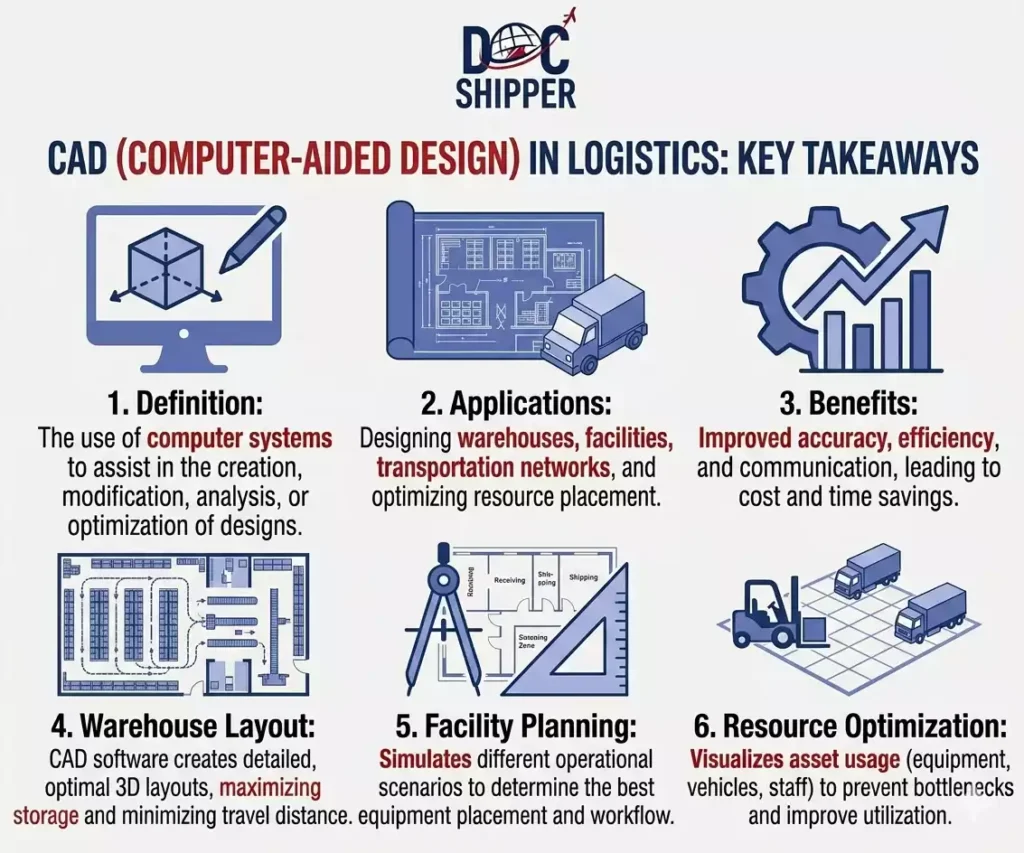
CAD (Computer-Aided Design) is software technology used to create precise 2D drawings and 3D models of physical products before manufacturing. It enables engineers, designers, and manufacturers to visualize, simulate, and optimize product designs digitally, reducing prototyping costs and accelerating time-to-market in international supply chains.Introduction
Many importers face costly production errors because manufacturers misinterpret technical specifications. Without precise digital blueprints, a single dimensional error can delay shipments by weeks and generate thousands in rework costs.
CAD technology eliminates these risks by creating unambiguous technical documentation that travels seamlessly across international supply chains. From initial concept to factory floor, CAD files ensure every stakeholder—designers in Paris, engineers in Shanghai, quality inspectors in Hamburg—works from identical specifications.
Key characteristics of CAD in logistics and manufacturing:
- Dimensional accuracy: Precision to 0.001mm eliminates measurement disputes between buyers and suppliers
- Universal file formats: STEP, IGES, and STL files enable cross-platform collaboration regardless of software vendor
- Version control: Digital revision tracking prevents outdated specifications from reaching production lines
- Simulation capabilities: Virtual testing identifies design flaws before physical prototyping, saving 40-60% in development costs
- Regulatory compliance: Automated generation of technical drawings meeting ISO, ANSI, and DIN standards for customs documentation
Technical Applications & Industry Standards
CAD systems function through parametric modeling, where geometric shapes are defined by mathematical relationships rather than fixed coordinates. This approach allows designers to modify one dimension—a bracket thickness, for example—and watch dependent features update automatically across the entire assembly.
In international trade, CAD file formats serve as the technical language between parties. The STEP (Standard for the Exchange of Product Data) format, governed by ISO 10303, has become the de facto standard for cross-border product data exchange. Unlike proprietary formats tied to specific software, STEP files preserve geometric and metadata integrity when transferred between different CAD platforms.
Manufacturing documentation generated from CAD models must comply with multiple regulatory frameworks. The ISO 128 standard for technical drawings establishes line types, dimensioning methods, and projection systems recognized by customs authorities worldwide. According to the International Organization for Standardization, these standardized drawings reduce customs clearance disputes by 73% compared to non-compliant documentation.
Tolerance specification within CAD systems directly impacts manufacturing feasibility and cost. Geometric Dimensioning and Tolerancing (GD&T) symbols embedded in CAD drawings communicate acceptable variation ranges. A hole specified as Ø10mm ±0.05mm costs 30% more to machine than Ø10mm ±0.2mm due to tighter quality control requirements.
At DocShipper, we verify that CAD documentation includes complete GD&T specifications before production begins, preventing the common scenario where suppliers quote low prices based on loose tolerances, then demand surcharges when precise drawings arrive.
Digital twin technology extends CAD capabilities into logistics planning. By creating virtual replicas of physical products, companies simulate packaging configurations, container loading patterns, and transportation stresses. This predictive modeling identifies potential damage risks—a fragile component lacking adequate cushioning, an unstable pallet stack—before goods leave the factory.
Concrete Examples & Implementation Data
Real-world CAD implementation demonstrates measurable impact on supply chain efficiency and cost control. The following data reflects documented outcomes from international manufacturing projects:
| Manufacturing Scenario | Without CAD | With CAD | Cost/Time Impact |
|---|---|---|---|
| Custom injection mold design | 3 physical prototypes, 8 weeks | Virtual simulation, 2 weeks | -$12,000, -75% timeline |
| Sheet metal enclosure (500 units) | Manual drawings, 15% rework rate | Parametric CAD, 2% rework rate | -$8,500 in scrap costs |
| Multi-component assembly (200 parts) | 5 interference issues found in production | 0 issues (clash detection used) | -3 weeks production delay avoided |
| Regulatory compliance documentation | Manual drafting, 40 hours | Auto-generated from CAD, 4 hours | -90% engineering time |
| Supplier communication (China-Europe) | 23 email clarifications, 12 days | Shared 3D model, 2 days | -83% communication cycle |
Use Case: Electronics Enclosure Import
A European electronics distributor needed 2,000 custom aluminum enclosures manufactured in Vietnam. Initial specifications consisted of hand-drawn sketches with incomplete dimensions. The Vietnamese supplier quoted €18 per unit based on their interpretation of the drawings.
After receiving the first 100-unit sample batch, the buyer discovered:
- Mounting holes misaligned by 3mm (circuit boards wouldn’t fit)
- Ventilation slots 40% smaller than intended (overheating risk)
- Surface finish incompatible with planned anodizing process
The buyer then engaged DocShipper to create comprehensive CAD documentation. Our engineering team produced:
- Parametric 3D model with full GD&T annotations
- 2D manufacturing drawings in STEP and PDF formats
- Material specification sheet referencing ISO aluminum grades
- Surface finish requirements per ISO 1302 standards
- 3D PDF for supplier review (no CAD software required)
The revised quotation increased to €21 per unit (reflecting actual manufacturing complexity), but the final production run achieved:
- Zero dimensional defects across 2,000 units
- First-time approval of pre-shipment inspection
- On-time delivery (no rework delays)
- Total project cost €6,000 lower than initial failed attempt
Industry adoption data from manufacturing sectors shows CAD utilization rates of 94% in aerospace, 89% in automotive, and 67% in consumer goods. Companies using integrated CAD-to-manufacturing workflows report 34% faster time-to-market and 28% lower product development costs compared to those relying on traditional drafting methods.
Conclusion
CAD technology transforms abstract product concepts into precise, manufacturable specifications that eliminate costly miscommunication in international supply chains. The investment in proper CAD documentation—typically 2-5% of total product development costs—prevents errors that routinely consume 15-25% of manufacturing budgets.
Need expert assistance with technical documentation for your import projects? Contact DocShipper for CAD preparation, supplier coordination, and quality assurance services.
📚 Quiz
Test Your Knowledge: CAD (Computer-Aided Design)
1. What is the primary purpose of CAD (Computer-Aided Design) in international manufacturing and supply chains?
2. A supplier quotes a low price based on a dimension stated as "Ø10mm" with no tolerance specified. Once precise GD&T drawings arrive showing Ø10mm ±0.05mm, the supplier demands a surcharge. What does this scenario illustrate about CAD documentation?
3. You are sourcing 2,000 custom aluminum enclosures from a Vietnamese manufacturer. Which approach best leverages CAD to protect your project?
🎯 Your Result
📞 Free Quote in 24hFAQ | CAD (Computer-Aided Design): Definition, Applications & Concrete Examples
Request STEP (.stp or .step) files as the primary format, as they're universally compatible and preserve geometric accuracy. IGES (.igs) works as a secondary option, though it may lose some parametric data. Avoid proprietary formats unless you use the same software as your supplier.
Include all critical dimensions, tolerances, material specifications, and surface finish requirements. Models should be detailed enough that suppliers can generate toolpaths and cost estimates without assumptions. Incomplete models typically result in quotes 20-40% below actual production costs.
Free CAD tools like FreeCAD or Fusion 360 (hobbyist version) work for simple projects, but lack advanced features like automated tolerance analysis and industry-standard file export options. Professional projects requiring ISO-compliant documentation typically need commercial software.
2D drawings show flat views (top, side, front) with dimensions, suitable for simple parts. 3D models represent complete geometry in virtual space, essential for complex assemblies, interference checking, and modern CNC manufacturing. Most projects require both: 3D for design validation, 2D for shop floor reference.
Request a first-article inspection report with dimensional measurements cross-referenced to your CAD drawing callouts. Suppliers should provide measurement data for all critical dimensions before full production begins. This verification step prevents the common scenario of discovering errors after 1,000 units are manufactured.
Geometric Dimensioning and Tolerancing (GD&T) is a symbolic language that defines allowable variation in part geometry. It matters because a dimension like "50mm" without tolerance could mean anything from 49mm to 51mm depending on supplier interpretation. GD&T eliminates ambiguity and prevents quality disputes.
Send simplified CAD files or technical drawings for initial quotes, but withhold detailed models until a non-disclosure agreement is signed. This protects intellectual property while giving suppliers enough information for accurate pricing. Full CAD data should only go to verified, contracted manufacturers.
Professional CAD services range from $500-$3,000 depending on complexity. A simple bracket might cost $500, while a multi-component assembly with custom tolerances could reach $3,000. This investment typically saves 5-10 times its cost by preventing manufacturing errors and rework.
Yes, technical drawings generated from CAD models serve as supporting documentation for customs declarations, particularly for products requiring safety certifications or technical compliance verification. Drawings should include material specifications, dimensions, and weight data matching commercial invoices.
Use secure cloud platforms like Dropbox Business, Google Drive, or WeTransfer Pro rather than email attachments. Compress files into ZIP archives and include a PDF version for quick reference. Establish a shared folder structure with version control to prevent confusion over which revision is current.
Update CAD models immediately when design changes occur, and increment version numbers clearly (e.g., V1.0, V1.1, V2.0). Maintain a revision log documenting what changed and why. Never modify existing files without changing the filename—this prevents suppliers from accidentally using outdated specifications.
No, free viewers like eDrawings, FreeCAD, or online platforms like ShareCAD.org allow you to open and inspect STEP, IGES, and STL files without purchasing CAD software. These viewers let you measure dimensions, check geometries, and generate screenshots for communication, though they don't allow editing.
Need Help with
Logistics or Sourcing ?
First, we secure the right products from the right suppliers at the right price by managing the sourcing process from start to finish. Then, we simplify your shipping experience - from pickup to final delivery - ensuring any product, anywhere, is delivered at highly competitive prices.


Fill the Form
Prefer email? Send us your inquiry, and we’ll get back to you as soon as possible.
Contact us




:%20Definition,%20Applications%20&%20Concrete%20Examples)