


In short ⚡
ETA, ETC, ETD, ETR, and ETS are critical shipping timestamps representing Estimated Time of Arrival, Estimated Time of Completion, Estimated Time of Departure, Estimated Time of Readiness, and Estimated Time of Sailing. These acronyms form the backbone of logistics planning, enabling precise coordination across supply chain operations, customs clearance, and delivery scheduling.
Introduction
Confusion around shipping timestamps causes 30% of logistics delays globally. Misinterpreting ETA versus ETD can derail inventory management, warehouse staffing, and customer commitments. In international freight, these five acronyms represent distinct milestones that must align perfectly.
Understanding these terms is essential for anyone managing import/export operations. They directly impact customs clearance timing, storage costs, and delivery promises to end clients.
Key characteristics of shipping timestamps:
- Sequential interdependence: Each timestamp triggers the next phase in the logistics chain
- Dynamic updates: Weather, port congestion, and operational delays require constant recalculation
- Contractual significance: Timestamps determine demurrage charges, detention fees, and delivery penalties
- Multi-party coordination: Exporters, freight forwarders, carriers, customs brokers, and importers all rely on these estimates
- Technology-driven precision: Modern tracking systems provide real-time timestamp updates via AIS and IoT sensors
Understanding Shipping Timestamps: Mechanisms & Implications
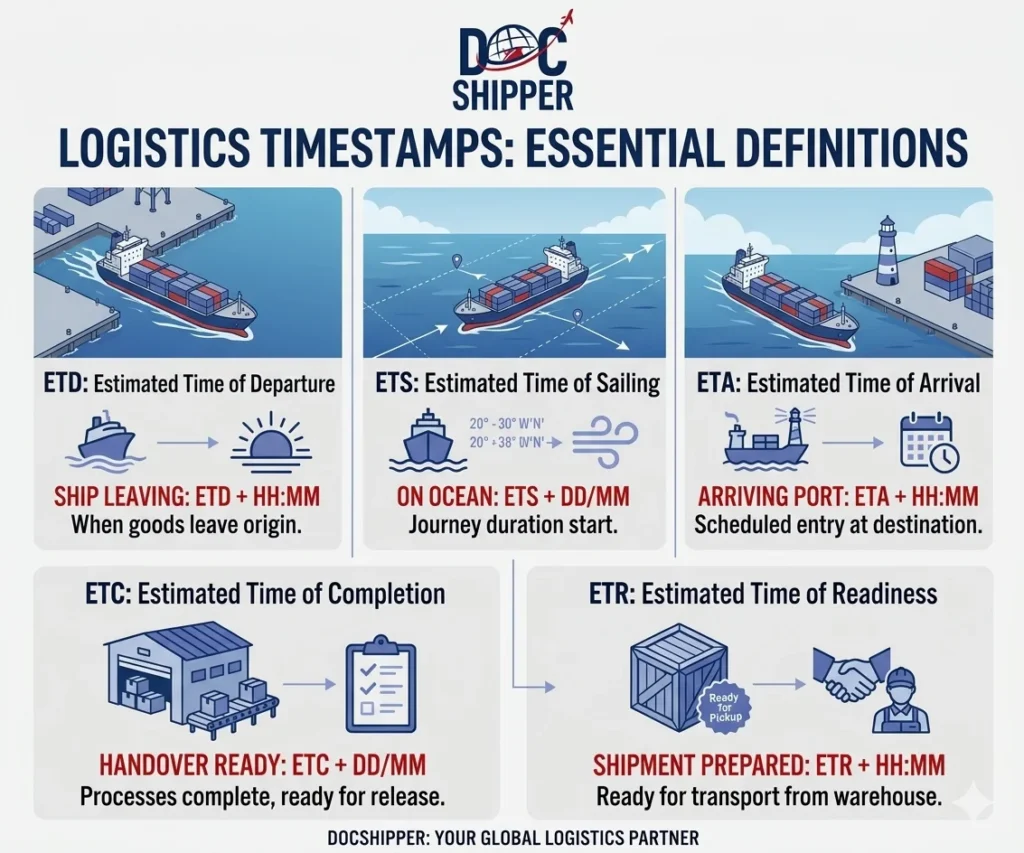
ETD (Estimated Time of Departure) marks when a vessel or aircraft is scheduled to leave the origin port or airport. This timestamp sets the foundation for all subsequent calculations. Carriers publish ETD in booking confirmations, but operational realities frequently shift this baseline.
ETR (Estimated Time of Readiness) indicates when cargo is prepared for loading. This often-overlooked timestamp matters critically in container operations. Cargo must pass customs pre-clearance, complete fumigation if required, and receive terminal gate-in approval before ETR status.
ETS (Estimated Time of Sailing) differs from ETD by accounting for departure procedures. While ETD reflects planned departure, ETS captures actual casting-off time after pilot boarding, tugboat assistance, and clearance from port authorities. The International Maritime Organization recognizes ETS as the definitive departure record.
ETA (Estimated Time of Arrival) represents projected arrival at the destination port or airport. Calculated using vessel speed, distance, and weather forecasts, ETA updates continuously during transit. This timestamp directly affects warehouse scheduling, customs broker availability, and delivery appointments.
ETC (Estimated Time of Completion) applies primarily to specific operations like customs clearance processing or container unloading. At DocShipper, we calculate ETC by factoring inspection probability, documentation complexity, and historical processing times at each port. This precision helps clients schedule onward transportation without costly waiting periods.
Legal implications vary by jurisdiction. Under Incoterms 2020, seller obligations often extend until ETS confirmation, while buyer responsibilities commence at ETA. Demurrage charges typically begin accruing at a fixed period after ETA, making accurate timestamps financially critical.
Practical Applications & Data: Use Cases
Consider a European importer receiving electronics from Shenzhen. The original booking shows:
| Timestamp | Original Estimate | Updated Estimate | Impact |
|---|---|---|---|
| ETR | March 5, 14:00 | March 5, 14:00 | On schedule |
| ETD | March 6, 08:00 | March 7, 11:00 | 27-hour delay |
| ETS | March 6, 10:00 | March 7, 13:30 | Port congestion |
| ETA | March 28, 16:00 | March 29, 19:00 | Weekend arrival |
| ETC (Customs) | March 29, 12:00 | April 1, 10:00 | 2.5 extra days |
The 27-hour ETD delay cascaded into weekend ETA, triggering customs processing delays since many EU ports operate reduced weekend staffing. The importer faced €450 in additional storage fees and missed a retail stocking deadline.
Industry benchmark data:
- Average ETD accuracy: Trans-Pacific routes achieve 78% on-time departure; intra-Asia routes reach 82%
- ETA deviation: Container vessels average ±36 hours variance on long-haul routes
- ETC customs processing: Major European ports complete 68% of standard declarations within 4 hours
- Cost of timestamp errors: Every day of ETA miscalculation costs importers an average of $75-$200 in demurrage and storage
- Update frequency: Leading carriers update ETA every 6-12 hours during transit using satellite tracking
At DocShipper, our proprietary tracking system monitors all five timestamps simultaneously, alerting clients to deviations exceeding threshold parameters. This proactive approach reduces detention charges by 62% on average compared to reactive management.
Conclusion
Mastering ETA, ETC, ETD, ETR, and ETS transforms logistics from reactive firefighting to strategic planning. Accurate timestamp management protects profit margins and strengthens customer relationships.
Need expert guidance on timestamp optimization for your shipments? Contact DocShipper for customized tracking solutions.
📚 Quiz
Test Your Knowledge: ETA, ETC, ETD, ETR & ETS
What is the primary difference between ETD and ETS in shipping operations?
According to the article, which factor causes the highest percentage of ETA deviations in shipping?
In the practical case study of the European electronics importer, what was the primary consequence of the 27-hour ETD delay?
🎯 Your Result
📞 Free Quote in 24hFAQ | ETA, ETC, ETD, ETR & ETS: Definition, Calculation & Practical Examples
ETD represents the scheduled departure time set during booking, while ETS marks the actual moment the vessel begins moving after completing all port formalities. ETS typically occurs 2-4 hours after ETD due to pilot boarding, tugboat operations, and traffic clearance. Carriers use ETS for contractual calculations like transit time guarantees.
Professional carriers update ETA every 6-12 hours using AIS (Automatic Identification System) data. Updates intensify to 2-4 hour intervals when vessels approach destination ports. Importers should request email or SMS notifications for ETA changes exceeding 6 hours to adjust receiving operations accordingly.
ETR applies less formally in air cargo compared to ocean freight. Airlines focus on "ready for carriage" status, which combines ETR with documentation completion. For air shipments, cargo readiness typically means customs pre-clearance completion and physical delivery to airline cargo terminals 4-6 hours before departure.
Compensation depends on contract terms and applicable law. Standard shipping contracts include force majeure clauses excluding liability for weather delays. However, if delays result from carrier overbooking or equipment failures, clients may claim demurrage costs. Document all timestamp communications as evidence for potential disputes.
The top five ETA deviation causes are: port congestion (32% of delays), adverse weather (28%), mechanical issues (18%), customs inspections (14%), and routing changes (8%). Trans-Pacific routes experience higher deviation rates than short-sea routes due to extended weather exposure.
ETA marks vessel arrival at port, while ETC indicates when customs clearance completes. ETC depends on declaration complexity, duty payment speed, and inspection requirements. Standard declarations typically clear 24-48 hours after ETA, but high-risk shipments may require 5-7 days for physical inspection and laboratory testing.
Always use ETS for downstream planning since it reflects actual departure. ETD serves initial planning purposes, but ETS provides the confirmed baseline for calculating true ETA. Build 12-24 hour buffers into warehouse scheduling to absorb minor ETA variations without disrupting operations.
Modern tracking combines AIS satellite data, IoT container sensors, and blockchain documentation verification. Leading platforms achieve 94% ETA accuracy within ±12 hours for ocean freight. Machine learning algorithms analyze historical route performance, weather patterns, and port congestion to refine predictions continuously.
Incoterms 2020 implicitly reference these timestamps. FOB terms transfer responsibility at ETS completion, while CIF extends seller obligations until ETA. DAP requires sellers to manage through destination ETA plus inland delivery. Always clarify timestamp definitions in commercial contracts to avoid disputes.
Carriers grant free time starting from ETA (typically 5-7 days for import containers). Demurrage accrues for containers remaining at port terminals beyond free time. Detention charges apply when containers leave terminals but aren't returned within the allowed period. Accurate ETA forecasting helps schedule container returns before charges begin.
Comprehensive freight visibility platforms integrate carrier APIs, port systems, and customs databases to display all timestamps simultaneously. Premium services offer exception-based alerts when deviations exceed preset thresholds. DocShipper's platform provides unified timestamp tracking across ocean, air, and land transportation modes.
No universal legal definition exists for ETA in international commerce. Courts generally interpret ETA as a good-faith estimate rather than a binding guarantee unless contracts explicitly state otherwise. Include language like "ETA subject to change due to operational factors" to limit liability while maintaining customer communication.
Need Help with
Logistics or Sourcing ?
First, we secure the right products from the right suppliers at the right price by managing the sourcing process from start to finish. Then, we simplify your shipping experience - from pickup to final delivery - ensuring any product, anywhere, is delivered at highly competitive prices.


Fill the Form
Prefer email? Send us your inquiry, and we’ll get back to you as soon as possible.
Contact us




