


In short ⚡
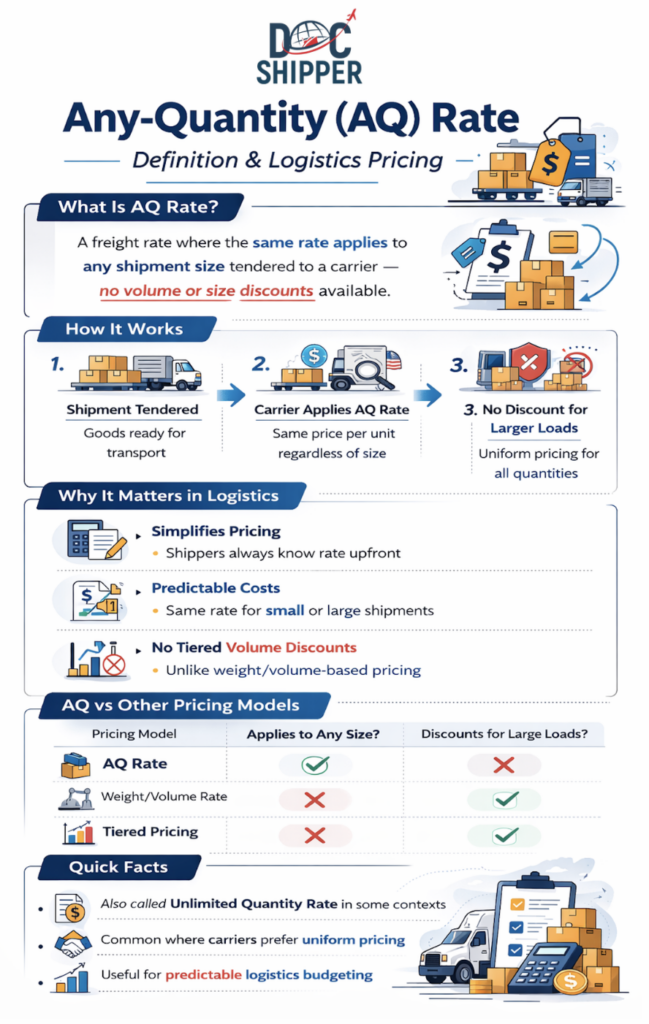
Any-Quantity (AQ) rate is a freight pricing structure where carriers charge the same rate per unit regardless of shipment volume. Unlike tiered pricing models, AQ rates eliminate volume-based discounts, providing consistent cost predictability for shippers handling irregular or small cargo quantities in international logistics.
Introduction
Many importers struggle with unpredictable freight costs when shipment volumes fluctuate between orders. Traditional tiered pricing models penalize smaller shipments with higher per-unit rates, creating budget uncertainty.
The AQ rate addresses this challenge by offering uniform pricing across all shipment sizes. This pricing structure proves particularly valuable in volatile supply chains where demand forecasting remains difficult.
Key characteristics of AQ rates include:
- Flat per-unit pricing regardless of total shipment weight or volume
- Elimination of minimum quantity requirements for preferential rates
- Simplified cost calculation for budgeting and procurement planning
- Reduced administrative complexity in freight negotiations
- Enhanced flexibility for just-in-time inventory management
Understanding AQ Rate Mechanics & Applications
AQ rates function as a departure from conventional break-bulk pricing, where carriers incentivize larger shipments through graduated discounts. Under AQ structures, a shipper pays $5 per kilogram whether moving 100 kg or 10,000 kg.
This pricing model primarily benefits businesses with irregular shipping patterns. E-commerce companies, prototype manufacturers, and seasonal retailers often find AQ rates more economical than maintaining minimum volume commitments for lower tiered rates.
Carriers typically offer AQ rates in specific trade lanes where capacity utilization remains high. Dense routes like Asia-Europe or transpacific corridors see more AQ offerings due to consistent cargo availability that offsets the lack of volume incentives.
From a contractual perspective, AQ agreements simplify service level agreements. Shippers avoid complex rate tables with multiple weight breaks, reducing disputes over classification and measurement discrepancies.
At DocShipper, we analyze whether AQ rates align with client shipping profiles during our freight optimization audits. For businesses shipping 3-8 containers monthly with varying weights, AQ structures often deliver 12-18% cost savings compared to standard tiered contracts.
Regulatory considerations also influence AQ adoption. The U.S. Federal Maritime Commission requires transparent rate disclosure, making AQ structures attractive for compliance-focused shippers seeking straightforward pricing documentation.
Cost Comparison & Real-World Scenarios
To illustrate AQ rate advantages, consider a textile importer shipping from Bangladesh to the United States with monthly volumes ranging from 5,000 to 15,000 kg.
| Pricing Model | 5,000 kg Shipment | 15,000 kg Shipment | Annual Cost (120,000 kg) |
|---|---|---|---|
| Tiered Rate (0-10k: $4.20/kg, 10k+: $3.50/kg) | $21,000 | $52,500 | $462,000 |
| AQ Rate ($3.80/kg) | $19,000 | $57,000 | $456,000 |
In this scenario, the AQ rate delivers $6,000 annual savings despite higher costs on large shipments. The consistent pricing eliminates the pressure to artificially inflate order sizes to reach volume thresholds.
Use Case: Electronics Distributor
A California-based electronics distributor imports components from Shenzhen with highly variable monthly volumes (2-18 CBM). After switching to an AQ rate of $85/CBM, their logistics manager reported:
- 23% reduction in emergency air freight usage (previously used to meet tiered minimums)
- Elimination of $12,000 annual demurrage fees from forced container consolidation delays
- Improved cash flow through predictable weekly shipment scheduling
Key considerations when evaluating AQ rates:
- Volume consistency: AQ rates favor fluctuating shipment sizes over predictable high volumes
- Trade lane maturity: Established routes offer better AQ pricing than emerging markets
- Carrier relationships: Long-term partnerships may unlock hybrid models blending AQ and tiered benefits
- Accessorial charges: Verify whether fuel surcharges and handling fees apply uniformly under AQ contracts
- Contract duration: AQ rates typically require 6-12 month commitments for rate stability
DocShipper Platform
One platform. Your entire supply chain
Sourcing, freight, customs & documents — all centralised, all visible, 24/7.
Conclusion
AQ rates provide strategic pricing flexibility for businesses navigating unpredictable shipping volumes. By eliminating tiered complexity, these structures enhance budget accuracy and operational agility in international logistics.
Need help determining if AQ rates suit your shipping profile? Contact DocShipper for a customized freight cost analysis.
📚 Quiz
Test Your Knowledge: Any-Quantity (AQ) Rate
Q1 — What is the defining characteristic of an Any-Quantity (AQ) rate in freight pricing?
Q2 — A shipper consistently moves 60+ containers per month with stable, predictable volumes. Which pricing model is likely more cost-effective for them?
Q3 — An e-commerce company ships between 3 and 12 CBM per month depending on seasonal demand. They want predictable freight costs without being forced to inflate order sizes. Which scenario best describes the benefit of switching to an AQ rate?
🎯 Your Result
📞 Free Quote in 24hFAQ | Any-Quantity (AQ) Rate: Definition, Calculation & Practical Examples
Businesses with irregular shipping volumes, seasonal demand fluctuations, or just-in-time inventory models gain maximum advantage. E-commerce sellers, prototype manufacturers, and project-based exporters typically see 10-20% cost reductions compared to tiered pricing.
Yes, though more common in ocean freight. Air cargo AQ rates exist primarily on high-density routes where carriers maintain consistent capacity. Ocean freight AQ structures dominate transpacific and Asia-Europe lanes.
FAK rates charge uniformly across commodity types but may still include volume tiers. AQ rates eliminate both commodity classification and volume-based pricing variations, offering complete simplification.
Absolutely. Competitive bidding among carriers often yields better AQ terms. Freight forwarders like DocShipper leverage multi-carrier relationships to secure optimal AQ pricing across trade lanes.
Not automatically. Most AQ contracts list base rates separately from bunker adjustment factors (BAF) or fuel surcharges. Always clarify whether quoted AQ rates are all-inclusive or subject to accessorial fees.
Typically 1-2 shipments monthly, though requirements vary by carrier and trade lane. Some carriers offer AQ rates without frequency commitments at slightly higher per-unit costs.
Standard contracts run 6-12 months with quarterly rate reviews. Longer agreements (24+ months) may include inflation adjustment clauses tied to industry indices like the Shanghai Containerized Freight Index.
Not inherently. AQ rates typically apply port-to-port. Inland transportation, customs clearance, and last-mile delivery require separate pricing unless negotiated as an all-inclusive logistics package.
Some carriers offer hybrid models where AQ base rates apply, but cumulative annual volumes trigger retroactive rebates. These structures balance pricing simplicity with volume loyalty rewards.
AQ contracts accommodate volume surges without penalty, unlike tiered agreements requiring renegotiation. However, extreme increases (300%+ over baseline) may trigger carrier requests for rate reviews to ensure mutual sustainability.
Generally yes for consistent high volumes. Shippers moving 50+ containers monthly usually secure better per-unit costs through tiered contracts. AQ rates optimize cost for variable or mid-range volumes (5-30 containers monthly).
Compare annual costs using historical shipment data. Plot monthly volumes against both pricing models. The break-even occurs where cumulative costs intersect—typically around 60-70% capacity utilization of the highest tier in traditional pricing.
Need Help with
Logistics or Sourcing ?
First, we secure the right products from the right suppliers at the right price by managing the sourcing process from start to finish. Then, we simplify your shipping experience - from pickup to final delivery - ensuring any product, anywhere, is delivered at highly competitive prices.


Fill the Form
Prefer email? Send us your inquiry, and we’ll get back to you as soon as possible.
Contact us




%20Rate:%20Definition%20&%20Guide%20for%202026)