


In short ⚡
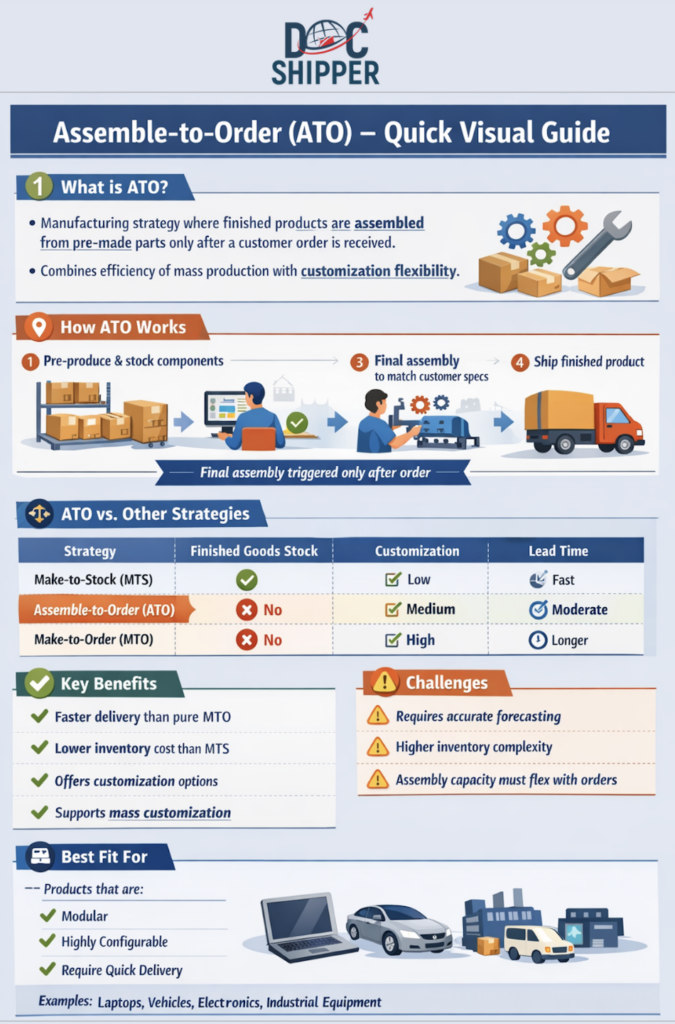
Assemble to Order (ATO) is a manufacturing strategy where products are assembled from pre-manufactured components only after receiving a customer order. This hybrid approach combines mass production efficiency with customization flexibility, allowing businesses to reduce inventory costs while meeting specific customer requirements within shorter lead times.Introduction
Many importers struggle with a critical dilemma: stock too much inventory and tie up capital, or stock too little and miss sales opportunities. This challenge becomes even more complex when customers demand personalized products without accepting long delivery delays.
Assemble to Order addresses this challenge by maintaining a strategic inventory of standardized components rather than finished goods. When orders arrive, manufacturers quickly assemble these parts into customized final products. This approach has become essential in international trade where market volatility and customer expectations create unprecedented pressure on supply chains.
Key characteristics of ATO include:
- Component-level inventory: Stock maintained as modular parts rather than finished products
- Order-triggered assembly: Final configuration occurs only after customer specification
- Moderate lead times: Faster than make-to-order, slower than make-to-stock
- Mass customization capability: Combines standardization with personalization
- Reduced obsolescence risk: Components remain versatile across product variants
ATO Mechanics & Strategic Implementation
The Assemble to Order model operates on a carefully designed component architecture. Manufacturers identify which elements can be standardized and which must remain variable. This modular design philosophy enables rapid final assembly while maintaining product diversity.
From a customs and logistics perspective, ATO creates specific implications. Components often cross borders under different HS codes than finished products, potentially offering tariff advantages. The World Customs Organization provides detailed guidance on classification for semi-finished goods versus components.
The bill of materials (BOM) becomes the operational backbone of ATO systems. This document lists every component required for each product variant. Sophisticated manufacturers maintain multi-level BOMs that track dependencies and alternative parts, enabling flexibility when supply disruptions occur.
Production scheduling in ATO environments requires advanced planning systems. Unlike make-to-stock where production runs follow forecasts, ATO schedules must balance component procurement lead times against customer delivery expectations. This creates a complex optimization problem where component availability directly impacts order fulfillment capability.
The order penetration point represents where customer specifications enter the production process. In ATO, this point sits between component manufacturing and final assembly. Managing this boundary effectively determines whether the strategy delivers its promised benefits or creates operational chaos.
At DocShipper, we help clients implement ATO strategies across international supply chains by coordinating component sourcing from multiple origins, managing consolidation at strategic locations, and ensuring customs compliance throughout the assembly process. Our expertise in multi-country procurement enables clients to source components globally while maintaining assembly flexibility.
Concrete Examples & Performance Data
The computer industry pioneered ATO at scale. Dell revolutionized PC manufacturing in the 1990s by maintaining inventories of processors, memory, storage drives, and cases, then assembling custom configurations within 48 hours of order receipt. This approach reduced inventory costs by approximately 60% compared to traditional retailers while offering thousands of configuration options.
Comparative analysis reveals distinct performance profiles across manufacturing strategies:
| Metric | Make-to-Stock | Assemble-to-Order | Make-to-Order |
|---|---|---|---|
| Lead Time | Immediate | 3-7 days | 15-45 days |
| Inventory Cost | High | Medium | Low |
| Customization | None | Moderate-High | Unlimited |
| Obsolescence Risk | High | Low | Minimal |
| Capital Requirements | Very High | Moderate | Low |
The automotive sector demonstrates ATO at industrial scale. A typical vehicle manufacturer maintains approximately 15,000 component SKUs that can be configured into over 100,000 distinct vehicle specifications. This complexity requires sophisticated supply chain orchestration where component suppliers deliver to assembly plants using just-in-time principles synchronized with customer orders.
Use Case: Electronics Importer
A European electronics distributor shifted from importing finished smartphones to importing component kits and performing final assembly locally. By maintaining stocks of screens, batteries, processors, and housings, they reduced customs duties by 8% (components classified differently than finished devices), cut inventory carrying costs by 45%, and reduced product obsolescence losses from €2.3M to €400K annually. Assembly time averaged 18 minutes per unit, enabling 5-day delivery from order to customer.
Performance data from manufacturing studies indicates ATO implementations typically achieve:
- Inventory reduction: 30-50% lower total inventory value
- Forecast accuracy improvement: Component-level forecasting proves 40% more accurate than finished-goods forecasting
- Customer satisfaction gains: Customization options increase order values by 15-25%
- Working capital efficiency: Cash-to-cash cycle times improve by 20-35 days
- Market responsiveness: New product variant introduction time reduced by 60%
DocShipper Platform
Optimize Your Global Logistics with Cutting-Edge Solutions
Enhance efficiency, cut costs, and gain 24/7 visibility 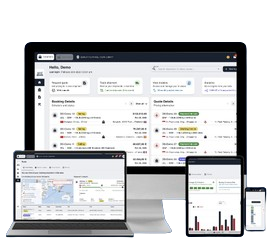 over your entire supply chain.
- Cut your shipping costs and maximize your margins
- Manage sourcing, freight, & customs on one platform
- Get real-time tracking and analytics
Conclusion
Assemble to Order represents a strategic middle ground that captures efficiency from standardization while delivering customization that modern markets demand. For international traders, ATO offers compelling advantages in inventory management, customs optimization, and market responsiveness.
Need assistance implementing an ATO strategy across your international supply chain? Contact DocShipper for expert guidance on component sourcing, assembly coordination, and customs compliance.
📚 Quiz
Test Your Knowledge: Assemble to Order (ATO)
Q1. What best defines the Assemble to Order (ATO) manufacturing strategy?
Q2. A common misconception about ATO is that it carries the same high obsolescence risk as Make-to-Stock. Why is this incorrect?
Q3. A European electronics distributor imports component kits (screens, batteries, processors) and assembles smartphones locally after receiving orders. Which outcome is a direct benefit of this ATO approach?
🎯 Your Result
📞 Free Quote in 24hFAQ | Assemble to Order (ATO): Definition, Process & Real-World Examples
Products with modular designs, multiple configuration options, and moderate complexity work best. Examples include computers, furniture, industrial equipment, and consumer electronics. Products requiring extensive customization or having very simple designs may not benefit from ATO.
Postponement delays product differentiation as late as possible in the supply chain. ATO is a specific implementation of postponement where final assembly represents the differentiation point. Postponement can also include labeling, packaging, or configuration activities beyond physical assembly.
ATO requires precise component-level inventory tracking, coordinated replenishment across multiple SKUs, and sophisticated demand forecasting for components rather than finished goods. Component stockouts can halt production of multiple product variants simultaneously, creating complex safety stock calculations.
Yes, though at smaller scales. The key is starting with limited component variety and gradually expanding. Cloud-based inventory systems and contract assembly services make ATO accessible to smaller operations without massive capital investment in facilities or technology.
Components and finished goods often have different tariff classifications and duty rates. ATO can create opportunities for duty optimization, but requires careful documentation of assembly processes and value-added activities. Transfer pricing considerations also apply when components cross borders within corporate groups.
Enterprise Resource Planning (ERP) systems with advanced planning modules, Product Lifecycle Management (PLM) tools for BOM management, and Manufacturing Execution Systems (MES) for assembly floor control. Integration between these systems enables real-time visibility and coordination.
Assembly duration varies dramatically by product complexity, from minutes for simple electronics to several days for complex machinery. The critical factor is predictability—consistent assembly times enable reliable delivery commitments to customers.
Quality assurance must occur at both component receipt and post-assembly stages. Component quality directly impacts final product quality, making supplier quality management critical. Assembly processes require standardized work instructions and verification protocols to ensure consistency across configurations.
ATO requires closer supplier collaboration than traditional purchasing. Suppliers must maintain component inventories, meet tighter delivery windows, and often participate in demand planning. Long-term partnerships with performance-based contracts typically replace transactional purchasing relationships.
Inadequate component standardization, poor BOM accuracy, insufficient assembly capacity planning, weak supplier coordination, and underestimating IT system requirements represent the most frequent implementation challenges. Successful ATO requires cross-functional alignment between product design, procurement, manufacturing, and sales.
Yes, hybrid approaches are common. Companies often use make-to-stock for high-volume standard products, ATO for configurable mid-volume products, and make-to-order for highly customized low-volume items. This portfolio approach optimizes the manufacturing strategy to specific product characteristics and market segments.
By reducing finished goods inventory, ATO minimizes waste from obsolete products. Component standardization enables better material utilization and recycling. Local assembly reduces transportation distances for bulky finished goods. However, increased component variety can complicate end-of-life recycling if not designed thoughtfully.
Need Help with
Logistics or Sourcing ?
First, we secure the right products from the right suppliers at the right price by managing the sourcing process from start to finish. Then, we simplify your shipping experience - from pickup to final delivery - ensuring any product, anywhere, is delivered at highly competitive prices.


Fill the Form
Prefer email? Send us your inquiry, and we’ll get back to you as soon as possible.
Contact us




:%20Definition%20&%20Guide%20for%202026)