Auditing: Definition & Logistics Guide for 2026

  • admin 7 Min
  • Published on March 3, 2026 Updated on March 5, 2026
img

In short ⚡

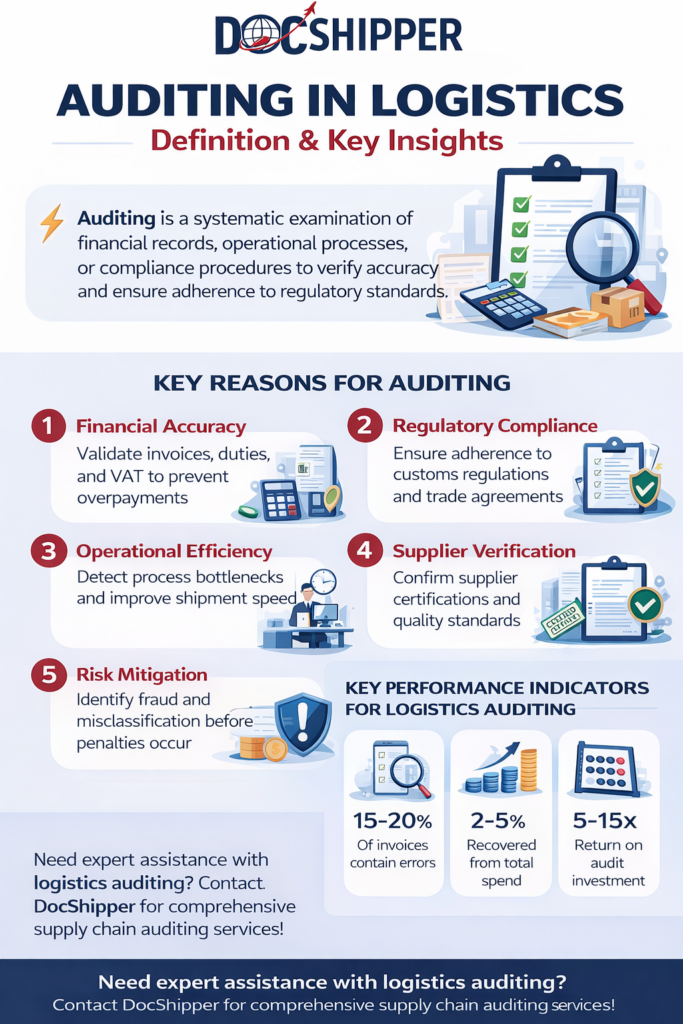
Auditing is a systematic examination of financial records, operational processes, or compliance procedures to verify accuracy, identify risks, and ensure adherence to regulatory standards. In international logistics, auditing validates documentation, costs, and supplier performance to prevent errors and fraud.

Introduction

Many importers discover hidden costs only after shipments arrive. Freight invoices contain errors 15-20% of the time. Customs classifications get disputed. Supplier certifications expire unnoticed.

Auditing solves these problems by creating accountability across the supply chain. It transforms reactive firefighting into proactive risk management. For businesses handling international shipments, auditing is not optional—it’s essential infrastructure.

  • Financial accuracy: Validates invoices, duties, and VAT calculations to prevent overpayments.
  • Regulatory compliance: Ensures adherence to customs regulations, trade agreements, and safety standards.
  • Operational efficiency: Identifies process bottlenecks and documentation gaps that delay shipments.
  • Supplier verification: Confirms certifications, quality standards, and contractual obligations.
  • Risk mitigation: Detects fraud, misclassification, and non-compliance before penalties occur.

In-Depth Analysis & Expertise

Auditing in logistics encompasses three primary domains: financial auditing (invoice verification, cost reconciliation), compliance auditing (regulatory adherence, certification validation), and operational auditing (process efficiency, performance metrics).

The audit trail forms the backbone of any examination. Every transaction must link to verifiable documentation—commercial invoices, bills of lading, certificates of origin, packing lists. Missing links create liability exposure. Electronic systems now mandate digital audit trails under regulations like the EU’s VAT e-commerce rules.

Customs auditing carries particular weight. Authorities conduct post-clearance audits up to three years after importation. Incorrect HS code classification can trigger retroactive duties plus penalties of 10-40%. The European Commission mandates that importers maintain records proving proper valuation methods and preferential origin claims.

Third-party audits provide objective assessments. Independent auditors evaluate supplier facilities for quality standards (ISO 9001), environmental compliance (ISO 14001), and social responsibility (SA8000). These audits protect brand reputation and satisfy due diligence requirements under laws like the German Supply Chain Act.

Continuous auditing represents the modern approach. Rather than annual snapshots, automated systems flag anomalies in real-time—duplicate invoices, pricing deviations, expired licenses. At DocShipper, we implement continuous monitoring protocols that alert clients immediately when documentation discrepancies emerge, preventing costly customs holds.

The materiality threshold determines audit scope. Auditors focus resources on high-value transactions and high-risk areas. A shipment worth €500 receives less scrutiny than one worth €500,000. Risk-based auditing allocates effort where financial or compliance exposure is greatest.

Auditing

Practical Examples & Data

Consider a European electronics importer receiving 200 shipments annually from Asian suppliers. Without auditing, they paid 12% more than necessary due to:

Issue Type Frequency Cost Impact
Freight invoice errors 18% of shipments €47,000 annually
Incorrect HS classification 9% of declarations €23,000 in excess duties
Unused trade agreements 35% of eligible shipments €61,000 in lost savings
Expired certifications 4 suppliers €15,000 in delays/reshipments

After implementing quarterly audits, recovery reached €146,000 in year one. The audit investment of €12,000 delivered a 12:1 ROI.

Case Study: A pharmaceutical importer faced a customs audit revealing misclassified active ingredients. The original classification applied 0% duty under a suspended tariff. Customs reclassified at 6.5%, demanding €89,000 in back duties plus €27,000 in penalties. Pre-audit binding tariff information (BTI) would have prevented this entirely.

Supplier audits yield measurable quality improvements. A textile importer conducting bi-annual factory audits reduced defect rates from 8.3% to 2.1% over 18 months. Rejected shipments dropped from 12 to 3 annually, saving €43,000 in replacement costs and lost sales.

Key Performance Indicators for Logistics Auditing:

  • Error detection rate: Industry average 15-20% of invoices contain discrepancies.
  • Recovery rate: Successful audits recover 2-5% of total logistics spend.
  • Compliance score: Target 95%+ accuracy in customs declarations.
  • Audit cycle time: Comprehensive audits require 40-80 hours depending on volume.
  • Cost-benefit ratio: Professional audits typically return 5-15x their cost.

Conclusion

Auditing transforms logistics from a cost center into a profit protector. It prevents overpayments, ensures compliance, and builds supplier accountability. Every shipment represents financial and regulatory risk—auditing quantifies and controls that risk.

Need expert assistance with logistics auditing or compliance verification? Contact DocShipper for comprehensive supply chain auditing services tailored to your international operations.

📚 Quiz
Test Your Knowledge: Auditing

FAQ | Auditing: Definition, Process & Practical Examples

Internal audits are conducted by company employees to improve processes. External audits are performed by independent third parties to verify compliance and provide objective assessments required by regulators or stakeholders.

Ask us anything!

Need Help with Logistics or Sourcing ?

First, we secure the right products from the right suppliers at the right price by managing the sourcing process from start to finish. Then, we simplify your shipping experience - from pickup to final delivery - ensuring any product, anywhere, is delivered at highly competitive prices.

Live Chat

Get instant assistance from our team—just click and start chatting!

Live Chat Now
image

Fill the Form

Prefer email? Send us your inquiry, and we’ll get back to you as soon as possible.

Contact us
image

Call us

Reach out to us on WhatsApp for quick, convenient, and personal support.

Call us
image