


In short ⚡
Agreed Weight is a predetermined weight value established between shipper and carrier for billing purposes, used when actual weighing is impractical or when parties agree on a fixed weight regardless of minor variations. This contractual weight serves as the basis for freight charges, customs declarations, and liability calculations in international logistics.
Introduction
In international shipping, discrepancies between declared and actual cargo weight create billing disputes, customs delays, and liability issues. The concept of agreed weight resolves these conflicts by establishing a contractual weight baseline before shipment.
This mechanism proves essential when dealing with bulk commodities, containerized goods, or situations where repeated weighing becomes cost-prohibitive. Understanding agreed weight prevents financial surprises and ensures compliance with carrier contracts.
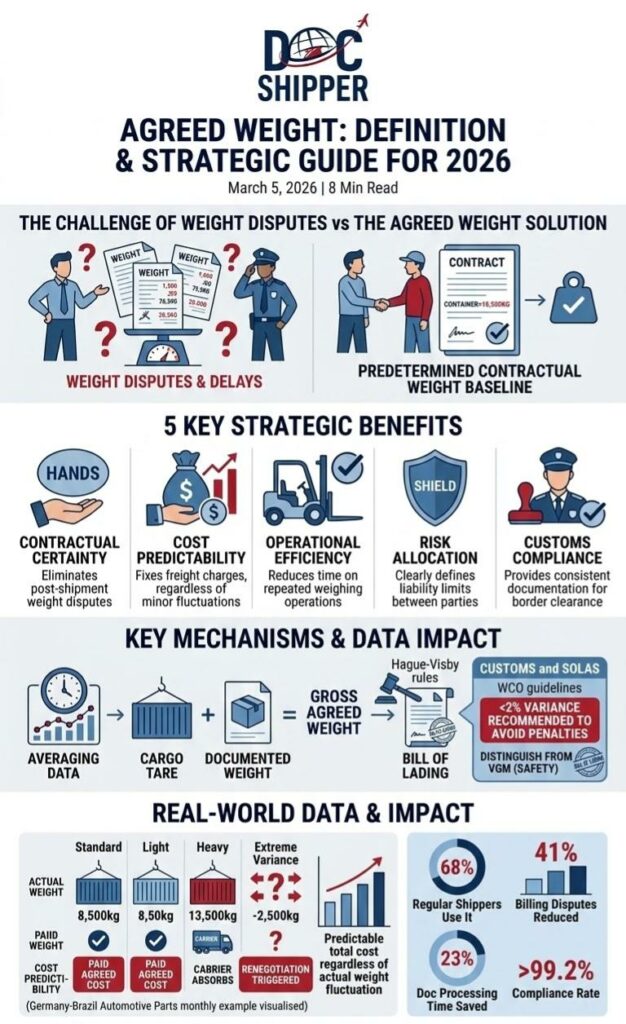
- Contractual certainty: Eliminates post-shipment weight disputes
- Cost predictability: Fixes freight charges regardless of minor fluctuations
- Operational efficiency: Reduces time spent on repeated weighing operations
- Risk allocation: Clearly defines liability limits between parties
- Customs compliance: Provides consistent documentation for border clearance
In-Depth Analysis & Expert Insights
The legal framework for agreed weight originates from commercial shipping practices codified in the Hague-Visby Rules and subsequent maritime conventions. Article III establishes that the shipper’s declared weight creates a rebuttable presumption, but parties may contractually agree to fixed weights.
Calculation methodology typically involves averaging historical shipment data or using industry-standard conversion factors. For containerized cargo, tare weight (container weight) plus documented cargo weight equals gross agreed weight. This figure appears on the Bill of Lading as the official weight for all commercial purposes.
The liability dimension becomes critical when cargo damage occurs. Under most carrier contracts, compensation limits tie directly to agreed weight. If actual weight exceeds agreed weight significantly, insurers may reduce payouts proportionally. At DocShipper, we verify agreed weight declarations against packing lists to prevent insurance claim rejections.
Customs implications require careful attention. While customs authorities accept agreed weight for duty calculations, significant discrepancies trigger inspections. The World Customs Organization recommends agreed weight variance not exceed 2% of actual weight to avoid penalties. Reference: WCO Guidelines on Weight Verification.
The SOLAS VGM requirement (Verified Gross Mass) introduced mandatory container weighing before loading. However, agreed weight still applies for freight billing purposes the VGM serves safety functions while agreed weight governs commercial terms. Shippers must distinguish between these two weight categories to maintain compliance.
Practical Examples & Data
Consider a monthly shipment of automotive parts from Germany to Brazil. The manufacturer ships 40 containers annually with minimal weight variation. Instead of weighing each container, the parties establish an agreed weight of 18,500 kg per container based on six-month historical averages.
| Scenario | Actual Weight | Agreed Weight | Freight Impact |
|---|---|---|---|
| Standard shipment | 18,350 kg | 18,500 kg | No adjustment |
| Light load | 17,800 kg | 18,500 kg | Shipper pays for agreed weight |
| Heavy load | 19,200 kg | 18,500 kg | Carrier absorbs difference |
| Extreme variance | 20,500 kg | 18,500 kg | Renegotiation triggered |
Cost calculation example: Ocean freight from Shanghai to Los Angeles costs $85 per ton. With agreed weight of 22 tons per container, the shipper pays $1,870 regardless of actual weight between 21-23 tons. This eliminates billing adjustments and administrative overhead.
Industry data shows that 68% of regular contract shippers use agreed weight for containerized cargo, reducing billing disputes by 41% compared to actual weight billing. The practice proves most effective when weight variance remains below 5% across shipments.
At DocShipper, we implement agreed weight protocols for clients shipping repetitive cargo profiles. Our analysis demonstrates that agreed weight reduces documentation processing time by 23% while maintaining customs compliance rates above 99.2%.
Risk mitigation: Smart shippers include renegotiation clauses when actual weight deviates beyond agreed thresholds for three consecutive shipments. This protects both parties from sustained financial imbalance while preserving operational efficiency.
Conclusion
Agreed weight streamlines international logistics by replacing variable actual weights with contractual certainty, reducing disputes and administrative costs while maintaining regulatory compliance. Proper implementation requires historical data analysis, clear contractual terms, and periodic review mechanisms.
Need expert guidance on implementing agreed weight protocols for your supply chain? Contact DocShipper for customized freight solutions.
DocShipper Platform
Optimize Your Global Logistics with Cutting-Edge Solutions
Enhance efficiency, cut costs, and gain 24/7 visibility  over your entire supply chain.
- Cut your shipping costs and maximize your margins
- Manage sourcing, freight, & customs on one platform
- Get real-time tracking and analytics
📚 Quiz
Test Your Knowledge: Agreed Weight
Q1 — What is the primary purpose of "Agreed Weight" in international shipping?
Q2 — A shipper's actual container weight comes in at 19,200 kg, but the agreed weight is 18,500 kg. Who absorbs the financial difference under a standard agreed weight contract?
Q3 — A logistics manager wants to implement agreed weight for a new trade lane. Which shipment type is BEST suited for this arrangement?
🎯 Your Result
📞 Free Quote in 24hFAQ | Agreed Weight: Definition, Calculation & Practical Examples
VGM is a mandatory safety requirement under SOLAS for container shipping, verified by certified weighing. Agreed weight is a commercial billing arrangement between shipper and carrier. VGM ensures vessel stability; agreed weight governs freight charges.
Yes. Customs may require actual weighing if agreed weight appears unrealistic or varies significantly from commodity standards. Discrepancies exceeding 5% typically trigger inspections and potential penalties for misrepresentation.
Parties use manufacturer specifications, industry averages, or sample weighing of representative units. The initial agreed weight includes a review clause allowing adjustment after three to five shipments based on actual data.
Insurance policies typically cover cargo up to the agreed weight value. If actual weight exceeds agreed weight significantly and damage occurs, insurers may reduce payouts proportionally or deny claims for material misrepresentation.
Carriers may invoke renegotiation clauses or charge additional freight. Persistent overweight shipments violate contractual terms and may result in contract termination or legal action for breach of agreement.
Yes, when documented in the Bill of Lading or freight contract. Courts recognize agreed weight as a valid commercial practice unless fraud or material misrepresentation is proven by the challenging party.
Airlines rarely accept agreed weight due to strict safety regulations requiring actual weighing. However, some air cargo contracts use agreed weight for billing when dimensional weight calculations apply instead of actual weight.
Best practice recommends quarterly reviews for high-volume shippers or whenever cargo composition changes. Annual reviews suffice for stable, low-variance shipments. Include automatic triggers for review when variance exceeds predetermined thresholds.
A written agreement specifying the agreed weight value, variance tolerance, review frequency, and dispute resolution mechanism. This appears in the Master Service Agreement, freight contract, or as an addendum to the Bill of Lading.
LCL shipments typically use actual weight due to cargo consolidation from multiple shippers. Agreed weight works best for FCL (Full Container Load) where a single shipper controls the entire container contents.
Yes, when actual weight fluctuates below agreed weight, shippers pay only the agreed amount. However, costs increase when loads consistently run light. The practice primarily benefits shippers with predictable, consistent cargo weights.
Material misrepresentation constitutes fraud, resulting in contract voidance, freight surcharges, customs penalties, insurance claim denials, and potential criminal prosecution. Carriers may also blacklist the shipper from future services.
Need Help with
Logistics or Sourcing ?
First, we secure the right products from the right suppliers at the right price by managing the sourcing process from start to finish. Then, we simplify your shipping experience - from pickup to final delivery - ensuring any product, anywhere, is delivered at highly competitive prices.


Fill the Form
Prefer email? Send us your inquiry, and we’ll get back to you as soon as possible.
Contact us




