
In short ⚡
Allision is a maritime incident where a moving vessel strikes a stationary object such as a dock, bridge, or anchored ship. Unlike collision (vessel-to-vessel), allision involves fixed structures. This distinction is critical for insurance claims, liability determination, and port safety protocols in international logistics.
Introduction
Many logistics professionals confuse allision with collision, creating complications in incident reporting and insurance processing. This misunderstanding can delay cargo claims and complicate legal proceedings.
In maritime transport, allision represents a significant operational risk. Port infrastructure damage, vessel delays, and cargo loss directly impact supply chain continuity. Understanding this concept is essential for freight forwarders, insurers, and importers.
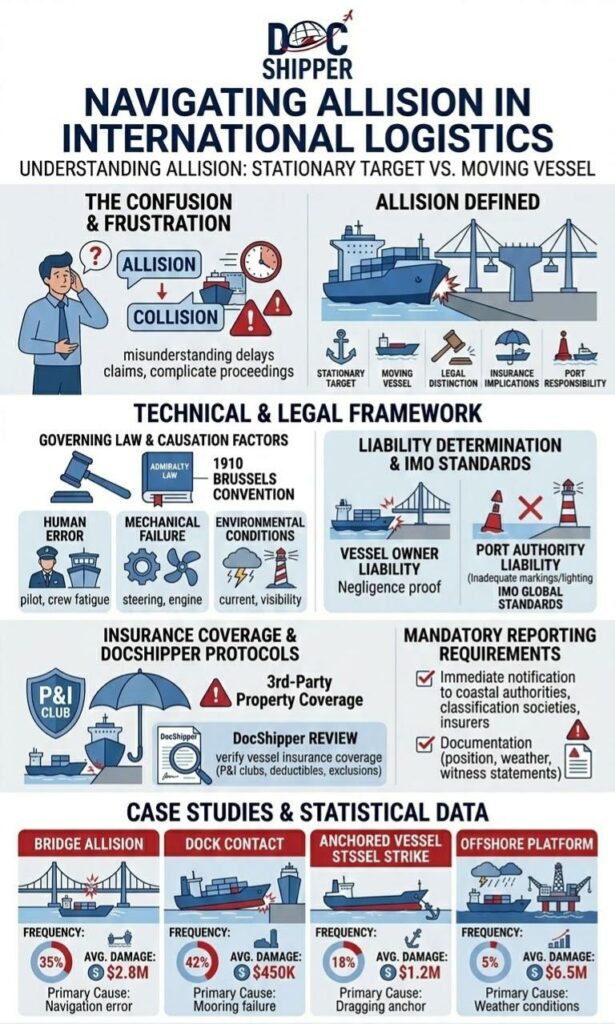
- Stationary target: The struck object remains fixed or anchored
- Moving vessel: The ship is under power or drifting
- Legal distinction: Different liability rules apply compared to collisions
- Insurance implications: Specific clauses govern allision coverage
- Port responsibility: Navigation aids and pilotage services affect liability
Technical & Legal Framework
Allision incidents fall under admiralty law, specifically governed by the 1910 Brussels Convention for Unification of Certain Rules of Law with Respect to Collision. However, many jurisdictions apply separate standards when the struck object is not a vessel.
Causation factors typically include human error (pilot miscalculation, crew fatigue), mechanical failure (steering malfunction, engine breakdown), or environmental conditions (strong currents, poor visibility). Port authorities must maintain proper navigation markers and depth charts to minimize risk.
Liability determination depends on negligence proof. If a vessel strikes a properly marked bridge pier, the vessel owner bears responsibility. Conversely, inadequate channel lighting or missing buoys may shift liability to port authorities. The International Maritime Organization (IMO) establishes global standards for safe navigation practices.
Insurance coverage under Protection & Indemnity (P&I) clubs typically includes allision damage to third-party property. However, deductibles and exclusions vary significantly. At DocShipper, we systematically review vessel insurance certificates before cargo loading to ensure adequate coverage for potential allision incidents.
Reporting requirements mandate immediate notification to coastal authorities, classification societies, and insurers. Failure to comply can void coverage or result in regulatory penalties. Documentation must include vessel position, weather conditions, and witness statements.
Case Studies & Statistical Data
Industry data reveals critical patterns in allision frequency and severity. Understanding these trends helps logistics professionals implement preventive measures.
| Incident Type | Frequency (%) | Avg. Damage Cost | Primary Cause |
|---|---|---|---|
| Bridge Allision | 35% | $2.8M | Navigation error |
| Dock Contact | 42% | $450K | Mooring failure |
| Anchored Vessel Strike | 18% | $1.2M | Dragging anchor |
| Offshore Platform | 5% | $6.5M | Weather conditions |
Use Case: Container Ship Allision
A 8,000 TEU container vessel struck the Sunshine Skyway Bridge in Tampa Bay during fog conditions. The incident resulted in:
- Bridge damage: $1.9 million repair costs
- Cargo delay: 320 containers rerouted, 5-day schedule disruption
- Liability split: 70% vessel owner, 30% pilot association
- Insurance payout: P&I club settled within 8 months
- Regulatory outcome: Enhanced pilotage requirements implemented
This case demonstrates how proper documentation and immediate incident response minimize financial exposure. At DocShipper, our port agents provide real-time monitoring to detect potential allision risks before cargo loading begins.
Conclusion
Allision represents a distinct maritime risk requiring specialized knowledge of admiralty law, insurance protocols, and port operations. Proper risk assessment and documentation protect cargo interests throughout the supply chain.
Need expert guidance on maritime incident management or cargo insurance? Contact DocShipper for comprehensive logistics support.
📚 Quiz
Test Your Knowledge: Allision
Q1 — Which of the following best defines an allision in maritime transport?
Q2 — In an allision incident, can liability ever be shifted away from the vessel owner?
Q3 — A container ship strikes a bridge pier during heavy fog. Which scenario correctly describes this event?
🎯 Your Result
📞 Free Quote in 24hFAQ | Allision: Definition, Causes & Concrete Examples in Maritime Transport
Allision occurs when a moving vessel strikes a stationary object (dock, bridge), while collision involves two moving vessels. This distinction affects legal liability and insurance coverage under maritime law.
Liability depends on negligence. Typically the vessel owner bears responsibility, but inadequate navigation aids or port authority errors can shift partial liability. Pilotage services may also share fault.
Standard cargo policies cover physical damage from allision under Institute Cargo Clauses (A). However, delays or consequential losses require specific extensions. Always verify coverage terms before shipment.
Simple cases settle in 3-6 months. Complex incidents involving multiple parties or disputed liability may take 12-24 months. Proper documentation accelerates the process significantly.
Yes, through proper navigation training, functional equipment maintenance, adequate pilotage services, and compliance with port regulations. Advanced radar systems and AIS technology reduce risk substantially.
Vessel logbook entries, bridge navigation records, VDR data, weather reports, witness statements, photographs, and immediate notification to insurers and coastal authorities. Missing documentation complicates claims.
Modern bridge designs include protective fenders and impact-resistant piers. Older structures may lack adequate protection, increasing damage severity. Port authorities regularly assess structural vulnerability.
Minor incidents cause 1-3 day delays for inspection and repairs. Severe allisions may require cargo transshipment, adding 5-14 days. Contingency planning minimizes supply chain disruption.
Certified pilots provide local navigation expertise, reducing allision risk by 60-75%. Their knowledge of currents, channel depths, and traffic patterns is critical in congested ports.
Extreme weather may reduce liability but rarely eliminates it entirely. Vessel masters must exercise reasonable prudence, including delaying transit or requesting tug assistance during hazardous conditions.
Surveyors inspect structural damage, assess seaworthiness, and may suspend vessel certification pending repairs. Their reports influence insurance settlements and regulatory compliance.
Gross negligence or intoxication can result in criminal charges against the master or crew. Environmental damage from fuel spills triggers additional penalties under pollution statutes.
Need Help with Logistics or Sourcing ?
First, we secure the right products from the right suppliers at the right price by managing the sourcing process from start to finish. Then, we simplify your shipping experience - from pickup to final delivery - ensuring any product, anywhere, is delivered at highly competitive prices.
Fill the Form
Prefer email? Send us your inquiry, and we’ll get back to you as soon as possible.
Contact us


