


In short ⚡
American Bureau of Shipping (ABS) is a leading international classification society providing maritime safety, quality, and environmental standards for vessels and offshore structures. Founded in 1862, ABS certifies ships, conducts inspections, and ensures compliance with international maritime regulations, making it essential for secure global trade operations.Introduction
In international shipping, vessel safety isn’t optional—it’s mandatory. Yet many importers and exporters overlook the critical role classification societies play in ensuring their cargo arrives safely.
The American Bureau of Shipping stands as one of the world’s most trusted maritime authorities. Every vessel carrying your goods must meet strict technical standards before sailing.
Understanding ABS certification matters because:
- Insurance validity depends on proper vessel classification
- Port authorities verify ABS certification before allowing docking
- Cargo liability increases significantly on non-certified vessels
- Regulatory compliance requires adherence to international maritime conventions
- Risk mitigation reduces delays, accidents, and financial losses
Technical Expertise & Regulatory Framework
ABS operates as a non-governmental classification society recognized by over 100 national maritime administrations worldwide. Its primary function involves establishing and maintaining technical standards for vessel design, construction, and operation.
The organization conducts statutory surveys mandated by international conventions including SOLAS (Safety of Life at Sea), MARPOL (Marine Pollution), and Load Line regulations. These inspections verify structural integrity, machinery reliability, and safety equipment functionality.
ABS certification follows a rigorous process:
- Plan approval during vessel design phase
- Construction surveys at shipyard facilities
- Periodic inspections throughout vessel operational life
- Damage assessments following maritime incidents
- Class renewal every five years with intermediate surveys
The society maintains regional offices in major shipping hubs including Houston, Singapore, Shanghai, and Rotterdam. This global presence enables rapid response to vessel certification needs and emergency situations.
For offshore structures, ABS provides specialized services for oil platforms, floating production units, and subsea installations. These certifications ensure compliance with API (American Petroleum Institute) standards and regional regulatory requirements.
At DocShipper, we verify ABS certification status for all vessels transporting client cargo, ensuring insurance coverage remains valid and reducing transit risk exposure.
According to the International Maritime Organization, classification societies like ABS act as recognized organizations (ROs) authorized to perform statutory certification on behalf of flag states, making their role indispensable in global maritime commerce.
Practical Applications & Industry Data
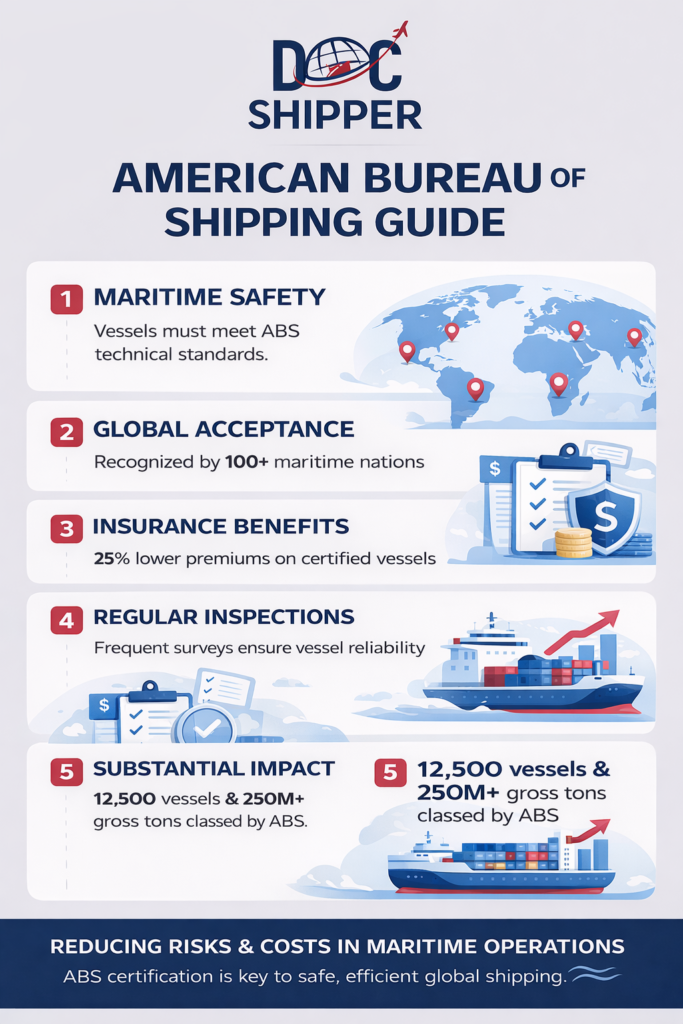
ABS currently classifies approximately 12,500 vessels totaling over 250 million gross tons—representing roughly 11% of the global commercial fleet. This extensive portfolio demonstrates the organization’s market influence and technical credibility.
The financial implications of ABS certification are substantial:
| Certification Status | Insurance Premium Impact | Port Access | Average Delay Risk |
|---|---|---|---|
| ABS Certified | Standard rates | Unrestricted | 2-5% |
| Non-Certified | +40-80% surcharge | Limited/Denied | 35-60% |
| Expired Certification | Coverage void | Detention likely | 70-90% |
Use Case: Container Ship Certification
A 8,000 TEU container vessel operating Asia-Europe routes requires comprehensive ABS certification. The process includes:
- Initial classification cost: $180,000-$250,000
- Annual survey expenses: $35,000-$50,000
- Special periodic survey (5-year): $120,000-$180,000
- Emergency inspection response: 24-48 hours in major ports
- Insurance premium reduction: 15-25% compared to non-IACS vessels
For LNG carriers, ABS provides specialized gas carrier certification under IGC Code requirements. These vessels represent the highest classification complexity, with certification costs reaching $500,000+ for newbuilds.
Recent industry data shows that Port State Control detention rates for ABS-classed vessels remain consistently below 2%, compared to the global average of 5.6%. This performance metric directly translates to reduced operational disruptions and cargo delivery reliability.
DocShipper maintains partnerships with ABS-certified carriers across our service network, ensuring clients benefit from reduced insurance costs and minimized customs clearance complications related to vessel documentation.
Conclusion
American Bureau of Shipping certification represents more than regulatory compliance—it’s a fundamental risk management tool for international trade operations. Vessel classification directly impacts insurance validity, port access, and cargo security throughout the supply chain.
Need assistance verifying vessel certifications or optimizing your shipping strategy? Contact DocShipper for expert guidance on maritime logistics compliance.
DocShipper Platform
Cut logistics costs. Not corners.
See exactly where your logistics costs are bleeding — and how to fix it. Book your expert demo.

📚 Quiz
American Bureau of Shipping (ABS)
Q1 — What is the primary role of the American Bureau of Shipping (ABS)?
Q2 — A vessel's ABS certification has expired. What is the most likely immediate consequence?
Q3 — An importer is choosing between two carriers for an Asia-Europe route: one ABS-certified, one unclassified. Which statement best reflects the practical impact of that choice?
🎯 Your Result
📞 Free Quote in 24hFAQ | American Bureau of Shipping (ABS): Definition, Role & Practical Examples
ABS is one of twelve members of the International Association of Classification Societies (IACS). While all IACS members follow unified requirements, ABS maintains specific expertise in offshore structures, LNG carriers, and U.S. regulatory frameworks, making it preferred for vessels operating in American waters.
Annual surveys verify ongoing compliance, with comprehensive special periodic surveys every five years. Intermediate surveys occur at 2.5-year intervals. Additional inspections may be required following incidents, major repairs, or flag state requests.
Yes, vessels can transfer between IACS-member societies through a formal transfer process. This requires documentation review, condition surveys, and outstanding recommendation closure. The process typically takes 4-8 weeks and costs $15,000-$40,000 depending on vessel type.
While not a guarantee, valid ABS certification is a prerequisite for most marine insurance policies. Insurers require current classification certificates as evidence of seaworthiness. Expired or suspended classification typically voids coverage immediately.
Identified deficiencies receive classifications as "conditions of class" or "recommendations." Critical issues result in class suspension, preventing the vessel from trading until rectified. Port authorities may detain vessels with suspended classification.
Cargo transported on ABS-certified vessels typically receives 10-20% lower insurance premiums compared to non-IACS classified ships. This reduction reflects statistically lower incident rates and improved safety records.
While not legally mandatory, classification by an IACS member (including ABS) is practically essential. Most ports, insurance companies, and cargo owners refuse engagement with unclassified vessels due to elevated risk profiles.
Safehull is an optional ABS notation providing enhanced structural analysis for tankers and bulk carriers. It uses finite element analysis to assess hull strength under various loading conditions, reducing structural failure risk by approximately 30%.
Complete certification for newbuild vessels requires 18-36 months depending on vessel complexity. The process begins during design phase with plan approval, continues through construction surveys, and concludes with sea trials and final certification issuance.
Absolutely. ABS maintains surveyor networks in over 70 countries and certifies vessels constructed in any compliant shipyard globally. Approximately 85% of ABS-classed vessels are built in Asian shipyards, particularly China, South Korea, and Japan.
ABS certification typically costs 15-30% more than non-IACS societies but provides substantially better insurance terms, port acceptance, and resale value. The premium reflects rigorous standards, global recognition, and comprehensive technical support infrastructure.
Yes, ABS offers cyber safety notation covering shipboard operational technology systems, navigation equipment, and cargo management software. This voluntary certification addresses IMO Resolution MSC.428(98) requirements for cyber risk management in safety management systems.
Need Help with
Logistics or Sourcing ?
First, we secure the right products from the right suppliers at the right price by managing the sourcing process from start to finish. Then, we simplify your shipping experience - from pickup to final delivery - ensuring any product, anywhere, is delivered at highly competitive prices.


Fill the Form
Prefer email? Send us your inquiry, and we’ll get back to you as soon as possible.
Contact us




