


In short ⚡
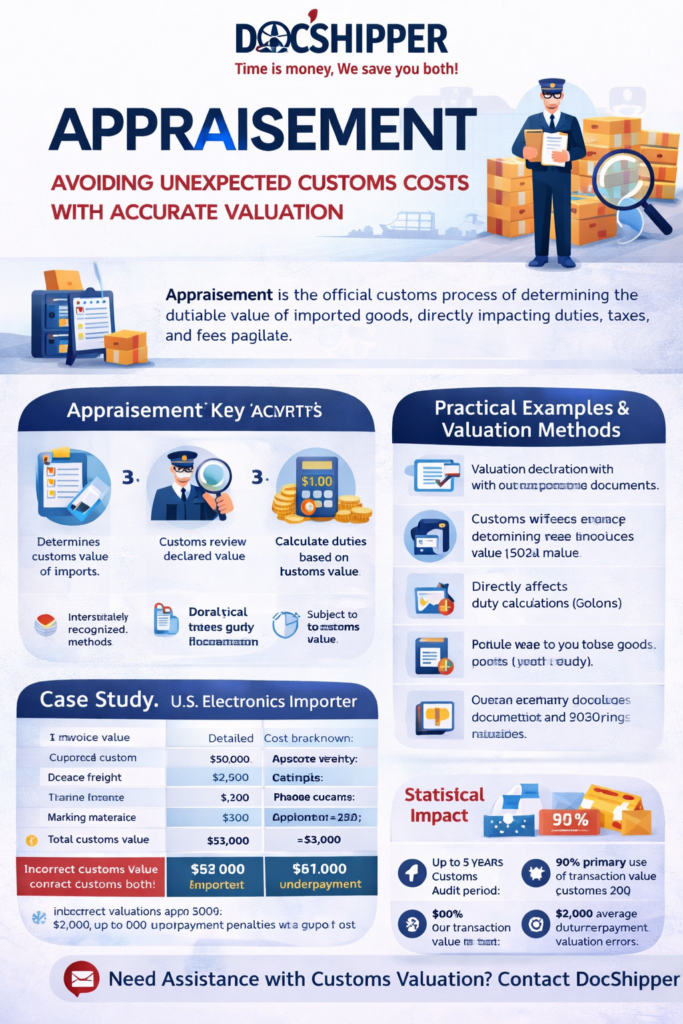
Appraisement is the official customs process of determining the dutiable value of imported goods. This valuation directly impacts the amount of duties, taxes, and fees payable to customs authorities, making it a critical component of international trade compliance and cost management.
Introduction
Many importers struggle with unexpected customs charges. The root cause? Misunderstanding appraisement. This valuation process determines exactly how much duty you’ll pay on imported goods.
In international logistics, appraisement serves as the foundation for customs clearance. Without accurate valuation, shipments face delays, penalties, or even seizure.
Key characteristics of appraisement include:
- Determines the customs value of imported merchandise
- Follows internationally recognized valuation methods
- Directly affects duty calculations and total landed costs
- Requires proper documentation and transparency
- Subject to audit and verification by customs authorities
Understanding the Appraisement Process
Appraisement operates under the WTO Valuation Agreement, which establishes six sequential methods for determining customs value. The primary method uses the transaction value—the price actually paid or payable for the goods when sold for export.
The process involves three critical stages. First, the importer submits a customs declaration with supporting commercial documents. Second, customs officers review the declared value against comparable imports and market data. Third, if discrepancies arise, authorities may request additional documentation or apply alternative valuation methods.
Legal compliance requires understanding related party transactions. When buyer and seller have business relationships, customs authorities scrutinize whether the relationship influenced the price. Transfer pricing documentation becomes essential in these scenarios.
The dutiable value includes more than just the invoice price. It encompasses freight to the port of importation, insurance, packing costs, and certain assists or royalties. Conversely, post-importation costs like inland transportation typically remain excluded.
At DocShipper, we systematically verify all valuation elements before customs submission to prevent costly adjustments or delays. Our compliance team ensures your documentation supports the declared value under WCO guidelines.
Customs authorities possess post-clearance audit rights extending up to five years in many jurisdictions. Maintaining detailed records of purchase orders, payment proof, and valuation adjustments protects against retrospective duty assessments.
Practical Examples & Valuation Methods
Understanding appraisement requires examining real-world scenarios. The following table compares how different valuation methods apply when the transaction value cannot be determined:
| Valuation Method | Application | Example Scenario |
|---|---|---|
| Transaction Value | Primary method (90% of cases) | Invoice shows $10,000 + $500 freight = $10,500 customs value |
| Identical Goods | When transaction value unavailable | Use value of identical goods imported within 90 days |
| Similar Goods | No identical goods found | Comparable products with similar characteristics and materials |
| Deductive Value | Based on resale price | Retail price $15,000 minus profit/costs = $9,000 customs value |
| Computed Value | Production cost basis | Materials + labor + overhead + profit = customs value |
Case Study: A U.S. electronics importer purchased smartphones from a Chinese manufacturer for $50,000 FOB Shanghai. The appraisement calculation included:
- Invoice value: $50,000
- Ocean freight to Los Angeles: $2,500
- Marine insurance: $300
- Packing materials: $200
- Total customs value: $53,000
With a 3.9% duty rate for electronics (HS code 8517), the importer paid $2,067 in duties. Incorrect appraisement excluding freight would have resulted in underpayment and potential penalties.
DocShipper’s valuation experts analyze every cost component to ensure accurate duty calculations and prevent compliance issues during customs clearance.
Conclusion
Appraisement determines your customs costs and compliance standing. Accurate valuation protects against penalties while optimizing landed costs. Mastering this process is essential for successful international trade operations.
Need assistance with customs valuation or import compliance? Contact DocShipper for expert guidance on your international shipments.
DocShipper Platform
Cut logistics costs. Not corners.
See exactly where your logistics costs are bleeding — and how to fix it. Book your expert demo.

📚 Quiz
Test Your Knowledge: Appraisement
Q1 — What is the primary purpose of appraisement in international trade?
Q2 — A U.S. importer buys electronics for $50,000 FOB Shanghai. Which of the following correctly reflects what should be included in the customs appraisement value?
Q3 — When the transaction value cannot be used as the basis for appraisement, which method should customs authorities apply next according to the WTO Valuation Agreement?
🎯 Your Result
📞 Free Quote in 24hFAQ | Appraisement: Definition, Process & Practical Examples
Appraisement is the official customs process, while customs valuation refers to the determined value itself. The terms are often used interchangeably in trade documentation.
Yes. Most jurisdictions allow importers to file administrative appeals or request formal review of valuation determinations within specified timeframes, typically 90 days.
The appraised value serves as the basis for calculating duties and taxes. A higher customs value increases duty payments, directly impacting your total product cost.
Essential documents include commercial invoices, bills of lading, packing lists, purchase orders, payment records, and any agreements affecting the transaction price.
Royalties and license fees are included when they're a condition of sale and relate to the imported goods, even if paid separately from the purchase price.
Most customs authorities require retention of import records for five years from the entry date to facilitate potential audits or verification requests.
Undervaluation can result in penalties, interest charges, and increased scrutiny on future shipments. Overvaluation leads to unnecessary duty payments without recourse in many cases.
Appraisement applies to commercial imports. Personal effects, gifts below de minimis thresholds, and certain temporary imports may follow simplified procedures.
Licensed customs brokers are authorized to prepare and submit valuation declarations on your behalf, though the importer remains legally responsible for accuracy.
FTAs don't change valuation methods but may reduce or eliminate duties on properly appraised goods meeting rules of origin requirements.
Related parties include parent-subsidiary relationships, common ownership, or business partnerships. These transactions receive additional scrutiny to ensure arm's length pricing.
No. Costs incurred after goods arrive at the port of importation, such as inland freight or installation, are excluded from the customs value calculation.
Need Help with
Logistics or Sourcing ?
First, we secure the right products from the right suppliers at the right price by managing the sourcing process from start to finish. Then, we simplify your shipping experience - from pickup to final delivery - ensuring any product, anywhere, is delivered at highly competitive prices.


Fill the Form
Prefer email? Send us your inquiry, and we’ll get back to you as soon as possible.
Contact us




