


In short ⚡
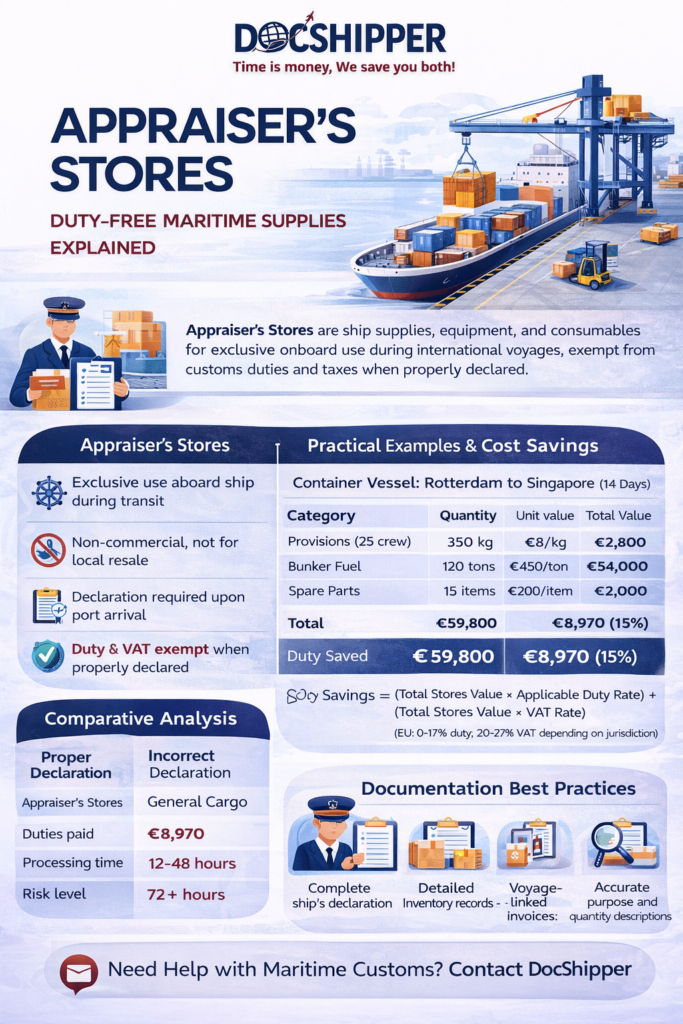
Appraiser's Stores are ship supplies, equipment, and consumables intended exclusively for vessel operation during international voyages. These items are exempt from customs duties and taxes when properly declared, as they remain aboard and do not enter the destination country's commerce.Introduction
Maritime logistics professionals frequently encounter confusion between appraiser’s stores and regular cargo. This distinction directly impacts customs clearance, duty calculations, and vessel compliance.
Appraiser’s stores represent a critical exemption category in international maritime trade. Proper classification ensures vessels avoid unnecessary taxation while maintaining regulatory compliance across jurisdictions.
Key characteristics include:
- Exclusive use aboard the vessel during international transit
- Non-commercial nature preventing resale in destination markets
- Mandatory declaration upon port arrival with supporting documentation
- Exemption from import duties and value-added taxes when properly documented
- Coverage of provisions, fuel, spare parts, and operational equipment
Regulatory Framework & Compliance Requirements
The legal foundation for appraiser’s stores exemptions stems from the International Convention on the Simplification and Harmonization of Customs Procedures (Revised Kyoto Convention). This framework establishes standardized treatment across signatory nations.
Customs authorities distinguish appraiser’s stores through three primary mechanisms. First, purpose verification confirms items serve vessel operations rather than commercial resale. Second, quantity assessment ensures volumes align with voyage duration and crew size. Third, documentation validation requires comprehensive manifests and supporting records.
The ship’s declaration form constitutes the central compliance document. Captains must itemize all stores with detailed descriptions, quantities, and values. According to World Customs Organization guidelines, declarations must be submitted before vessel arrival.
Exemption eligibility extends to five categories: provisions (food and beverages for crew consumption), bunker fuel (propulsion and auxiliary power), maintenance supplies (lubricants, paints, cleaning materials), spare parts (replacement components for onboard systems), and safety equipment (life-saving and navigation devices).
At DocShipper, we systematically verify appraiser’s stores documentation during pre-clearance audits to prevent customs delays and ensure full regulatory compliance across all maritime jurisdictions.
Penalties for non-compliance vary by jurisdiction but typically include duty assessment on improperly classified items, administrative fines ranging from €500 to €50,000, and potential vessel detention pending resolution. Repeat violations may trigger enhanced inspection protocols for subsequent port calls.
Practical Examples & Calculation Methods
Understanding appraiser’s stores through concrete scenarios clarifies application and financial implications. The following cases demonstrate typical situations maritime operators encounter.
Use Case 1: Container Vessel Rotterdam to Singapore
A 14-day voyage requires provisioning calculations:
| Category | Quantity | Unit Value | Total Value | Duty Saved (15%) |
|---|---|---|---|---|
| Provisions (25 crew) | 350 kg | €8/kg | €2,800 | €420 |
| Bunker Fuel | 120 tons | €450/ton | €54,000 | €8,100 |
| Spare Parts | 15 items | €200/item | €3,000 | €450 |
| Total | €59,800 | €8,970 |
Proper classification saves €8,970 in duties per voyage. Annually, this vessel completes 18 similar routes, generating €161,460 in exemption value.
Use Case 2: Cruise Ship Mediterranean Circuit
A 7-day circuit with 2,500 passengers demonstrates scale:
- Provisions: 35 tons (€280,000 value) – duty exemption €42,000
- Beverage Stores: 12,000 liters (€96,000 value) – duty exemption €14,400
- Maintenance Supplies: €18,000 value – duty exemption €2,700
- Total Weekly Savings: €59,100
- Annual Savings (40 circuits): €2,364,000
DocShipper Platform
One platform. Your entire supply chain
Sourcing, freight, customs & documents — all centralised, all visible, 24/7.
Comparative Analysis: Proper vs. Improper Classification
| Scenario | Classification | Duties Paid | Processing Time | Risk Level |
|---|---|---|---|---|
| Correct Declaration | Appraiser’s Stores | €0 | 2-4 hours | Low |
| Incorrect Declaration | General Cargo | €8,970 | 12-48 hours | High |
| Undeclared Items | Non-Compliance | €8,970 + €15,000 fine | 72+ hours | Critical |
Calculation Formula: Duty Savings = (Total Stores Value × Applicable Duty Rate) + (Total Stores Value × VAT Rate). For EU ports, standard rates apply: 0-17% duty + 20-27% VAT depending on jurisdiction.
Conclusion
Appraiser’s stores represent a significant cost-saving mechanism in maritime operations when properly managed. Accurate classification and comprehensive documentation ensure compliance while maximizing financial benefits across international routes.
Need expert guidance on maritime customs procedures? Contact DocShipper for specialized support in vessel clearance and regulatory compliance.
📚 Quiz
Test Your Knowledge: Appraiser's Stores
Q1 — What best defines "Appraiser's Stores" in maritime logistics?
Q2 — A cruise ship carries 5,000 liters of premium spirits aboard. Under what condition do these qualify as Appraiser's Stores?
Q3 — A container vessel arrives at Singapore with undeclared spare parts worth €20,000. Which outcome is most likely?
🎯 Your Result
📞 Free Quote in 24hFAQ | Appraiser's Stores: Definition, Calculation & Practical Examples
Items exclusively for vessel operation qualify: provisions for crew consumption, bunker fuel, lubricants, spare parts, safety equipment, and maintenance supplies. Items intended for resale or passenger purchase do not qualify.
Exemptions apply while items remain aboard during international transit. Once a vessel enters domestic trade or items are landed, exemptions terminate and standard duties apply.
Yes, fishing vessels engaged in international operations qualify. However, the catch itself does not qualify—only operational supplies, fuel, and equipment used for vessel functioning.
Required documents include: ship's declaration form, detailed stores manifest, crew list, voyage itinerary, previous port clearance certificates, and invoices for high-value items exceeding threshold limits.
Quantities must be reasonable for voyage duration and crew size. Customs authorities may challenge excessive amounts. Standard calculation: crew size × voyage days × consumption rate per category.
Private yachts on international passages qualify for limited exemptions. However, restrictions are stricter than commercial vessels, particularly regarding alcohol, tobacco, and luxury provisions.
Unauthorized landing or sale constitutes smuggling. Penalties include full duty assessment, substantial fines (often 3-5× duty value), potential vessel seizure, and criminal prosecution in severe cases.
Modern port systems like EU's ICS require specific commodity codes for stores. Vessels must pre-declare through electronic manifests 24-48 hours before arrival, specifying quantities and values by category.
Transfers require customs authorization and documentation. Both vessels must be in international service. Domestic transfers typically trigger duty obligations unless specific exemptions apply.
Core principles align, but procedural requirements differ. US requires CBP Form 1302 and stricter agricultural product restrictions. EU uses standardized declaration forms with harmonized commodity classifications across member states.
Verification methods include physical inspection, manifest cross-referencing with previous ports, crew size analysis, and voyage duration assessment. Risk-based targeting focuses on vessels with historical discrepancies.
Penalties vary by jurisdiction and violation severity. Minor errors may result in €500-€2,000 administrative fines. Deliberate misclassification can trigger duty assessment plus 100-300% penalties and potential criminal charges.
Need Help with
Logistics or Sourcing ?
First, we secure the right products from the right suppliers at the right price by managing the sourcing process from start to finish. Then, we simplify your shipping experience - from pickup to final delivery - ensuring any product, anywhere, is delivered at highly competitive prices.


Fill the Form
Prefer email? Send us your inquiry, and we’ll get back to you as soon as possible.
Contact us




