


In short ⚡
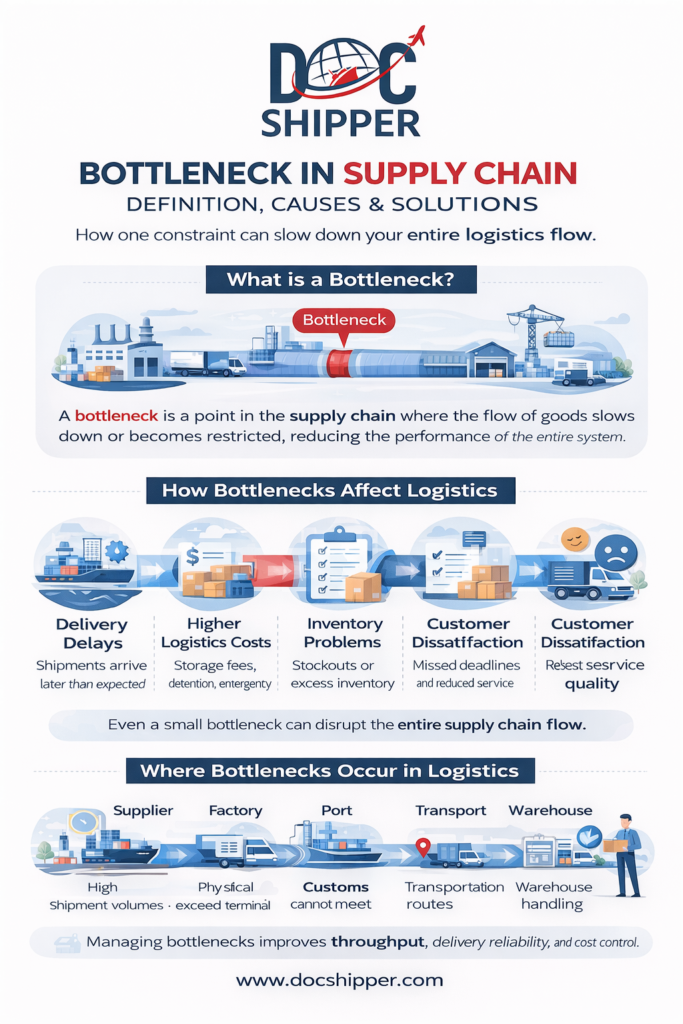
A bottleneck is a constraint point in a supply chain or production process where capacity is limited, causing delays and reduced throughput. This critical disruption occurs when demand exceeds the system's processing ability at a specific stage, creating congestion that impacts the entire operational flow.
Introduction
Every logistics manager has faced this frustration: shipments pile up, deadlines slip, and costs escalate—all because one single point in the chain cannot keep pace. This is the bottleneck phenomenon, the Achilles’ heel of operational efficiency.
In international trade, bottlenecks can emerge at any stage: port congestion, customs clearance delays, warehouse capacity limitations, or transportation shortages. Understanding and addressing these constraints is essential for maintaining competitive advantage and customer satisfaction.
Key characteristics of logistics bottlenecks include:
- Capacity limitation: The constraint point processes fewer units than required by upstream or downstream operations
- Queue formation: Work-in-progress accumulates before the bottleneck, creating inventory buildup
- System-wide impact: Even if other stages have excess capacity, overall throughput cannot exceed the bottleneck’s rate
- Dynamic nature: Bottlenecks can shift between different points as conditions change
- Cost multiplication: Delays compound throughout the supply chain, exponentially increasing expenses
Understanding Bottlenecks: Mechanisms & Implications
The Theory of Constraints, developed by Eliyahu Goldratt, identifies bottlenecks as the primary factor limiting system performance. In logistics, this translates to identifying the single weakest link that governs entire supply chain velocity.
Bottlenecks manifest through several mechanisms. Resource constraints occur when equipment, personnel, or infrastructure cannot handle volume demands. A port with only three gantry cranes cannot unload vessels faster than those cranes’ combined capacity, regardless of available dock space. Process inefficiencies create bottlenecks when procedures are unnecessarily complex—customs documentation requiring manual verification slows clearance even with adequate staffing.
Demand variability transforms adequate capacity into bottlenecks during peak periods. A warehouse designed for average daily volumes becomes constrained during holiday seasons or promotional campaigns. Interdependency effects mean that upstream delays create artificial bottlenecks downstream—delayed container arrivals leave trucks idle, creating apparent transportation bottlenecks.
The bullwhip effect amplifies bottleneck impacts. Small demand fluctuations at retail level create magnified order variations upstream, overwhelming production or shipping capacity. According to research published by the European Union’s logistics efficiency framework, unaddressed bottlenecks can reduce supply chain efficiency by 20-40% and increase operational costs proportionally.
At DocShipper, we systematically map client supply chains to identify potential bottlenecks before they disrupt operations, implementing buffer strategies and alternative routing to maintain flow continuity.
Legal and contractual implications arise when bottlenecks cause delivery failures. Force majeure clauses may not protect against foreseeable capacity constraints. International Chamber of Commerce Incoterms® specify risk transfer points, but bottleneck-induced delays can trigger penalty clauses, especially in just-in-time manufacturing contracts. For detailed regulatory frameworks, consult the WTO Trade Facilitation Agreement, which addresses administrative bottlenecks in cross-border trade.
Concrete Examples & Performance Data
Real-world bottleneck scenarios illustrate their diverse manifestations and quantifiable impacts across international logistics operations.
Use Case 1: Port Congestion Bottleneck
In 2021, Los Angeles-Long Beach port complex experienced severe bottlenecks. With 40% of U.S. containerized imports flowing through these ports, limited berth space created vessel queues exceeding 100 ships. Average dwell time increased from 3 days to 11 days, adding $1,500-$3,000 per container in demurrage and detention fees. Companies using alternative ports like Oakland or East Coast facilities reduced delays by 60-70%, though at higher transportation costs.
Use Case 2: Customs Clearance Bottleneck
A European electronics importer faced consistent 5-7 day customs delays at Rotterdam due to incomplete HS code classifications. After implementing automated classification software and pre-clearance procedures, processing time dropped to 18 hours. The bottleneck elimination reduced inventory carrying costs by €45,000 monthly and improved product availability by 35%.
DocShipper Platform
Cut logistics costs. Not corners.
See exactly where your logistics costs are bleeding — and how to fix it. Book your expert demo.
Comparative Bottleneck Impact Analysis
| Bottleneck Type | Average Delay | Cost Impact per Container | Mitigation Strategy |
|---|---|---|---|
| Port Congestion | 5-12 days | $2,000-$4,500 | Alternative ports, vessel sharing |
| Customs Processing | 3-7 days | $800-$1,800 | Pre-clearance, AEO certification |
| Warehouse Capacity | 2-5 days | $500-$1,200 | Cross-docking, 3PL partnerships |
| Transportation Shortage | 3-8 days | $1,000-$2,500 | Carrier diversification, advance booking |
| Documentation Errors | 1-4 days | $300-$900 | Digital platforms, validation systems |
Key Performance Indicators
- Throughput rate: Bottlenecks reduce system throughput to match the constraint’s capacity (e.g., 200 units/hour bottleneck limits 500 units/hour system to 200)
- Cycle time inflation: Each bottleneck day adds 2-3 days to total delivery time due to cascading effects
- Inventory accumulation: Pre-bottleneck inventory increases 15-25% for each day of constraint duration
- Cost escalation: Bottleneck-related expenses (storage, demurrage, expediting) average 12-18% of total logistics costs
- Service level degradation: On-time delivery rates drop 8-12 percentage points per bottleneck occurrence
DocShipper’s predictive analytics identify emerging bottlenecks 72-96 hours before critical impact, enabling proactive rerouting and resource allocation that maintains 94% on-time delivery rates even during peak seasons.
Conclusion
Bottlenecks represent the single greatest threat to supply chain efficiency, transforming well-designed logistics systems into costly, unresponsive operations. Identifying, monitoring, and systematically addressing these constraints is not optional—it’s fundamental to competitive international trade.
Need expert support in diagnosing and resolving supply chain bottlenecks? Contact DocShipper for comprehensive logistics optimization tailored to your operational challenges.
📚 Quiz
Test Your Knowledge: Bottleneck
1. What is a bottleneck in a supply chain or logistics process?
2. A supply chain has five stages, each capable of processing 500 units/hour — except one stage that can only handle 200 units/hour. What is the maximum throughput of the entire system?
3. A European importer experiences consistent 5–7 day customs delays due to incomplete HS code classifications. According to bottleneck management principles, what is the most effective first step to resolve this?
🎯 Your Result
📞 Free Quote in 24hFAQ | Bottleneck: Definition, Impact & Concrete Examples in Logistics
While often used interchangeably, a bottleneck is the active constraint currently limiting system throughput. A constraint is any limiting factor, but only becomes a bottleneck when it's the primary restriction affecting overall performance at a given time.
Identify bottlenecks by analyzing queue formations, measuring process cycle times, tracking inventory accumulation points, and calculating utilization rates. The stage with highest utilization (approaching 100%) and longest queues is typically the bottleneck.
Only one true bottleneck exists at any moment—the single point limiting overall throughput. However, secondary constraints may become bottlenecks when the primary one is resolved, creating a shifting bottleneck phenomenon requiring continuous monitoring.
Bottlenecks typically increase logistics costs by 12-25% through demurrage fees, expedited shipping, inventory carrying costs, and lost sales. Major port bottlenecks can add $2,000-$5,000 per container in direct and indirect expenses.
The Theory of Constraints focuses improvement efforts on the bottleneck, as enhancing non-constraint areas doesn't improve overall throughput. In shipping, this means prioritizing solutions at congestion points rather than optimizing already-efficient stages.
Effective strategies include increasing bottleneck capacity, reducing load through demand management, implementing buffer inventory before constraints, using alternative routes or facilities, and improving process efficiency specifically at the bottleneck point.
Seasonal demand peaks overwhelm capacity designed for average volumes. Holiday shipping periods, agricultural harvest seasons, and promotional campaigns create temporary bottlenecks at ports, warehouses, and transportation networks, requiring flexible capacity planning.
Technology enables real-time visibility, predictive analytics, and automated decision-making. IoT sensors detect queue formations early, AI algorithms predict bottleneck emergence, and digital platforms facilitate rapid rerouting and resource reallocation.
Customs bottlenecks arise from documentation errors, incomplete declarations, physical inspections, and manual processing. Implementing AEO status, pre-clearance programs, and digital documentation systems can reduce customs processing time by 60-80%.
Bottlenecks necessitate strategic buffer inventory placement. Inventory before the bottleneck protects against upstream variability, while inventory after the bottleneck is wasteful. Just-in-time systems are particularly vulnerable to bottleneck disruptions.
Third-party logistics providers (3PLs) offer scalable capacity, alternative facilities, and specialized expertise that can bypass internal bottlenecks. However, outsourcing introduces dependency risks and requires careful vendor selection and performance monitoring.
Success metrics include throughput increase, cycle time reduction, queue length decrease, inventory level normalization, and cost per unit improvement. Effective bottleneck resolution should show 15-30% throughput improvement within the first operational cycle.
Need Help with
Logistics or Sourcing ?
First, we secure the right products from the right suppliers at the right price by managing the sourcing process from start to finish. Then, we simplify your shipping experience - from pickup to final delivery - ensuring any product, anywhere, is delivered at highly competitive prices.


Fill the Form
Prefer email? Send us your inquiry, and we’ll get back to you as soon as possible.
Contact us




