


In short ⚡
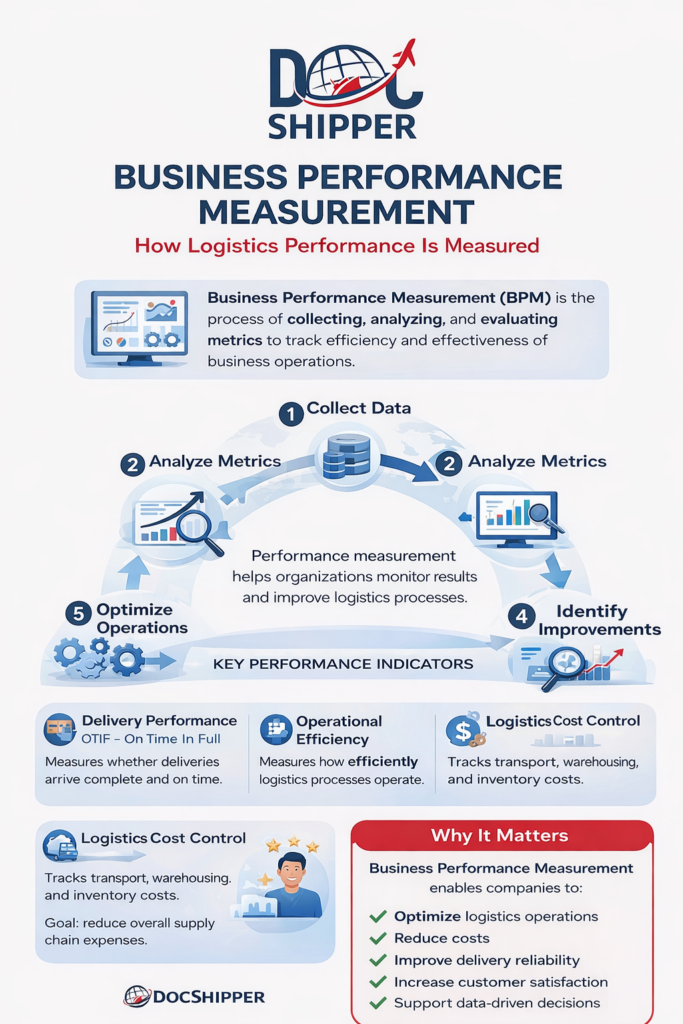
Business Performance Measurement (BPM) is a systematic approach to evaluating organizational effectiveness through quantifiable metrics and KPIs. It encompasses financial indicators, operational efficiency, customer satisfaction, and strategic goal achievement, enabling data-driven decision-making across supply chain and logistics operations.Introduction
Many businesses struggle to identify which metrics truly reflect operational success. Without structured performance measurement, companies navigate blindly through complex international logistics.
BPM provides the compass for strategic decision-making in import/export operations. It transforms raw data into actionable insights that optimize costs, reduce delays, and enhance customer satisfaction.
- Quantifiable assessment of logistics efficiency and cost-effectiveness
- Real-time visibility into supply chain bottlenecks and opportunities
- Benchmarking capabilities against industry standards and competitors
- Predictive analytics for proactive risk management
- Stakeholder alignment through transparent reporting mechanisms
Understanding BPM Frameworks & Methodologies
Business Performance Measurement operates through structured frameworks that align operational activities with strategic objectives. The most widely adopted models include the Balanced Scorecard, which evaluates performance across four perspectives: financial, customer, internal processes, and learning/growth.
In logistics contexts, BPM integrates Key Performance Indicators (KPIs) such as on-time delivery rates, inventory turnover, order accuracy, and transportation costs. These metrics must be SMART: Specific, Measurable, Achievable, Relevant, and Time-bound.
The SCOR model (Supply Chain Operations Reference) provides industry-standard metrics across five processes: Plan, Source, Make, Deliver, and Return. This framework enables cross-organizational comparisons and identifies improvement opportunities.
Legal and regulatory compliance constitutes a critical dimension. According to EU customs regulations, businesses must maintain auditable performance records demonstrating compliance with trade agreements and safety standards.
Data quality determines BPM effectiveness. Automated data collection through IoT sensors, ERP systems, and blockchain technology ensures accuracy and reduces manual errors. At DocShipper, we implement integrated tracking systems that capture performance data across every shipment stage, from factory gate to final delivery.
Practical Applications & Performance Data
Consider a mid-sized electronics importer shipping from Shenzhen to Rotterdam. Their initial BPM implementation revealed critical insights:
| Metric | Before BPM | After BPM | Improvement |
|---|---|---|---|
| On-Time Delivery Rate | 73% | 94% | +21% |
| Average Transit Time | 38 days | 29 days | -24% |
| Cost per Container | $4,200 | $3,650 | -13% |
| Documentation Errors | 8.2% | 1.4% | -83% |
| Customer Satisfaction Score | 6.8/10 | 8.9/10 | +31% |
Use Case: Automotive Parts Distributor
A European automotive supplier implemented BPM to optimize their Asia-Europe supply chain. By tracking Perfect Order Rate (complete, on-time, damage-free deliveries), they identified a recurring issue with customs clearance delays in Hamburg.
Analysis revealed 62% of delays stemmed from incomplete HS code documentation. After implementing automated classification systems and pre-clearance protocols, their Perfect Order Rate improved from 81% to 96% within six months, saving approximately €340,000 annually in expedited shipping costs.
Key performance indicators for logistics BPM include:
- Order Cycle Time: Average duration from order placement to delivery completion
- Freight Cost as % of Revenue: Transportation expenses relative to total sales
- Inventory Accuracy: Alignment between physical stock and system records
- Carrier Performance Score: Composite metric evaluating reliability, cost, and service quality
- Cash-to-Cash Cycle Time: Days between paying suppliers and receiving customer payment
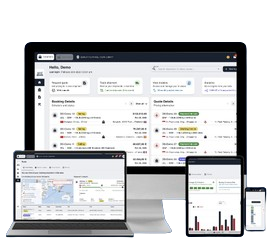
DocShipper Platform
One platform. Your entire supply chain
Sourcing, freight, customs & documents — all centralised, all visible, 24/7.
Conclusion
Business Performance Measurement transforms logistics operations from reactive firefighting to strategic optimization. Implementing structured BPM frameworks enables businesses to identify inefficiencies, reduce costs, and enhance competitive positioning in global markets.
Need expert guidance on implementing performance measurement systems for your international shipments? Contact DocShipper for customized logistics solutions that integrate advanced BPM capabilities.
📚 Quiz
Test Your Knowledge: Business Performance Measurement (BPM)
Q1. What best describes Business Performance Measurement (BPM)?
Q2. A logistics manager says: "Our KPIs are our BPM system." Is this statement correct?
Q3. A European automotive supplier is experiencing recurring customs clearance delays. Which BPM-driven action would most directly address this issue?
🎯 Your Result
📞 Free Quote in 24hFAQ | Business Performance Measurement (BPM): Definition, Calculation & Concrete Examples
BPM is the comprehensive framework for measuring organizational performance, while KPIs are specific quantifiable metrics within that framework. BPM encompasses methodology, tools, and strategic alignment; KPIs are the individual data points tracked.
Operational metrics require daily or weekly monitoring (delivery rates, transit times), while strategic indicators are typically reviewed monthly or quarterly. Critical metrics should trigger real-time alerts when thresholds are breached.
On-time delivery rate, freight cost per unit, customs clearance time, documentation accuracy, and carrier performance scores represent core metrics. The specific priority depends on business model and customer requirements.
Absolutely. Even simplified BPM tracking 5-7 core metrics provides significant competitive advantages. Cloud-based tools and integrated platforms make sophisticated measurement accessible to businesses of all sizes.
BPM tracks documentation accuracy, classification errors, and clearance times, identifying recurring compliance issues. This data enables proactive corrections, reducing delays, penalties, and audit risks.
Basic BPM requires ERP or TMS systems with reporting capabilities. Advanced implementations leverage IoT sensors, AI analytics, blockchain for transparency, and integrated dashboard platforms for real-time visibility.
Initial insights typically emerge within 4-6 weeks of data collection. Measurable operational improvements generally appear within 3-6 months, with strategic benefits accruing over 12-18 months as processes mature.
Industry standards vary by sector, but 95%+ is considered excellent for international logistics. Ocean freight typically ranges 85-92%, while air freight achieves 93-97%. Context matters—complexity and distance affect benchmarks.
BPM tracks carbon emissions per shipment, packaging waste, modal efficiency, and route optimization. These metrics enable evidence-based sustainability strategies and compliance with environmental regulations like EU Green Deal requirements.
Selective sharing builds collaborative relationships. Carrier scorecards, joint KPIs, and performance-based contracts align incentives. Transparency improves service quality while protecting commercially sensitive data.
Tracking too many metrics without prioritization, measuring activities instead of outcomes, ignoring data quality, lacking executive sponsorship, and failing to link metrics to actionable improvements represent frequent pitfalls.
BPM provides early warning indicators for disruptions—carrier performance degradation, port congestion trends, supplier reliability scores. These metrics enable proactive risk mitigation and contingency planning before issues escalate.
Need Help with
Logistics or Sourcing ?
First, we secure the right products from the right suppliers at the right price by managing the sourcing process from start to finish. Then, we simplify your shipping experience - from pickup to final delivery - ensuring any product, anywhere, is delivered at highly competitive prices.


Fill the Form
Prefer email? Send us your inquiry, and we’ll get back to you as soon as possible.
Contact us




