


In short ⚡
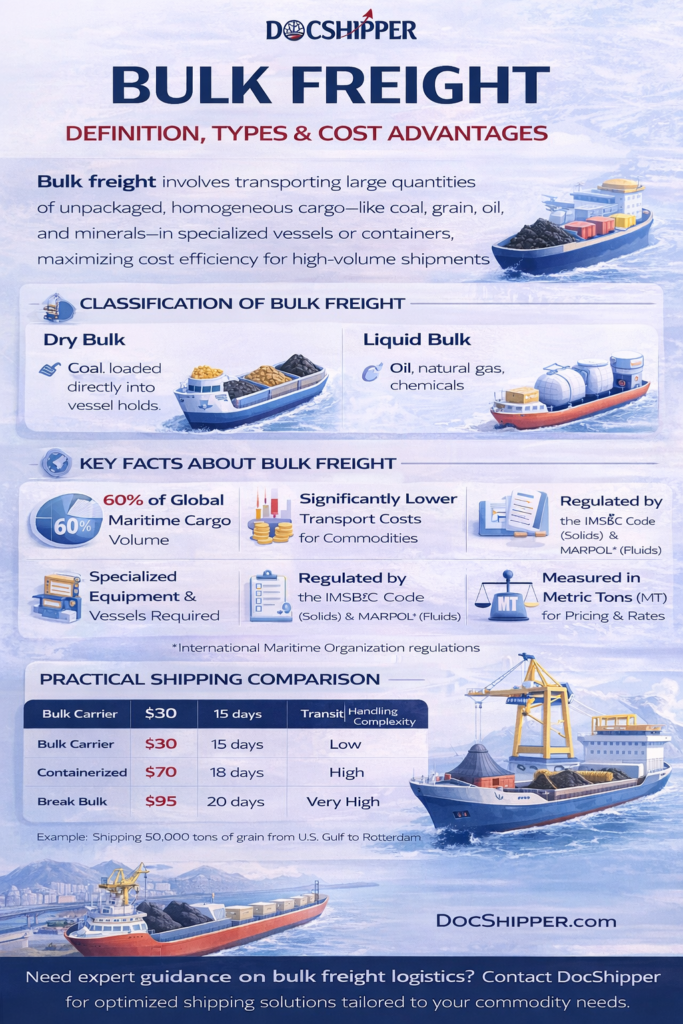
Bulk freight refers to the transportation of large quantities of homogeneous cargo that is shipped unpackaged in a single lot. This cargo type, including commodities like coal, grain, oil, and minerals, is loaded directly into specialized vessels or containers without individual packaging, optimizing cost-efficiency for high-volume shipments.
Introduction
Many businesses struggle to understand when bulk freight becomes the most economical shipping solution. The confusion often stems from misidentifying cargo types or underestimating the infrastructure requirements for bulk handling.
In international trade, bulk freight represents approximately 60% of global maritime cargo volume. This shipping method fundamentally shapes commodity pricing, port infrastructure development, and supply chain strategies for raw material industries.
Key characteristics of bulk freight include:
- Cargo shipped in loose, unpackaged form directly into vessel holds or containers
- Homogeneous products that can be poured, pumped, or mechanically loaded
- Specialized handling equipment required at loading and discharge points
- Significantly lower per-unit transportation costs compared to containerized cargo
- Two primary categories: dry bulk (solids) and liquid bulk (fluids)
Technical Classifications & Transportation Methods
Bulk freight divides into two fundamental categories based on physical state. Dry bulk encompasses solid materials like iron ore, coal, grain, cement, and sugar. Liquid bulk includes petroleum products, chemicals, liquefied natural gas (LNG), and edible oils.
The shipping industry employs specialized vessels designed for each bulk type. Bulk carriers (bulkers) transport dry commodities with cargo holds featuring reinforced floors and hatches for mechanical loading. Tankers carry liquid bulk in segregated compartments with sophisticated pumping systems and temperature controls.
Loading methods vary significantly by cargo type. Gravity discharge systems use conveyor belts and chutes for materials like grain and coal. Pneumatic systems employ compressed air for cement and flour. Grab cranes handle ores and aggregates, while pipeline systems transfer liquid bulk directly from shore facilities to vessel tanks.
International maritime regulations govern bulk freight safety. The International Maritime Organization (IMO) publishes the International Maritime Solid Bulk Cargoes Code (IMSBC Code), which classifies materials by hazard level and establishes handling procedures.
Stowage factor calculations determine vessel capacity utilization. This metric expresses the volume (cubic meters or feet) occupied by one ton of cargo. Coal typically has a stowage factor of 1.3-1.5 m³/ton, while iron ore ranges from 0.3-0.4 m³/ton, directly impacting freight rates and vessel selection.
At DocShipper, we analyze stowage factors and cargo characteristics to recommend optimal vessel types and routing, ensuring cost-effective bulk freight solutions that comply with international safety standards.
Practical Examples & Industry Data
Understanding bulk freight economics requires examining real-world scenarios. A grain exporter shipping 50,000 tons of wheat from the U.S. Gulf to Rotterdam faces specific considerations that illustrate bulk freight advantages.
| Shipping Method | Cost per Ton | Transit Time | Handling Complexity |
|---|---|---|---|
| Bulk Carrier | $28-32 | 12-14 days | Low (direct loading) |
| Containerized | $65-75 | 14-16 days | High (bagging, stuffing) |
| Break Bulk (Bagged) | $85-95 | 18-22 days | Very High (manual handling) |
The data demonstrates that bulk shipping reduces transportation costs by approximately 55-65% compared to containerization for large-volume homogeneous cargo.
Case Study: Iron Ore Shipment from Brazil to China
A mining company exports 180,000 tons of iron ore quarterly. Using a Capesize bulk carrier (typical capacity: 180,000+ DWT), the operation achieves:
- Freight rate: $18-22 per ton (versus $45-50 containerized)
- Loading time: 36-48 hours using conveyor systems
- Discharge time: 48-60 hours with grab cranes
- Annual cost savings: approximately $4.8-5.6 million
- Carbon footprint reduction: 30-35% per ton-mile compared to multiple container vessels
According to the United Nations Conference on Trade and Development (UNCTAD), global dry bulk trade reached 5.2 billion tons in 2023, with iron ore (1.5 billion tons), coal (1.2 billion tons), and grain (540 million tons) dominating volumes.
Liquid Bulk Example: Crude Oil Transport
A petroleum company shipping 2 million barrels (approximately 270,000 tons) from the Middle East to Europe employs a Very Large Crude Carrier (VLCC). Key metrics include:
- Worldscale rate application (standardized pricing system)
- Typical voyage cost: $3.5-4.2 million (including port fees)
- Per-barrel cost: $1.75-2.10
- Pipeline loading/discharge: 12-16 hours each operation
Conclusion
Bulk freight remains the backbone of global commodity trade, offering unmatched cost-efficiency for high-volume shipments of homogeneous materials. Understanding vessel types, handling methods, and regulatory requirements enables businesses to optimize their supply chain strategies.
Need expert guidance on bulk freight logistics? Contact DocShipper for tailored solutions that streamline your commodity shipping operations.
📚 Quiz
Test Your Knowledge: Bulk Freight
Q1 — Which of the following best defines bulk freight?
Q2 — A logistics manager claims that bulk freight and break bulk shipping are the same thing, since neither uses standard containers. Is this correct?
Q3 — A mining company needs to ship 180,000 tons of iron ore from Brazil to China. Which shipping approach is most appropriate?
🎯 Your Result
📞 Free Quote in 24hFAQ | Bulk Freight: Definition, Types & Practical Examples
Typically, shipments exceeding 1,000 tons justify bulk freight methods, though economic viability depends on cargo type, route, and handling infrastructure. Smaller volumes may use bulk containers (flexitanks, bulk bags).
Yes, certain perishables like grain, sugar, and refrigerated liquid bulk (fruit juices, oils) ship in bulk using temperature-controlled vessels or specialized containers with climate management systems.
Liquid bulk rates often include premiums for specialized tanker requirements, safety equipment, and cleaning between cargoes. Dry bulk rates primarily reflect vessel availability and commodity-specific handling costs.
Key risks include cargo liquefaction (moisture-induced shifting), contamination from previous cargoes, weight distribution issues causing vessel instability, and commodity price volatility during transit affecting cargo value.
Yes, port tariffs vary based on cargo type, handling method, and infrastructure usage. Bulk terminals typically charge per ton plus wharfage fees, with additional costs for specialized services like fumigation or sampling.
Dry bulk uses weight (metric tons) verified by draft surveys measuring vessel displacement before and after loading. Liquid bulk employs shore tank measurements or vessel tank calibrations with temperature/density corrections.
Essential documents include the Bill of Lading, cargo manifest, Certificate of Origin, quality/quantity certificates, fumigation certificates (for agricultural products), and Material Safety Data Sheets (MSDS) for hazardous materials.
Yes, bulk cargo insurance considers specific risks like cargo shifting, contamination, and total loss scenarios. Premiums reflect commodity value volatility, vessel age, and route-specific hazards like piracy or weather patterns.
Demurrage refers to charges incurred when loading or discharge operations exceed agreed laytime (free time). Rates typically range from $10,000-$50,000 daily depending on vessel size and market conditions.
IMO 2020 sulfur cap regulations mandate low-sulfur fuel or scrubber systems. Ballast water management conventions require treatment systems to prevent invasive species transfer. Compliance costs impact freight rates by 5-15%.
Handysize vessels (10,000-35,000 DWT) access smaller ports and handle diverse cargoes. Capesize carriers (150,000+ DWT) transport major bulk commodities on high-volume routes but require deep-water terminals and specialized infrastructure.
The industry is adopting LNG-powered vessels, optimizing voyage routes using weather routing software, implementing slow steaming (reduced speeds), and exploring alternative fuels like ammonia and hydrogen to reduce carbon emissions.
Need Help with
Logistics or Sourcing ?
First, we secure the right products from the right suppliers at the right price by managing the sourcing process from start to finish. Then, we simplify your shipping experience - from pickup to final delivery - ensuring any product, anywhere, is delivered at highly competitive prices.


Fill the Form
Prefer email? Send us your inquiry, and we’ll get back to you as soon as possible.
Contact us




