


In short ⚡
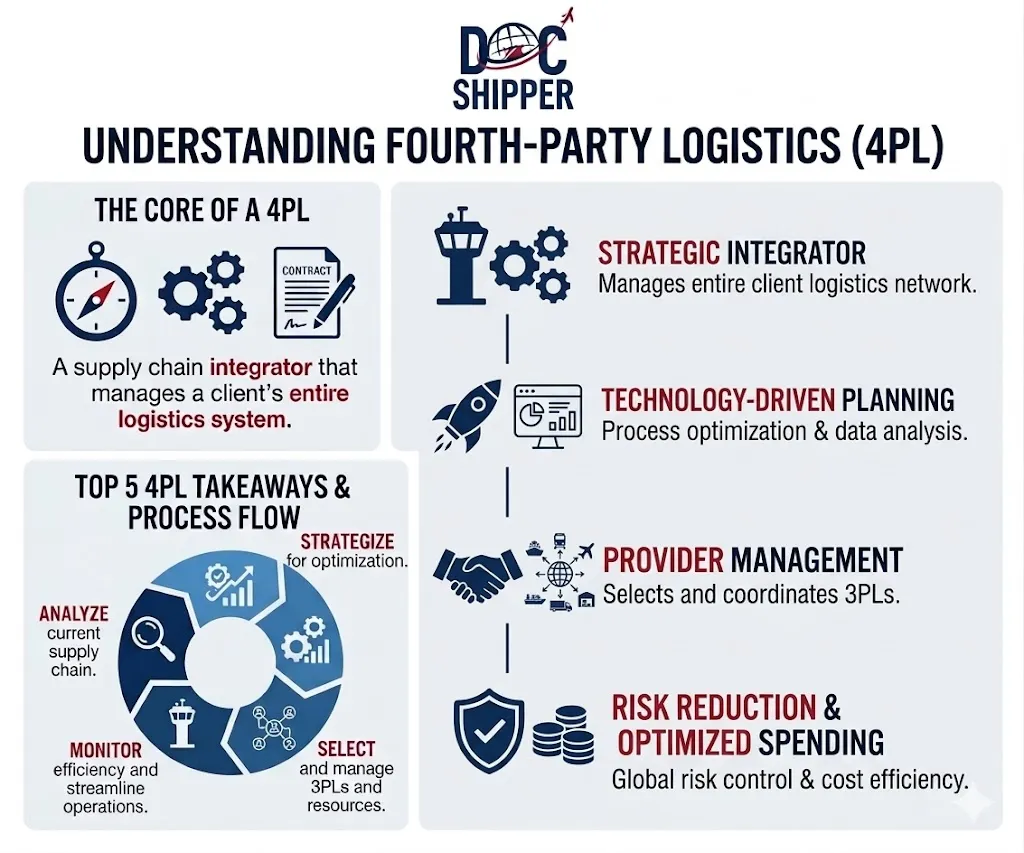
Fourth Party Logistics (4PL) is an advanced supply chain management model where a single integrator manages all logistics resources, technology, and infrastructure on behalf of a client. Unlike traditional providers, a 4PL acts as a strategic partner orchestrating multiple 3PLs, carriers, and service providers to optimize the entire supply chain end-to-end.Introduction
Many businesses struggle to coordinate multiple logistics providers, technology platforms, and global distribution networks simultaneously. This fragmentation leads to inefficiencies, visibility gaps, and increased operational costs. The Fourth Party Logistics model emerged as a solution to this complexity.
In international trade, where shipments cross multiple borders and involve various stakeholders, coordinating freight forwarders, customs brokers, warehouses, and carriers becomes exponentially complex. A 4PL provider assumes full responsibility for designing, implementing, and managing the entire logistics ecosystem.
Key characteristics of Fourth Party Logistics include:
- Supply Chain Integration: Manages all logistics activities through a single point of contact
- Vendor Neutrality: Selects best-in-class service providers without ownership bias
- Technology Enablement: Implements unified platforms for visibility and control
- Strategic Partnership: Focuses on long-term optimization rather than transactional execution
- Performance Accountability: Takes responsibility for end-to-end supply chain outcomes
Strategic Orchestration & Expertise
The fundamental difference between 3PL and 4PL lies in operational scope. While a Third Party Logistics provider executes specific logistics functions like warehousing or transportation, a Fourth Party Logistics provider designs and manages the entire supply chain strategy.
A 4PL operates as a control tower, maintaining complete visibility across all logistics operations. This includes real-time tracking, predictive analytics, and proactive exception management. The provider doesn’t necessarily own physical assets like trucks or warehouses. Instead, they leverage their network to select optimal partners for each component.
The vendor-neutral approach represents a critical advantage. Unlike traditional logistics providers who might favor their own services, a true 4PL prioritizes client outcomes. They evaluate carriers, freight forwarders, and service providers based purely on performance, cost, and reliability metrics.
From a regulatory perspective, 4PL providers must navigate complex compliance frameworks across multiple jurisdictions. According to World Trade Organization guidelines, logistics service providers operating internationally must ensure adherence to customs regulations, trade compliance standards, and data privacy laws.
Technology integration forms the backbone of 4PL operations. Providers implement unified technology platforms that connect disparate systems—ERP, WMS, TMS, and customs software—into a cohesive ecosystem. This integration enables seamless data flow and eliminates information silos that plague traditional multi-vendor logistics arrangements.
At DocShipper, we collaborate with 4PL providers to ensure seamless coordination across international shipments. Our expertise in customs clearance and freight forwarding complements the strategic oversight that 4PL partners provide, creating a comprehensive supply chain solution for our clients.
Concrete Examples & Data
Understanding 4PL through practical scenarios illustrates its transformative impact on supply chain performance. Consider a multinational electronics manufacturer shipping components from Southeast Asia to assembly plants in Europe and North America.
Traditional Multi-Provider Model:
- Company manages 12 different freight forwarders across regions
- Uses 5 separate warehouse operators in destination countries
- Coordinates with 8 customs brokers for compliance
- Operates 4 disconnected tracking systems
- Average shipment visibility gap: 72 hours
4PL-Managed Model:
- Single point of contact coordinates entire network
- Optimized carrier selection reduces routes by 23%
- Unified platform provides real-time visibility
- Consolidated reporting across all shipments
- Total logistics cost reduction: 18-22%
| Metric | Traditional 3PL Model | 4PL Model | Improvement |
|---|---|---|---|
| Vendor Management Hours/Month | 180 hours | 45 hours | 75% reduction |
| Supply Chain Visibility | 65% | 96% | +31 points |
| On-Time Delivery Rate | 87% | 94% | +7 points |
| Average Claims Processing Time | 14 days | 4 days | 71% faster |
| Technology Integration Cost | $450K initial | Included in service | Eliminated upfront cost |
Another concrete example involves a pharmaceutical company requiring temperature-controlled distribution across 40 countries. The 4PL provider implemented a network of qualified cold chain partners, established monitoring protocols, and created compliance documentation systems that reduced regulatory violations by 89% while cutting distribution costs by 16%.
The financial impact extends beyond direct cost savings. Companies implementing 4PL solutions typically experience inventory optimization that reduces working capital requirements by 12-18%. By centralizing demand forecasting and distribution planning, 4PL providers minimize stock-outs while reducing excess inventory.
Conclusion
Fourth Party Logistics represents a strategic evolution in supply chain management, transforming fragmented operations into integrated, optimized ecosystems. For companies managing complex international logistics, the 4PL model delivers visibility, efficiency, and strategic value that traditional approaches cannot match.
Need guidance on optimizing your international supply chain? Contact DocShipper to discuss how our logistics expertise can complement your strategic objectives.
📚 Quiz
Test Your Knowledge: Fourth Party Logistics (4PL)
What is the primary role of a Fourth Party Logistics (4PL) provider?
What is a key characteristic that distinguishes 4PL providers from traditional 3PL providers?
A company managing 12 freight forwarders, 5 warehouse operators, and experiencing 72-hour visibility gaps considers switching to 4PL. What primary benefit should they expect?
🎯 Your Result
📞 Free Personalized QuoteFAQ | Fourth Party Logistics (4PL): Definition, Role & Concrete Examples
A 3PL executes specific logistics functions like transportation or warehousing, while a 4PL manages the entire supply chain strategy, coordinating multiple service providers and acting as a single point of accountability. The 4PL focuses on integration and optimization rather than asset-based services.
Typically no. True 4PL providers operate as non-asset-based integrators, maintaining vendor neutrality by selecting best-in-class partners without ownership bias. This independence allows them to optimize provider selection based solely on performance and client needs rather than internal capacity utilization.
4PL fees typically range from 3-8% of total logistics spend, but clients generally achieve 15-25% overall cost reduction through optimization, consolidation, and improved efficiency. The model shifts from transactional costs to strategic investment with measurable ROI across the supply chain.
Complex, global supply chains in pharmaceuticals, automotive, consumer electronics, and retail see the greatest benefit. Companies with multiple SKUs, diverse distribution channels, strict compliance requirements, or rapid growth patterns gain significant advantage from the strategic oversight and integration that 4PL provides.
Full implementation ranges from 6 to 18 months depending on supply chain complexity, geographic scope, and technology integration requirements. Phased approaches allow companies to realize benefits incrementally while gradually transitioning from existing provider relationships to the integrated 4PL model.
Yes, though historically focused on enterprise clients, 4PL providers increasingly offer scaled solutions for SMEs. Companies with international operations, multi-channel distribution, or rapid growth benefit from 4PL even at smaller volumes, particularly when logistics complexity exceeds internal management capabilities.
Fourth Party Logistics providers deploy integrated control towers combining Transportation Management Systems (TMS), Warehouse Management Systems (WMS), visibility platforms, and analytics tools. Cloud-based solutions enable real-time tracking, predictive analytics, and seamless integration with client ERP systems and partner networks.
By consolidating data from multiple carriers, warehouses, and customs systems into unified platforms, 4PL providers create end-to-end transparency. Real-time tracking, exception alerts, and predictive analytics enable proactive management rather than reactive problem-solving, typically improving visibility from 60-70% to 95%+ across the network.
Effective 4PL providers assess current relationships objectively, retaining high-performing partners while identifying improvement opportunities. The transition preserves valuable vendor relationships within the new integrated framework, though underperforming providers may be replaced with alternatives that better serve strategic objectives.
Fourth Party Logistics providers coordinate customs brokers, maintain compliance documentation systems, and ensure adherence to international trade regulations. They implement standardized processes across jurisdictions, manage classification and valuation, and leverage trade agreements to optimize duty payments while maintaining full regulatory compliance.
Key performance indicators include on-time delivery rates, total logistics cost as percentage of revenue, order accuracy, inventory turnover, claims frequency and resolution time, supply chain visibility scores, and exception management speed. Strategic metrics like customer satisfaction and working capital optimization provide comprehensive performance assessment.
Absolutely. E-commerce companies benefit significantly from 4PL due to complex multi-channel fulfillment, international expansion requirements, and need for scalable infrastructure. The 4PL model provides flexibility to manage peak seasons, optimize returns logistics, and integrate marketplace platforms without massive capital investment in physical infrastructure.
Need Help with
Logistics or Sourcing ?
First, we secure the right products from the right suppliers at the right price by managing the sourcing process from start to finish. Then, we simplify your shipping experience - from pickup to final delivery - ensuring any product, anywhere, is delivered at highly competitive prices.


Fill the Form
Prefer email? Send us your inquiry, and we’ll get back to you as soon as possible.
Contact us




:%20Definition,%20Role%20&%20Concrete%20Examples)