


In short ⚡
Free Alongside Ship (FAS) is an Incoterm requiring the seller to deliver goods alongside the vessel at the named port of shipment. The seller bears all costs and risks until goods are positioned next to the ship, after which responsibility transfers to the buyer for loading and maritime transport.Introduction
Many exporters struggle to determine exactly where their responsibility ends when shipping goods internationally. FAS creates confusion because it differs fundamentally from more common terms like FOB or CIF.
This Incoterm applies exclusively to sea and inland waterway transport. It defines the critical transfer point where costs, risks, and responsibilities shift from seller to buyer in the shipping process.
Key characteristics of FAS include:
- Port-specific delivery: Goods must reach a designated location alongside the vessel
- Pre-loading obligation: Seller handles all inland transport, export customs clearance, and positioning
- Risk transfer point: Buyer assumes all risks once goods are alongside the ship
- Loading exclusion: Unlike FOB, seller does not arrange or pay for cargo loading onto the vessel
- Maritime restriction: Cannot be used for containerized cargo at modern terminals
In-Depth Analysis & Legal Framework
The FAS Incoterm represents one of the eleven delivery terms standardized by the International Chamber of Commerce in the Incoterms 2020 rules. Its practical application requires precise understanding of both parties’ obligations.
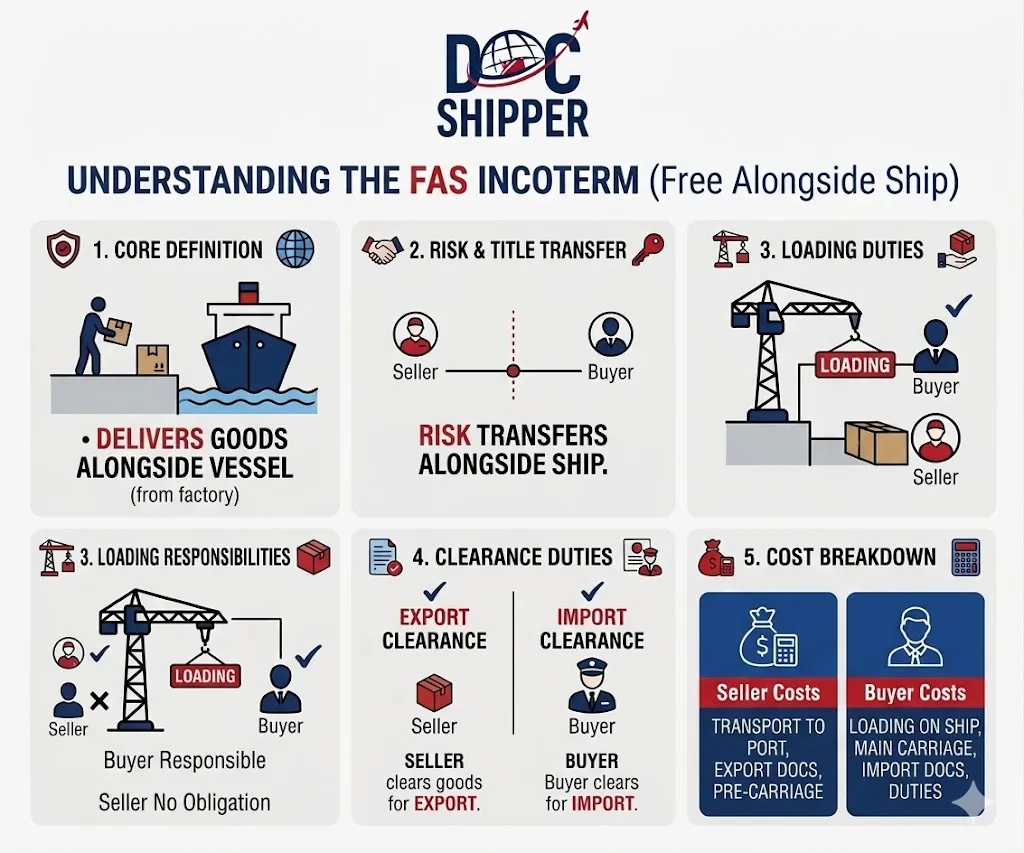
Under FAS, the seller must deliver goods alongside the nominated vessel at the named port of shipment. This means positioning cargo at the quayside or on a barge ready for the buyer’s loading operations. The seller completes delivery when goods are physically placed next to the ship.
The export clearance obligation falls entirely on the seller. This includes obtaining export licenses, completing customs documentation, and paying export duties. According to ICC Incoterms 2020, this represents a fundamental seller responsibility that cannot be transferred.
Risk transfer occurs at a specific moment: when goods are placed alongside the vessel. Before this point, the seller bears all risk of loss or damage. After positioning, the buyer assumes complete risk even if the ship hasn’t arrived or cargo hasn’t been loaded.
The loading cost allocation distinguishes FAS from FOB. The buyer must arrange and pay for all loading operations, stevedoring services, and stowage aboard the vessel. This creates potential coordination challenges at busy ports.
Insurance arrangements under FAS require careful attention. Neither party has a mandatory obligation to insure the goods, though the buyer should secure marine cargo insurance from the transfer point onward. At DocShipper, we systematically advise clients on appropriate insurance coverage aligned with their Incoterm selection to prevent costly gaps in protection.
Practical Examples & Cost Breakdown
Understanding FAS requires examining real-world applications and comparative cost structures against similar Incoterms.
Use Case: Machinery Export from Hamburg
A German manufacturer exports industrial equipment to a Brazilian buyer under FAS Hamburg terms. The seller transports machinery from the factory to Hamburg port, completes German export customs procedures, and positions the equipment on the quay alongside the designated vessel. Total seller costs: €8,500 (transport €5,200 + customs €800 + positioning €2,500). The buyer then contracts stevedores for loading (€3,200), pays ocean freight (€12,000), and handles Brazilian import clearance (€4,800).
Comparative Cost Analysis:
| Cost Element | FAS | FOB | CFR |
|---|---|---|---|
| Inland transport to port | Seller | Seller | Seller |
| Export customs clearance | Seller | Seller | Seller |
| Loading onto vessel | Buyer | Seller | Seller |
| Ocean freight | Buyer | Buyer | Seller |
| Risk transfer point | Alongside ship | On board ship | On board ship |
Modern Terminal Limitations:
FAS has become increasingly impractical at containerized terminals. Modern ports typically require one party to handle the entire terminal delivery process, making the “alongside” transfer point operationally difficult. Statistics from the World Shipping Council indicate that over 80% of general cargo now moves in containers, reducing FAS applicability to bulk cargo, heavy machinery, and project cargo shipments.
Key Practical Considerations:
- FAS works best for bulk commodities like grain, coal, or liquid cargo where loading is continuous
- Buyers must have established relationships with stevedoring companies at the loading port
- Timing coordination becomes critical since seller obligations end before buyer operations begin
- Documentation must specify the precise alongside location to avoid disputes
- Currency fluctuations between contracting and delivery can affect the buyer’s loading costs significantly
Conclusion
FAS provides a specialized solution for maritime shipments where buyers prefer controlling loading operations while sellers handle export procedures. Its declining use reflects modern containerization trends, yet it remains valuable for specific cargo types.
Need expert guidance on selecting the right Incoterm for your shipments? Contact DocShipper for personalized logistics consultation.
📚 Quiz
Test Your Knowledge: Free Alongside Ship (FAS)
1. Under FAS terms, at what point does the seller complete their delivery obligation?
2. Who is responsible for arranging and paying loading costs under FAS?
3. A textile manufacturer wants to ship containerized garments from Shanghai to Los Angeles. Is FAS the appropriate Incoterm?
🎯 Your Result
📞 Free Quote in 24hFAQ | Free Alongside Ship (FAS): Definition, Obligations & Practical Examples
The critical distinction lies in the loading responsibility. Under FAS, the seller delivers goods alongside the vessel but the buyer arranges and pays for loading. Under FOB (Free On Board), the seller must load the goods onto the vessel. This shifts both cost and risk transfer points, with FOB placing more obligations on the seller.
FAS is generally unsuitable for containerized shipments at modern terminals. Container terminals require unified handling from gate to vessel, making the "alongside ship" delivery point impractical. FAS works best for break-bulk cargo, heavy machinery, or bulk commodities loaded directly from quayside. For containers, FOB or FCA terms are more appropriate.
Terminal handling charges (THC) fall to the buyer under FAS terms. Since the seller's obligation ends when goods are positioned alongside the vessel, all subsequent costs including stevedoring, loading equipment, lashing, and terminal fees become the buyer's responsibility. This can create unexpected costs if not clearly communicated during contract negotiation.
Yes, the seller must provide sufficient notice that goods have been delivered alongside the nominated vessel. This notification allows the buyer to arrange loading operations, contract stevedores, and coordinate with shipping lines. Timely communication prevents demurrage charges and ensures smooth cargo transfer at the port.
Once the seller positions goods alongside the vessel at the agreed time, delivery is complete regardless of vessel arrival. If the ship is delayed, the buyer bears storage costs and risks at the port. The seller has no obligation to maintain custody after proper delivery. This makes FAS risky for buyers when vessel schedules are uncertain.
Absolutely. The seller must complete all export customs formalities including obtaining licenses, filing export declarations, and paying export duties or taxes. This represents a fundamental seller obligation under FAS that cannot be transferred to the buyer, even by contractual agreement contradicting the Incoterm.
No. FAS applies exclusively to sea and inland waterway transport. For air shipments, use FCA (Free Carrier). For rail or multimodal transport, FCA is also the appropriate Incoterm. Using FAS for non-maritime transport creates legal ambiguity and potential disputes over delivery obligations.
Neither party has a mandatory insurance obligation under FAS, unlike CIF or CIP terms. However, the buyer should arrange marine cargo insurance covering risks from the moment goods are placed alongside the vessel through final delivery. Many buyers extend coverage backward to factory origin for comprehensive protection.
The seller must provide proof of delivery (typically a dock receipt or warehouse receipt confirming goods were positioned alongside the vessel), commercial invoice, packing list, and export customs documentation. The seller is not responsible for obtaining the bill of lading, which is issued after loading—a buyer responsibility under FAS.
FAS creates unique payment timing challenges. Since seller obligations complete before loading, payment terms often trigger upon presentation of the dock receipt rather than the bill of lading. Buyers should structure letters of credit carefully to ensure documents match actual FAS delivery requirements rather than standard maritime documentation.
Frequent disputes include disagreements over the precise "alongside" location, responsibility for goods damaged while awaiting loading, demurrage charges when buyers delay loading operations, and allocation of port security or documentation fees. Clear contract specification of the exact delivery point and timeline expectations minimizes these conflicts.
The shift toward containerization, integrated terminal operations, and just-in-time logistics has reduced FAS practicality. Modern ports prefer single-party responsibility from gate to vessel. Additionally, the complexity of coordinating separate seller delivery and buyer loading creates operational inefficiencies that FOB or FCA terms avoid, making them preferred choices for contemporary supply chains.
Need Help with
Logistics or Sourcing ?
First, we secure the right products from the right suppliers at the right price by managing the sourcing process from start to finish. Then, we simplify your shipping experience - from pickup to final delivery - ensuring any product, anywhere, is delivered at highly competitive prices.


Fill the Form
Prefer email? Send us your inquiry, and we’ll get back to you as soon as possible.
Contact us




:%20Definition,%20Obligations%20&%20Practical%20Examples)