


In short ⚡
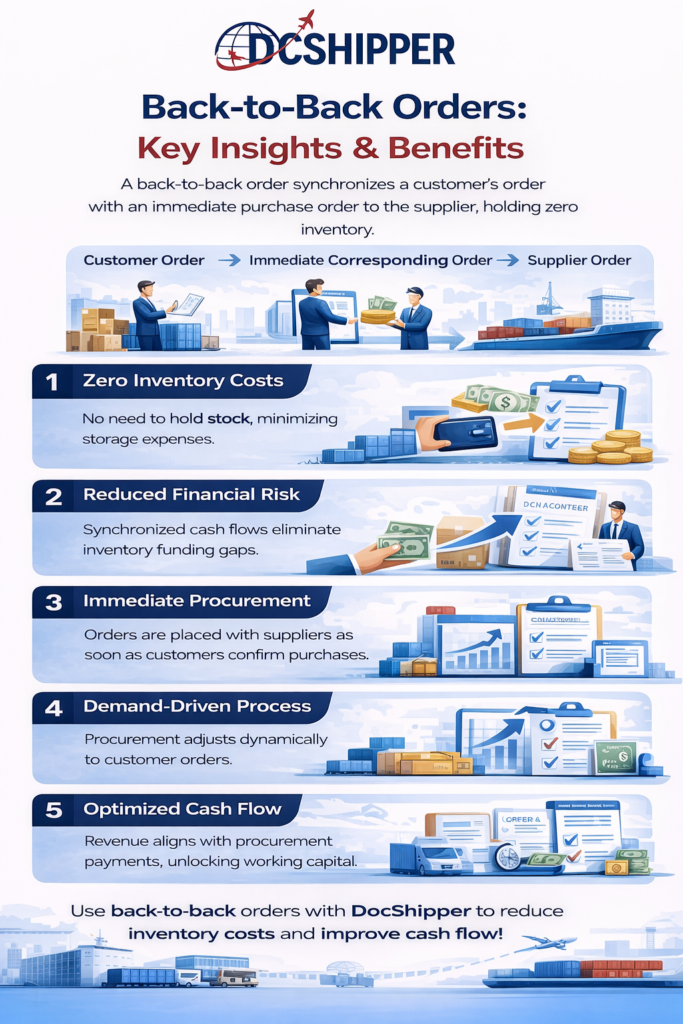
A back-to-back order is a procurement arrangement where a company receives a customer order and immediately places a corresponding purchase order with a supplier, without holding inventory. This method minimizes financial exposure and storage costs by synchronizing sales and procurement cycles in real-time.
Introduction
Many businesses struggle with inventory management: holding stock ties up capital, while stockouts lose sales. The back-to-back order model solves this dilemma by eliminating inventory risk entirely.
In international trade, this procurement strategy is particularly valuable for importers managing high-value goods, volatile demand, or limited warehouse capacity. It transforms traditional supply chain dynamics by making procurement reactive rather than predictive.
Key characteristics of back-to-back orders include:
- Zero inventory holding – goods flow directly from supplier to customer
- Matched payment terms – procurement timing aligns with sales revenue
- Risk transfer – supplier bears storage and obsolescence costs
- Lower working capital requirements – no cash locked in unsold stock
- Demand-driven procurement – orders triggered by confirmed sales only
Mechanism & Strategic Expertise
The back-to-back order process follows a precise sequence. When a customer places an order, the intermediary company immediately issues a mirror purchase order to the supplier with identical specifications. This creates a contractual chain where obligations flow through the intermediary without inventory accumulation.
From a legal perspective, back-to-back contracts require careful alignment. The delivery terms in the sales contract must allow sufficient time for the supplier to fulfill the purchase order. Any discrepancy in Incoterms, payment conditions, or quality standards creates liability exposure for the intermediary.
Financial institutions recognize back-to-back arrangements in trade finance. Banks may issue back-to-back letters of credit, where the sales LC serves as collateral for the purchase LC. According to ICC Uniform Customs and Practice (UCP 600), these instruments must be structured carefully to avoid documentary discrepancies.
The margin structure in back-to-back operations is transparent but vulnerable. Since the intermediary adds value through market access rather than inventory management, profit margins typically range from 3% to 15% depending on market complexity and service level. Currency fluctuations between order confirmation and supplier payment can erode these margins rapidly.
At DocShipper, we structure back-to-back arrangements to protect client margins by negotiating fixed-price supplier agreements with currency hedging clauses, ensuring predictable profitability even in volatile markets.
Operational risk concentrates on supplier reliability. If the supplier fails to deliver, the intermediary remains contractually obligated to the customer. Due diligence on supplier capacity, quality systems, and financial stability is non-negotiable. Many intermediaries require supplier performance bonds or escrow arrangements as protection.
Practical Examples & Data
Consider a European distributor receiving an order for 10,000 specialized electronic components from a German manufacturer. Rather than stocking inventory, the distributor immediately places a back-to-back order with a Taiwanese supplier:
| Parameter | Sales Contract (Customer) | Purchase Contract (Supplier) |
|---|---|---|
| Quantity | 10,000 units | 10,000 units |
| Price | €4.50/unit (€45,000 total) | €3.80/unit (€38,000 total) |
| Margin | €7,000 (15.6%) | |
| Delivery Terms | DDP Hamburg (60 days) | FOB Kaohsiung (45 days) |
| Payment Terms | Net 30 after delivery | 30% advance, 70% at shipment |
In this scenario, the distributor faces a cash flow challenge: supplier payment is required before customer payment. Working capital financing or extended supplier terms become critical.
Industry data reveals back-to-back orders are most prevalent in:
- Electronics – 42% of B2B transactions use this model due to rapid obsolescence
- Industrial machinery – 28% adoption for custom-configured equipment
- Pharmaceuticals – 19% for temperature-sensitive products with short shelf life
- Fashion and textiles – 31% for seasonal collections to avoid overstock
- Automotive parts – 24% for just-in-time manufacturing support
A real-world case: A UK medical equipment importer used back-to-back orders to supply NHS contracts. By eliminating £2.3 million in inventory carrying costs annually, the company improved return on capital by 18% while maintaining 99.2% on-time delivery performance.
DocShipper clients using back-to-back structures report average working capital reductions of 35-40% compared to traditional stock-and-sell models, with inventory turnover ratios improving from 4-6x to effectively infinite.
Conclusion
Back-to-back orders represent a sophisticated procurement strategy that converts inventory risk into supplier management discipline. When executed properly, this model unlocks capital, reduces storage costs, and aligns cash flows with revenue cycles.
Need expert guidance on implementing back-to-back order systems in your supply chain? Contact DocShipper for tailored logistics solutions that optimize your working capital.
📚 Quiz
Test Your Knowledge: Back-to-Back Order
Q1 — What best defines a back-to-back order in international trade?
Q2 — A common misconception about back-to-back orders is that they eliminate all financial risk for the intermediary. What is the correct interpretation?
Q3 — A UK importer receives a confirmed order from a retailer for 5,000 units of a specialized electronic component. The importer has no warehouse space and wants to minimize working capital usage. Which approach is most appropriate?
🎯 Your Result
📞 Free Quote in 24hFAQ | Back-to-Back Order: Definition, Mechanism & Practical Examples
Back-to-back orders involve the intermediary taking legal ownership and contractual responsibility, while drop shipping typically means the supplier ships directly without the intermediary assuming title. Back-to-back provides more control but greater liability.
The buyer's LC (master LC) serves as collateral for a second LC issued to the supplier (back-to-back LC). The intermediary's bank issues the second LC based on the first, with adjusted amounts reflecting the margin.
Primary risks include supplier delivery failure, quality discrepancies, currency fluctuations between contracts, and payment term mismatches creating cash flow gaps. Proper supplier vetting and contract alignment mitigate these risks.
Yes, but timing becomes critical. Perishable goods require highly reliable suppliers and expedited logistics. Many food importers use back-to-back models with air freight to minimize spoilage risk while avoiding inventory waste.
Customs authorities treat back-to-back orders as standard imports. The intermediary must be the importer of record, handling all customs declarations, duties, and compliance requirements regardless of the direct supplier-customer flow.
Margins vary by industry complexity: commodity products (3-8%), specialized equipment (10-20%), regulated goods like pharmaceuticals (15-25%). Higher margins reflect greater market expertise and regulatory navigation rather than physical handling.
The intermediary should maintain cargo insurance covering the full value of goods in transit. Since ownership transfers through the intermediary, standard supplier insurance may not protect against all loss scenarios during international shipment.
Absolutely. Professional services firms frequently use back-to-back contracts when subcontracting specialized work while maintaining client relationships. The same principles of matched obligations and margin protection apply.
This creates significant exposure. Most back-to-back arrangements include cancellation clauses with penalties matching supplier commitments. Alternatively, intermediaries negotiate flexible supplier terms or purchase cancellation insurance for high-value orders.
Mismatched payment terms can eliminate profits through financing costs. Optimal structures have customer payments arriving before supplier payments are due, creating positive cash flow. Many intermediaries use trade finance facilities to bridge timing gaps.
Yes, particularly for startups with limited capital. Back-to-back models allow small importers to compete without warehouse investments. However, strong supplier relationships and credit facilities become essential to manage payment timing challenges.
The intermediary remains liable to the customer for quality defects. Effective back-to-back contracts include quality warranties from suppliers matching customer contract terms, plus inspection protocols before shipment to prevent disputes.
Need Help with
Logistics or Sourcing ?
First, we secure the right products from the right suppliers at the right price by managing the sourcing process from start to finish. Then, we simplify your shipping experience - from pickup to final delivery - ensuring any product, anywhere, is delivered at highly competitive prices.


Fill the Form
Prefer email? Send us your inquiry, and we’ll get back to you as soon as possible.
Contact us




