


In short ⚡
Business Continuity Management (BCM) is a holistic management process that identifies potential threats to an organization and establishes frameworks to ensure resilience and rapid recovery. It encompasses risk assessment, crisis response protocols, and operational continuity strategies to minimize disruption during supply chain interruptions, natural disasters, or geopolitical events.Introduction
When a cargo ship blocks the Suez Canal or a pandemic shuts down production facilities, businesses without a Business Continuity Management strategy face devastating losses. BCM transforms reactive crisis management into proactive resilience planning.
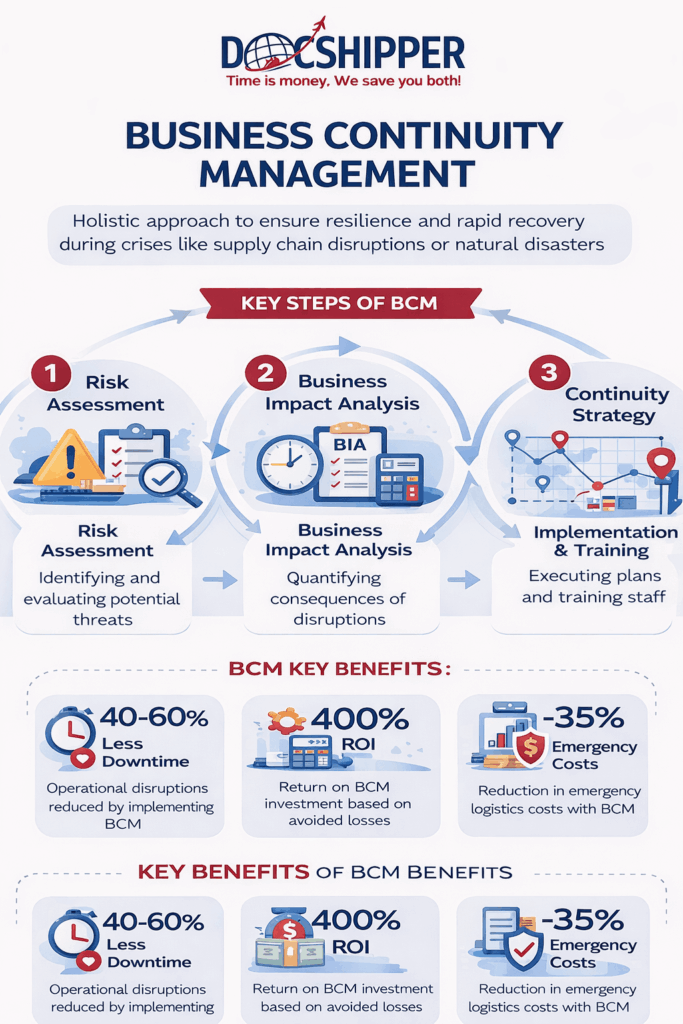
In international logistics, BCM ensures supply chains remain operational despite disruptions. Companies that implement robust BCM frameworks reduce downtime by 40-60% compared to unprepared competitors.
Key characteristics of effective BCM include:
- Risk identification: Systematic assessment of vulnerabilities across the logistics chain
- Business Impact Analysis (BIA): Quantification of disruption consequences
- Recovery strategies: Predefined protocols for resuming critical operations
- Regular testing: Simulations and drills to validate response plans
- Continuous improvement: Iterative refinement based on lessons learned
BCM Framework & Strategic Expertise
Business Continuity Management operates through structured phases aligned with international standards like ISO 22301. The framework begins with establishing organizational context and governance structures.
The Business Impact Analysis phase identifies critical functions, quantifies maximum tolerable downtime, and calculates Recovery Time Objectives (RTO) and Recovery Point Objectives (RPO). This analysis reveals which logistics operations cannot exceed specific interruption thresholds without causing irreversible damage.
Risk assessment follows, evaluating both probability and impact of threats ranging from supplier bankruptcy to port closures. Organizations categorize risks into operational, financial, reputational, and compliance dimensions.
The continuity strategy development phase creates alternative workflows, backup supplier networks, and redundant transportation routes. For freight forwarding, this might include pre-negotiated capacity with multiple carriers or diversified warehouse locations across geographies.
Implementation requires documented procedures, trained response teams, and communication protocols. At DocShipper, we integrate BCM principles into client supply chain designs, ensuring alternative routing options and supplier redundancy are embedded from the outset.
According to the ISO 22301 standard, organizations must conduct regular exercises and management reviews. These validation activities identify gaps before real crises occur, transforming theoretical plans into operational readiness.
Concrete Examples & Industry Data
Real-world BCM applications demonstrate measurable resilience improvements across logistics operations. Industry data reveals the financial impact of preparedness versus reactive approaches.
Comparative Scenario: Electronics Manufacturer
| Scenario Element | Without BCM | With BCM |
|---|---|---|
| Supplier Factory Fire | 14-day production halt, scrambling for alternatives | 2-day transition to pre-qualified backup supplier |
| Revenue Loss | $2.8M in delayed shipments | $400K in expedited freight costs |
| Customer Retention | 23% client churn due to missed deliveries | 5% churn, maintained SLA compliance |
| Recovery Timeline | 6 weeks to restore normal operations | 10 days to full operational capacity |
Use Case: Pharmaceutical Cold Chain Disruption
A pharmaceutical importer faced refrigeration equipment failure at their distribution center during a heatwave. Their BCM plan included:
- Pre-contracted backup storage: Temperature-controlled facility within 50km on standby
- Emergency protocols: Product transfer completed within 4 hours
- Regulatory compliance: Maintained FDA temperature logs throughout incident
- Financial outcome: Avoided $1.2M in spoiled inventory and regulatory penalties
- Operational impact: Zero customer delivery delays despite infrastructure failure
Industry research from the Business Continuity Institute shows companies with mature BCM programs experience 50% fewer supply chain disruptions and recover 3x faster when incidents occur. The average ROI on BCM investment reaches 400% when calculated against avoided losses.
DocShipper clients implementing our recommended BCM frameworks report 35% reduction in emergency logistics costs and improved insurance premium negotiations due to demonstrated risk management capabilities.
Conclusion
Business Continuity Management transforms logistics vulnerability into strategic advantage. Organizations that embed BCM principles into supply chain design achieve operational resilience that competitors cannot replicate during crisis periods.
Need expert guidance on implementing BCM for your international logistics operations? Contact DocShipper to develop a customized continuity strategy aligned with your supply chain complexity.
📚 Quizz
Test Your Knowledge: Business Continuity Management (BCM)
Q1 — What is the primary purpose of Business Continuity Management (BCM)?
Q2 — A logistics manager says: "We already have a disaster recovery plan for our IT systems, so our BCM is complete." Is this correct?
Q3 — A pharmaceutical importer's cold storage facility fails during a heatwave. Which outcome best reflects a company with a mature BCM plan in place?
🎯 Your Result
📞 Free Quote in 24hFAQ | Business Continuity Management (BCM): Definition, Framework & Concrete Examples
BCM encompasses the entire organization's resilience strategy, while disaster recovery focuses specifically on IT systems restoration. BCM includes operational continuity, communication protocols, and supply chain alternatives beyond technology recovery.
ISO 22301 recommends annual full-scale exercises with quarterly tabletop simulations. High-risk logistics operations should conduct testing semi-annually, adjusting frequency based on supply chain complexity and regulatory requirements.
RTO defines the maximum acceptable downtime for a critical business function. For international shipments, RTO might be 48 hours before customer SLAs are breached, guiding the urgency of recovery procedures.
Absolutely. Small operations face higher vulnerability to single-point failures. Simplified BCM frameworks focusing on supplier diversification and alternative routing provide disproportionate protection for resource-constrained businesses.
Treating BCM as a one-time project rather than continuous process, creating overly complex plans that staff cannot execute under stress, and failing to integrate BCM with existing risk management systems.
Insurers recognize mature BCM programs as risk mitigation, offering premium reductions of 10-25%. Documented continuity capabilities demonstrate lower probability of catastrophic losses, improving underwriting terms.
Digital tools enable real-time risk monitoring, automated alert systems, and cloud-based plan accessibility. However, technology supports rather than replaces strategic continuity planning and human decision-making frameworks.
No. BCM minimizes disruption impact and accelerates recovery rather than preventing all incidents. The goal is operational resilience—maintaining acceptable service levels despite unavoidable external shocks.
Initial framework development requires 3-6 months for mid-sized logistics operations. Full maturity including tested procedures and organizational culture integration typically spans 18-24 months with iterative refinement.
BIA systematically evaluates consequences of function interruptions, quantifying financial losses, regulatory penalties, and reputational damage over time. It prioritizes which operations require fastest recovery based on business-critical dependencies.
Selectively yes. Share relevant continuity expectations and communication protocols with critical suppliers and carriers. Full disclosure risks competitive intelligence leakage, but coordination points must be transparent for effective crisis response.
BCM frameworks incorporate scenario planning for trade restrictions, border closures, and sanctions. Geographic diversification strategies and alternative market access routes form core components of geopolitical resilience planning.
Need Help with
Logistics or Sourcing ?
First, we secure the right products from the right suppliers at the right price by managing the sourcing process from start to finish. Then, we simplify your shipping experience - from pickup to final delivery - ensuring any product, anywhere, is delivered at highly competitive prices.


Fill the Form
Prefer email? Send us your inquiry, and we’ll get back to you as soon as possible.
Contact us




