


In short ⚡
Capital refers to financial assets, resources, or funds used to finance business operations, investments, and growth. In international logistics, it encompasses working capital for inventory, equipment financing, and operational cash flow essential for import/export activities.
Introduction
Many businesses underestimate capital requirements when entering international trade. A shipment delayed at customs due to insufficient funds can disrupt entire supply chains.
Capital management determines whether companies can scale operations, negotiate better terms with suppliers, or maintain competitive pricing. In logistics, capital flows directly impact delivery timelines and customer satisfaction.
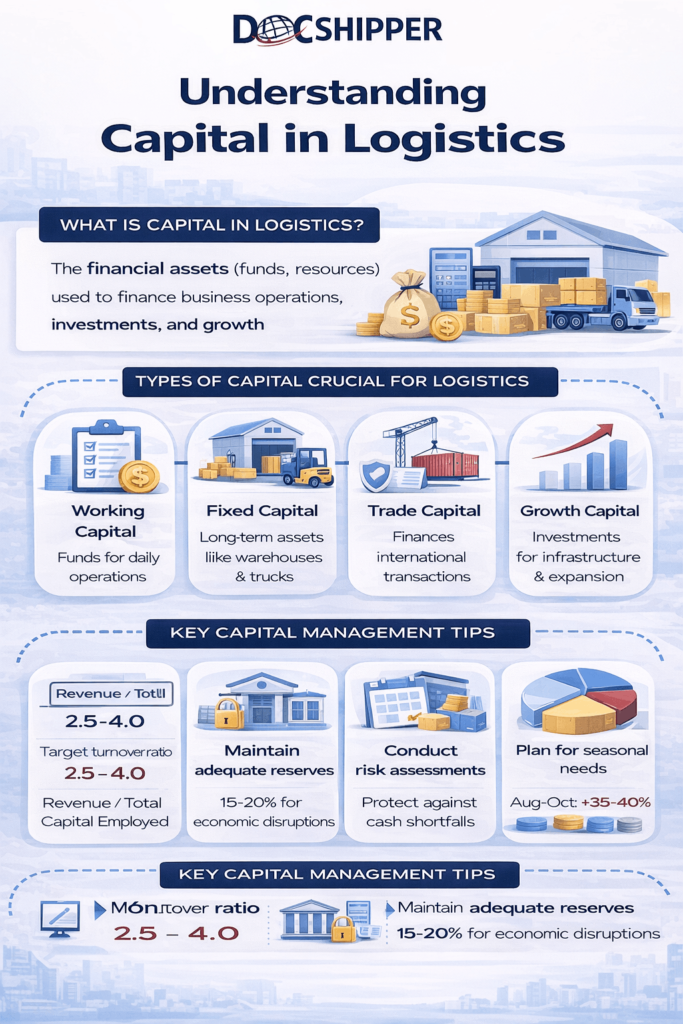
- Working capital ensures smooth day-to-day operations and inventory turnover
- Fixed capital covers long-term assets like warehouses and transportation equipment
- Trade capital finances letters of credit and payment guarantees
- Operating capital maintains cash flow during seasonal fluctuations
- Growth capital funds market expansion and infrastructure development
Capital Types & Strategic Management
Working capital represents the difference between current assets and current liabilities. For logistics operations, this typically includes inventory value, accounts receivable from shipped goods, and immediate operational expenses.
Fixed capital investments include warehouses, container fleets, and material handling equipment. These assets depreciate over time but provide long-term operational capacity. At DocShipper, we help clients optimize fixed capital allocation by analyzing utilization rates and ROI projections.
Trade finance capital enables international transactions through instruments like letters of credit. Banks require collateral equal to 100-110% of shipment value. This capital remains locked until goods clear customs and payment confirms.
The capital turnover ratio measures efficiency: Revenue ÷ Total Capital Employed. Higher ratios indicate better asset utilization. Logistics companies typically target ratios between 2.5 and 4.0, depending on service models.
According to International Monetary Fund reports, capital adequacy ratios directly correlate with supply chain resilience during economic disruptions. Companies maintaining 15-20% capital reserves weathered pandemic-related disruptions more effectively.
Practical Applications & Financial Data
Consider an importer purchasing $500,000 in electronics from Asia. The capital structure breaks down as follows:
| Capital Component | Amount (USD) | % of Total |
|---|---|---|
| Product Cost | $500,000 | 76.9% |
| Freight & Insurance | $75,000 | 11.5% |
| Customs Duties (8%) | $40,000 | 6.2% |
| Working Capital Buffer | $35,000 | 5.4% |
| Total Capital Required | $650,000 | 100% |
Capital efficiency scenario: A logistics provider with $2M in capital handles 120 shipments annually averaging $50,000 each. Total revenue: $6M. Capital turnover ratio: 3.0 (excellent efficiency).
Undercapitalization risk: A company with only $100,000 attempting a $500,000 import faces 80% capital shortfall. This forces expensive short-term financing at 12-18% annual rates, eroding profit margins by 6-9%.
Industry data shows optimal capital allocation for freight forwarders: 40% working capital, 35% fixed assets, 15% trade finance reserves, 10% growth investments. At DocShipper, we conduct capital adequacy assessments to ensure clients maintain operational flexibility.
Seasonal capital planning: Retailers importing for Q4 holidays require 35-40% additional capital from August through October. Early capital positioning secures better financing rates and supplier terms.
Conclusion
Capital management separates thriving logistics operations from those constantly fighting cash flow crises. Strategic allocation across working, fixed, and trade finance capital creates operational resilience and competitive advantage.
Need expert guidance on capital planning for your international operations? Contact DocShipper for customized financial structuring solutions.
📚 Quiz
Test Your Knowledge: Capital in Logistics
Q1 — In the context of international logistics, what does "capital" primarily refer to?
Q2 — A company has substantial capital tied up in inventory but struggles to pay its suppliers on time. What does this situation illustrate?
Q3 — An importer wants to reduce their capital requirements without losing operational capacity. Which strategy best achieves this?
🎯 Your Result
📞 Free Quote in 24hFAQ | Capital: Definition, Calculation & Concrete Examples
Most small-scale importers begin with $50,000-$100,000, covering initial inventory, shipping, and customs duties. However, requirements vary significantly based on product type and origin country.
Capital represents total financial resources available, while cash flow tracks money movement over time. A company can have substantial capital but poor cash flow if funds are tied up in inventory.
A current ratio (current assets ÷ current liabilities) above 1.5 indicates healthy liquidity. Debt-to-equity ratios below 2.0 suggest sustainable leverage levels for logistics operations.
Trade credit (payment terms from suppliers) reduces immediate capital needs but typically carries higher product costs. Most suppliers offer 30-90 day terms after establishing business relationships.
Each week of customs delay increases capital costs by 0.4-0.6% of shipment value due to storage fees, demurrage charges, and opportunity costs. Proper documentation minimizes these risks.
Capital intensity measures fixed assets relative to revenue. Asset-light models (freight forwarding) show ratios of 0.2-0.4, while asset-heavy operations (fleet ownership) range from 0.8-1.5.
Debt financing preserves ownership but requires regular payments. Equity financing provides flexibility but dilutes control. Most logistics companies use 60-70% debt, 30-40% equity for optimal structure.
Currency volatility can erode capital by 3-8% on international transactions. Hedging instruments like forward contracts lock exchange rates, protecting capital from unexpected devaluations.
Industry best practice recommends 15-20% of annual operating expenses in liquid reserves. This covers unexpected customs inspections, equipment failures, or temporary market disruptions.
Letters of credit freeze 100-110% of transaction value until shipment completion. This reduces available working capital for 30-60 days, requiring careful cash flow planning around major shipments.
ROCE measures profitability relative to capital invested: Operating Profit ÷ (Total Assets - Current Liabilities). Efficient logistics operations target ROCE above 12-15% annually.
Yes, 3PL partnerships eliminate fixed capital investments in warehouses and equipment. Companies typically reduce capital requirements by 40-60% while maintaining operational capacity through service contracts.
Need Help with
Logistics or Sourcing ?
First, we secure the right products from the right suppliers at the right price by managing the sourcing process from start to finish. Then, we simplify your shipping experience - from pickup to final delivery - ensuring any product, anywhere, is delivered at highly competitive prices.


Fill the Form
Prefer email? Send us your inquiry, and we’ll get back to you as soon as possible.
Contact us




