


In short ⚡
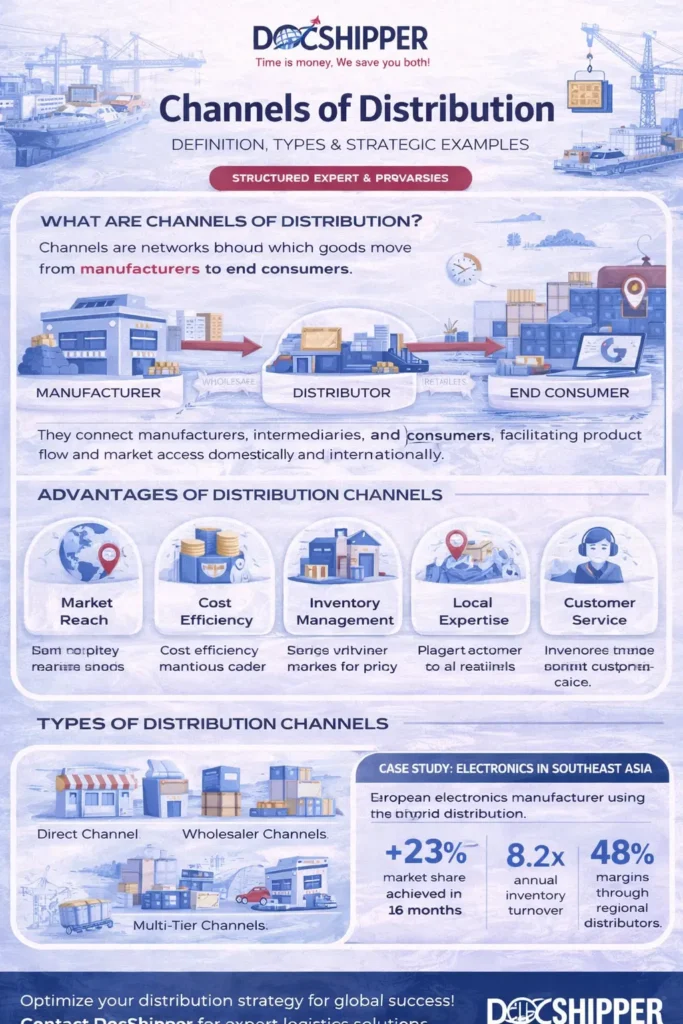
Channels of distribution are the pathways through which goods or services move from manufacturers to end consumers. These networks include intermediaries such as wholesalers, distributors, retailers, and logistics providers who facilitate product flow, ownership transfer, and market access across domestic and international markets.Introduction
Many importers struggle to understand why their products fail to reach target markets efficiently. The answer often lies in poorly designed distribution channels. In international trade, selecting the right distribution pathway directly impacts market penetration, cost structure, and competitive positioning.
Distribution channels serve as the commercial infrastructure connecting production to consumption. They determine product availability, pricing flexibility, and customer experience. For businesses engaged in cross-border trade, understanding channel dynamics is essential for regulatory compliance and supply chain optimization.
- Market reach: Channels expand geographic coverage beyond direct sales capabilities
- Cost efficiency: Intermediaries reduce transaction costs through economies of scale
- Inventory management: Distributors absorb stock-holding responsibilities and financial risk
- Local expertise: Regional partners provide market intelligence and regulatory navigation
- Customer service: Multi-tier channels enable localized support and after-sales care
Strategic Framework & Channel Architecture
Distribution channels are classified by the number of intermediary levels between manufacturer and consumer. Direct channels involve zero intermediaries, where producers sell directly through owned retail outlets or e-commerce platforms. This model maximizes margin control but requires significant capital investment in logistics and customer acquisition.
Indirect channels incorporate one or more intermediaries. Single-tier systems use either retailers or distributors exclusively. Multi-tier structures combine wholesalers, distributors, and retailers in sequence. Each additional layer reduces manufacturer control but increases market coverage and reduces operational burden.
The channel length decision depends on product characteristics, target market fragmentation, and regulatory constraints. Perishable goods require shorter channels to minimize transit time. High-value technical products often need specialized distributors with technical support capabilities. Consumer staples benefit from extensive retail networks.
Exclusive distribution grants single intermediaries territorial rights, common in luxury goods and automotive sectors. Selective distribution limits partners to maintain brand positioning while ensuring adequate coverage. Intensive distribution maximizes outlet presence, typical for mass-market consumer products.
International channels face additional complexity from customs procedures, trade agreements, and local regulations. According to the World Trade Organization, distribution restrictions remain a significant non-tariff barrier in service sectors across multiple jurisdictions.
At DocShipper, we analyze your product portfolio and target markets to recommend optimal channel structures. Our expertise in customs clearance and freight forwarding ensures seamless integration between international logistics and local distribution networks.
Practical Examples & Performance Metrics
Channel performance varies significantly by industry and geography. Consider these comparative scenarios across different distribution models:
| Channel Type | Intermediary Levels | Margin Impact | Market Coverage | Best Use Case |
|---|---|---|---|---|
| Direct E-commerce | 0 | 65-75% | Global (digital) | Niche products, high-margin items |
| Distributor Model | 1 | 45-55% | Regional | B2B equipment, industrial supplies |
| Wholesale-Retail | 2 | 30-40% | National | Consumer packaged goods |
| Agent Network | 1 (commission) | 55-65% | Targeted segments | Insurance, real estate, services |
Case Study: A European electronics manufacturer entering Southeast Asian markets faced channel selection challenges. Direct sales would preserve 70% margins but required $2.3M investment in warehousing and local staff. Partnering with regional distributors reduced margins to 48% but eliminated upfront capital requirements and accelerated market entry by 14 months.
The company selected a hybrid model: exclusive distributors for technical products requiring installation support, and selective retail partnerships for consumer electronics. This approach achieved 23% market share within 18 months while maintaining inventory turnover at 8.2 times annually.
Performance metrics for channel evaluation include distribution coverage ratio (actual outlets ÷ potential outlets), channel margin efficiency (gross profit ÷ channel costs), inventory days on hand, and order fulfillment accuracy. Leading companies benchmark these quarterly against industry standards.
Digital transformation is reshaping channel economics. Omnichannel strategies blend physical distribution with e-commerce platforms, enabling customers to research online and purchase through preferred touchpoints. This requires integrated inventory systems and coordinated pricing across channels.
DocShipper coordinates multi-modal logistics to support diverse channel strategies. Whether you need consolidated shipments to regional distributors or direct-to-consumer fulfillment, our network ensures reliable delivery and customs compliance across 150+ countries.
Conclusion
Distribution channels represent strategic decisions that shape market access, profitability, and competitive advantage. The optimal structure balances control, cost, and coverage based on product characteristics and market dynamics.
Need expert guidance on channel strategy for your international expansion? Contact DocShipper for customized logistics solutions that align with your distribution objectives.
📚 Quiz
Test Your Knowledge: Channels of Distribution
Q1 — What is the primary definition of "channels of distribution"?
Q2 — A manufacturer sells luxury watches exclusively through one authorized retailer per country. Which distribution strategy does this describe?
Q3 — A European electronics brand wants to enter Southeast Asia quickly with minimal upfront capital. Based on the case study in the article, which channel approach best fits this scenario?
🎯 Your Result
📞 Free Quote in 24hFAQ | Channels of Distribution: Definition, Types & Strategic Examples
Distribution channels focus on the commercial pathway from producer to consumer, emphasizing sales and market access. Supply chains encompass the entire production-to-delivery process, including procurement, manufacturing, and logistics. Channels are a subset of broader supply chain management.
Evaluate product complexity, target market size, capital availability, and control requirements. Direct channels suit high-margin products with concentrated customer bases. Indirect channels work better for mass-market goods requiring extensive geographic coverage and local market knowledge.
Channel conflicts occur when intermediaries compete for the same customers or when manufacturers bypass partners through direct sales. Prevent conflicts through clear territorial agreements, differentiated product offerings by channel, and transparent pricing policies that protect partner margins.
E-commerce enables direct manufacturer-to-consumer sales, potentially disintermediating traditional retailers. However, many brands adopt hybrid models where online platforms complement physical distribution, using stores for fulfillment, returns, and experiential marketing while maintaining digital convenience.
Key legal factors include exclusive distribution agreements, antitrust regulations, intellectual property protection, termination rights, and local content requirements. Many jurisdictions regulate vertical restraints and impose mandatory notice periods for distributor termination. Always consult local legal counsel.
Track metrics including market coverage percentage, sales per outlet, inventory turnover, order fulfillment rate, channel profitability (margin minus support costs), and customer satisfaction scores. Compare performance across channels and against industry benchmarks quarterly.
Selective distribution limits the number of intermediaries to maintain brand positioning and service quality. It's appropriate for premium products, technical goods requiring specialized knowledge, or brands seeking to control customer experience without the capital investment of exclusive distribution.
Customs clearance requirements influence whether to use local distributors who handle import formalities or centralized distribution with direct customs management. Products requiring certifications or inspections often benefit from local partners familiar with regulatory procedures and documentation requirements.
Channel changes are possible but require careful management. Review existing contracts for termination clauses and notice periods. Communicate transparently with current partners. Phase transitions gradually to avoid market disruption. Budget for potential legal costs and temporary sales disruption.
Logistics providers enable channel functionality through warehousing, transportation, and fulfillment services. Third-party logistics (3PL) partners can serve as quasi-distributors, managing inventory and order processing without taking ownership. They're essential for companies lacking distribution infrastructure.
New products often require intensive distribution through specialized channels with high service levels. Growth-stage products expand to broader channels. Mature products maximize coverage through intensive distribution. Declining products may consolidate to selective channels focusing on remaining profitable segments.
Reverse channels manage product returns, repairs, and recycling from consumers back through the distribution network. They're increasingly important for customer satisfaction, warranty management, and environmental compliance. Effective reverse logistics reduces costs and supports circular economy initiatives.
Need Help with
Logistics or Sourcing ?
First, we secure the right products from the right suppliers at the right price by managing the sourcing process from start to finish. Then, we simplify your shipping experience - from pickup to final delivery - ensuring any product, anywhere, is delivered at highly competitive prices.


Fill the Form
Prefer email? Send us your inquiry, and we’ll get back to you as soon as possible.
Contact us




