


In short ⚡
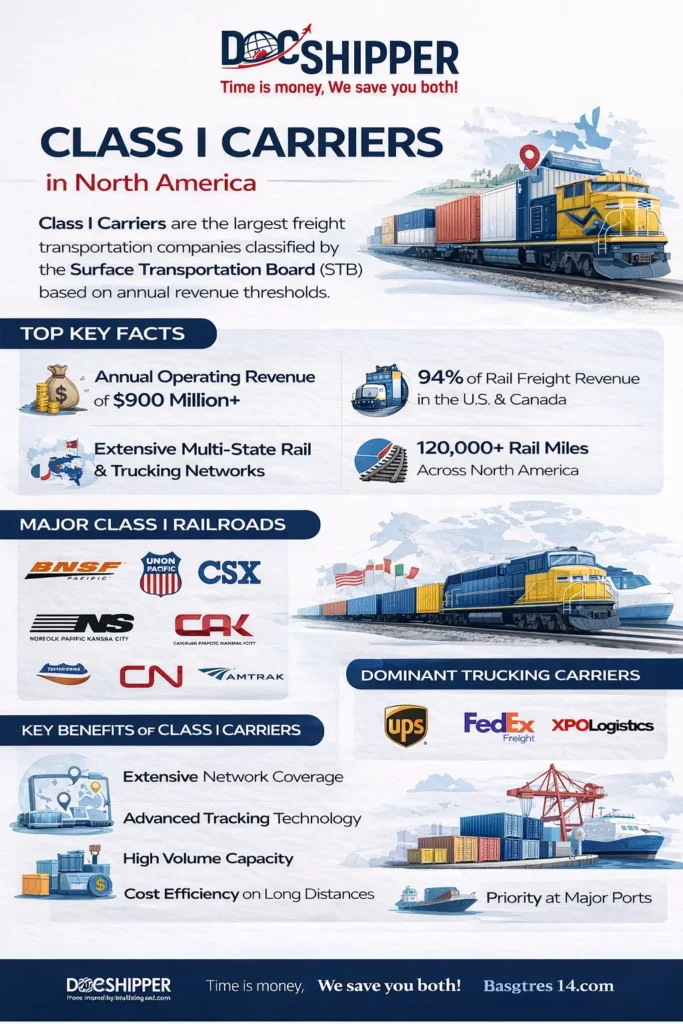
Class I Carrier refers to the largest freight transportation companies in North America, classified by the Surface Transportation Board (STB) based on annual operating revenue thresholds. These carriers dominate rail and trucking sectors, handling the majority of intercontinental freight movements across the United States, Canada, and Mexico.
Introduction
Many importers struggle to identify which freight carriers qualify as “Class I” and why this designation matters for their supply chain strategy. The classification directly impacts pricing structures, service reliability, and regulatory compliance in cross-border logistics.
Understanding Class I Carrier status is essential for businesses engaged in international trade. These carriers operate the backbone infrastructure that moves containerized goods, bulk materials, and intermodal shipments across North America.
Key characteristics include:
- Annual operating revenue exceeding federally mandated thresholds
- Extensive network coverage spanning multiple states or provinces
- Advanced tracking systems and intermodal capabilities
- Subject to enhanced regulatory oversight by the STB
- Priority access to major ports and rail terminals
Regulatory Framework & Classification Criteria
The Surface Transportation Board (STB) establishes revenue thresholds that determine Class I status. As of 2024, rail carriers must generate at least $900 million in annual operating revenue, adjusted periodically for inflation. Trucking carriers follow different criteria set by the Federal Motor Carrier Safety Administration (FMCSA).
This classification system creates three tiers: Class I (major carriers), Class II (regional carriers), and Class III (local/short-line carriers). The distinction affects reporting requirements, labor agreements, and infrastructure investment obligations.
Class I rail carriers operate under common carrier obligations, meaning they must provide service to all customers without discrimination. This regulatory framework ensures fair access to transportation networks while maintaining safety standards across the industry.
The Interstate Commerce Act governs rate-setting practices, preventing monopolistic pricing while allowing carriers to negotiate contracts. Shippers benefit from transparent tariff structures published annually by each Class I operator.
For international shipments, Class I carriers coordinate with customs brokers and border agencies to expedite clearance. At DocShipper, we work directly with Class I partners to ensure seamless documentation and compliance with CBP (Customs and Border Protection) regulations.
Additional compliance requirements include:
- Quarterly financial reporting to the STB
- Adherence to Federal Railroad Administration (FRA) safety protocols
- Environmental impact assessments for new route expansions
- Labor relations governed by the Railway Labor Act
Market Analysis & Operational Examples
Currently, seven Class I railroads operate in North America: BNSF Railway, Union Pacific, CSX Transportation, Norfolk Southern, Canadian Pacific Kansas City, Canadian National Railway, and National Railroad Passenger Corporation (Amtrak for passenger service). These entities control approximately 94% of rail freight revenue.
In the trucking sector, companies like UPS Freight, FedEx Freight, and XPO Logistics maintain Class I status through diversified service portfolios spanning LTL (less-than-truckload), truckload, and intermodal operations.
| Carrier Type | Revenue Threshold (2024) | Network Coverage | Primary Commodities |
|---|---|---|---|
| Class I Rail | $900M+ | Multi-state/National | Containers, coal, chemicals, grain |
| Class I Trucking | $100M+ | Regional to National | Consumer goods, automotive, perishables |
| Class II Rail | $40.4M–$900M | Regional | Specialized cargo, short-haul |
Use Case: An electronics importer shipping 40-foot containers from Los Angeles to Chicago would typically contract with a Class I rail carrier like BNSF. The shipment moves via double-stack intermodal trains, reducing transit time to 48 hours compared to 72 hours with regional carriers. Cost savings average 18-22% versus trucking for distances exceeding 750 miles.
Key operational advantages include:
- Fuel efficiency: Rail transport consumes 75% less fuel per ton-mile than trucks
- Capacity: A single train replaces 280 trucks, reducing highway congestion
- Reliability: On-time performance rates exceed 85% for priority freight
- Technology integration: Real-time GPS tracking and automated yard management
- Sustainability: Lower carbon emissions align with ESG (Environmental, Social, Governance) goals
DocShipper leverages partnerships with Class I carriers to optimize routing for high-volume importers, negotiating preferential rates through consolidated booking agreements.
Conclusion
Class I Carriers represent the critical infrastructure enabling efficient cross-border trade in North America. Their scale, regulatory compliance, and technological capabilities make them indispensable partners for businesses managing complex supply chains.
Need expert guidance on selecting the right carrier for your shipments? Contact DocShipper for tailored logistics solutions.
📚 Quiz
Test Your Knowledge: Class I Carrier
Q1 — What is the primary criterion used by the Surface Transportation Board (STB) to classify a rail carrier as Class I?
Q2 — A shipper requests freight service from a Class I railroad, but the carrier finds the route less profitable. Can the carrier legally refuse?
Q3 — An electronics importer needs to move 40-foot containers from Los Angeles to Chicago (over 2,000 miles). Which option best reflects the advantage of using a Class I carrier for this route?
🎯 Your Result
📞 Free Quote in 24hFAQ | Class I Carrier: Definition, Classification & Practical Examples
Class I carriers exceed $900 million in annual rail revenue or $100 million for trucking, while Class II operators fall between $40.4 million and $900 million. Class I entities handle larger volumes and operate broader networks.
The Surface Transportation Board adjusts thresholds annually based on the Railroad Cost Recovery Index (RCRI), accounting for inflation and operational cost changes in the transportation sector.
No. Common carrier obligations require Class I railroads to accept all reasonable freight requests unless safety or capacity constraints exist. Trucking carriers have more flexibility in contract negotiations.
Class I operators typically provide higher liability limits ($250,000+ per shipment) compared to smaller carriers. However, shippers should verify coverage terms in service agreements.
Intermodal combines rail and truck transport, where containers move long distances by train and complete final delivery via truck. Class I carriers dominate this segment through dedicated terminals.
They follow strict DOT and FRA regulations, requiring specialized training, placarding, and routing restrictions. Class I operators maintain dedicated hazmat response teams and tracking systems.
Rates vary by lane and volume. While base prices may be higher, Class I carriers often provide better value through faster transit, lower damage rates, and volume discounts for regular shippers.
Advanced systems include GPS tracking, automated equipment monitoring (AEI tags), predictive maintenance algorithms, and integrated TMS (Transportation Management Systems) for real-time visibility.
Their extensive networks and equipment pools provide redundancy during disruptions. Multiple routing options and priority access to terminals reduce delays compared to single-route regional carriers.
Yes, though minimum shipment requirements may apply. Freight forwarders like DocShipper consolidate smaller loads to meet Class I volume thresholds, providing cost-effective access for SMEs.
Rail transport produces 75% fewer greenhouse gas emissions per ton-mile than trucking. Class I carriers invest in fuel-efficient locomotives and idle-reduction technologies to meet sustainability targets.
They maintain partnerships with Mexican and Canadian counterparts, coordinating customs clearance through bonded facilities. Integrated systems streamline ACE (Automated Commercial Environment) filings for faster border crossings.
Need Help with
Logistics or Sourcing ?
First, we secure the right products from the right suppliers at the right price by managing the sourcing process from start to finish. Then, we simplify your shipping experience - from pickup to final delivery - ensuring any product, anywhere, is delivered at highly competitive prices.


Fill the Form
Prefer email? Send us your inquiry, and we’ll get back to you as soon as possible.
Contact us




