



In short ⚡
Class Rates are standardized freight pricing structures based on the National Motor Freight Classification (NMFC) system, which assigns shipping costs according to commodity characteristics including density, stowability, handling, and liability. These rates determine transportation costs for Less-Than-Truckload (LTL) shipments across North America.Introduction
Many shippers face unexpected freight charges because they misunderstand how class rates work. This confusion leads to budget overruns, invoice disputes, and strained carrier relationships. In international and domestic logistics, class rates form the backbone of LTL pricing across the United States and Canada.
Understanding class rates is essential for accurate cost forecasting and competitive pricing strategies. The classification system affects every stage of the supply chain, from warehouse planning to final delivery.
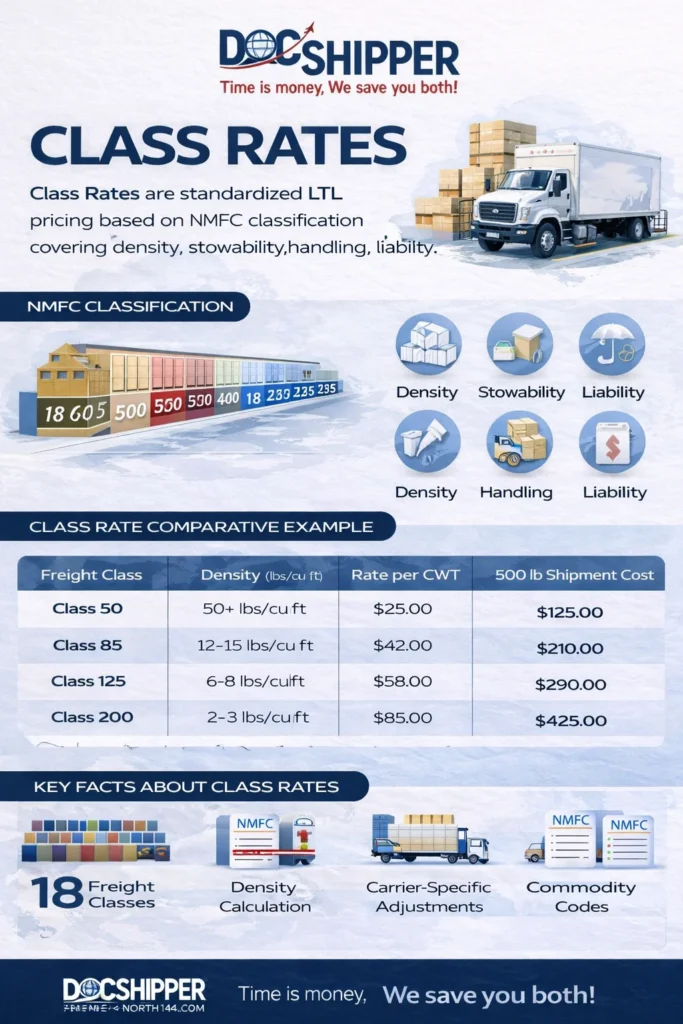
- 18 freight classes ranging from Class 50 (densest, cheapest) to Class 500 (least dense, most expensive)
- Four primary factors determine classification: density, stowability, handling requirements, and liability risk
- NMFC codes provide standardized commodity classifications maintained by the National Motor Freight Traffic Association
- Density-based pricing calculates pounds per cubic foot to determine appropriate freight class
- Carrier-specific variations allow individual carriers to adjust base class rates according to market conditions
Understanding Classification Systems & Rate Structures
The NMFC classification system divides commodities into 18 classes, each representing different shipping characteristics. Lower class numbers indicate denser, easier-to-handle freight that costs less to transport. Higher classes represent lighter, more fragile, or difficult-to-handle items commanding premium rates.
Density calculation serves as the primary determinant for most shipments. Shippers calculate density by dividing shipment weight (pounds) by volume (cubic feet). A shipment weighing 500 pounds occupying 20 cubic feet has a density of 25 pounds per cubic foot, typically falling into Class 85 or 92.5.
Stowability considerations address how efficiently freight fits into trailers alongside other shipments. Irregularly shaped items, hazardous materials requiring separation, or excessive length reduce stowability and increase freight class regardless of density.
Handling requirements impact classification when shipments need special equipment, extra labor, or careful manipulation. Fragile electronics, refrigerated goods, or items requiring liftgates automatically receive higher classifications due to increased carrier liability and operational complexity.
Liability factors account for theft risk, damage susceptibility, and cargo value. High-value electronics, pharmaceuticals, or perishable goods carry elevated classifications because carriers assume greater financial risk during transportation.
At DocShipper, we systematically verify freight classifications before booking shipments, ensuring accurate quotes and preventing costly reclassification penalties at destination. Our expertise helps clients optimize packaging strategies to achieve lower freight classes when possible.
For authoritative classification guidance, the National Motor Freight Traffic Association maintains the official NMFC database and publishes regular updates affecting class rate structures.
Practical Examples & Cost Calculations
Understanding how class rates translate into actual shipping costs requires examining real-world scenarios. Carriers apply base rates per hundredweight (CWT) that vary by freight class, origin, destination, and service level.
Comparative Class Rate Example
| Freight Class | Density (lbs/cu ft) | Rate per CWT | 500 lb Shipment Cost |
|---|---|---|---|
| Class 50 | 50+ lbs/cu ft | $25.00 | $125.00 |
| Class 85 | 12-15 lbs/cu ft | $42.00 | $210.00 |
| Class 125 | 6-8 lbs/cu ft | $58.00 | $290.00 |
| Class 200 | 2-3 lbs/cu ft | $85.00 | $425.00 |
Real-World Use Case: Electronics Shipment
A manufacturer ships computer monitors from California to New York. Each pallet contains 20 monitors weighing 400 pounds total, occupying 50 cubic feet of space.
Density calculation: 400 lbs ÷ 50 cu ft = 8 lbs/cu ft, placing the shipment in Class 125. At a carrier rate of $58 per CWT over 2,800 miles, the base freight charge equals $232 (4 CWT × $58). Additional fuel surcharges (typically 20-25%) and accessorial fees bring the total to approximately $295.
By optimizing packaging to reduce cubic footage to 35 cubic feet, density increases to 11.4 lbs/cu ft, potentially reclassifying the shipment to Class 92.5 with rates around $48 per CWT. This packaging adjustment saves $40 per shipment—$10,400 annually for weekly shipments.
Key Cost Factors
- Distance-based pricing: Longer routes command higher per-CWT rates regardless of freight class
- Accessorial charges: Liftgate service, residential delivery, or inside delivery add $75-$150 per occurrence
- Minimum charges: Most carriers enforce $100-$150 minimum freight charges for small LTL shipments
- Dimensional weight rules: Extremely low-density shipments may trigger dimensional pricing exceeding standard class rates
- Seasonal fluctuations: Peak shipping seasons (Q4) typically see 15-30% rate increases across all classes
DocShipper leverages established carrier relationships and volume commitments to secure preferential class rates below published tariffs, delivering consistent savings for our international and domestic shipping clients.
Conclusion
Mastering class rates enables shippers to forecast transportation costs accurately, optimize packaging strategies, and negotiate better carrier agreements. Understanding the interplay between density, handling, and liability transforms freight classification from a confusing obstacle into a strategic advantage.
Need expert guidance on freight classification and rate optimization? Contact DocShipper for customized logistics solutions that reduce your shipping costs while maintaining service quality.
📚 Quizz
Test Your Knowledge: Class Rates
Q1 — What does a Class Rate primarily determine in LTL freight shipping?
Q2 — A shipper believes that fuel surcharges are already included in the published class rate. Is this correct?
Q3 — A shipment weighs 400 lbs and occupies 50 cubic feet. A packaging redesign reduces the volume to 35 cubic feet with the same weight. What is the most likely outcome?
🎯 Your Result
📞 Free Quote in 24hFAQ | Class Rates: Definition, Calculation & Practical Examples
Class rates follow standardized NMFC classifications, while Freight All Kinds (FAK) rates apply a single negotiated class to all shipments regardless of actual commodity classification, simplifying billing for high-volume shippers.
Carriers conduct dimensional inspections and weight verification at terminals. Discrepancies trigger reclassification and additional charges based on corrected class rates, often including penalty fees for misclassification.
Yes, carriers may reclassify shipments if inspection reveals incorrect dimensions, weight, or commodity descriptions. Shippers receive revised invoices reflecting actual freight class and associated rate adjustments.
Individual carriers adjust base NMFC rates according to operational costs, service territories, equipment availability, and competitive positioning. Regional carriers often offer lower rates than national networks for specific lanes.
Many NMFC codes include sub-classes distinguishing between product variations within the same commodity category. Sub-classifications account for packaging differences, value ranges, or specific handling requirements affecting freight class assignment.
Some carriers use pure density pricing instead of traditional class rates, calculating charges solely on pounds per cubic foot without NMFC classifications. This approach simplifies pricing but may not account for handling or liability factors.
Yes, shippers with consistent volume can negotiate discounted class rates or FAK agreements. Carriers offer percentage discounts off published tariffs or flat rates per class based on annual shipping commitments.
Bill of lading entries, NMFC code references, density calculations with dimensions and weight, commodity descriptions, and photographs of packaged freight all serve as supporting documentation for classification decisions.
International ocean and air freight use different classification systems. However, domestic LTL portions of international shipments moving within North America follow standard NMFC class rate structures for trucking segments.
Shippers can dispute reclassifications by providing documentation supporting original class assignment. The National Motor Freight Traffic Association offers classification review services for contested determinations.
No, class rates represent base transportation charges. Carriers add fuel surcharges as separate line items, typically calculated as percentages of base freight charges and adjusted weekly based on diesel fuel price indexes.
Reducing cubic footage through tighter packaging, eliminating void fill, or using custom-sized containers increases density. Higher density often results in lower freight classifications and reduced per-CWT rates, generating significant cost savings.
Need Help with
Logistics or Sourcing ?
First, we secure the right products from the right suppliers at the right price by managing the sourcing process from start to finish. Then, we simplify your shipping experience - from pickup to final delivery - ensuring any product, anywhere, is delivered at highly competitive prices.


Fill the Form
Prefer email? Send us your inquiry, and we’ll get back to you as soon as possible.
Contact us




