


In short ⚡
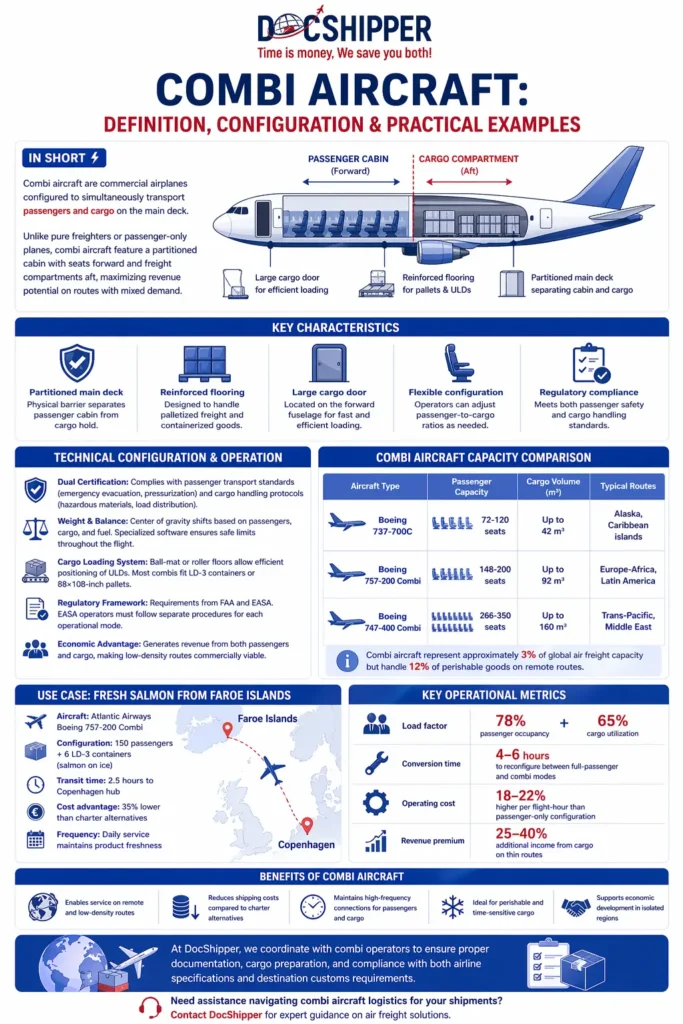
Combi aircraft are commercial airplanes configured to simultaneously transport passengers and cargo on the main deck. Unlike pure freighters or passenger-only planes, combi aircraft feature a partitioned cabin with seats forward and freight compartments aft, maximizing revenue potential on routes with mixed demand.Introduction
Many shippers struggle to find cost-effective air freight solutions on low-density routes where dedicated freighters are uneconomical. This gap creates delays and inflated shipping costs, particularly for time-sensitive cargo in remote regions.
Combi aircraft address this challenge by offering dual-purpose capacity. Airlines can serve passenger demand while simultaneously providing cargo space, making routes commercially viable that would otherwise be unprofitable.
Key characteristics of combi aircraft include:
- Partitioned main deck separating passenger cabin from cargo hold
- Reinforced flooring to handle palletized freight and containerized goods
- Large cargo door on the forward fuselage for efficient loading
- Flexible configuration allowing operators to adjust passenger-to-cargo ratios
- Regulatory compliance meeting both passenger safety and cargo handling standards
Technical Configuration & Operational Expertise
The defining feature of combi aircraft is the physical barrier installed on the main deck. This Class C cargo compartment partition must meet stringent fire suppression and structural requirements outlined by aviation authorities like the FAA and EASA.
The cargo loading system typically includes ball-mat or roller conveyor floors, enabling ground crews to position Unit Load Devices (ULDs) efficiently. Most combi configurations accommodate standard LD-3 containers or 88×108-inch pallets, depending on aircraft type.
From a regulatory perspective, combi operations require dual certification. The aircraft must comply with passenger transport standards (emergency evacuation, cabin pressurization) while also meeting cargo handling protocols (hazardous materials segregation, load distribution). According to EASA regulations, operators must maintain separate procedures for each operational mode.
Weight and balance calculations become more complex in combi configurations. The center of gravity shifts based on passenger load, cargo weight, and fuel consumption. Flight crews use specialized software to ensure the aircraft remains within safe operating limits throughout the flight.
At DocShipper, we coordinate with combi operators to ensure proper documentation and cargo preparation. Our team verifies that shipments meet both airline specifications and destination customs requirements, preventing costly delays at origin or arrival airports.
The economic advantage of combi aircraft becomes apparent on thin routes. Airlines can maintain passenger service frequency while generating additional revenue from cargo holds. This dual-income stream often determines whether a route remains operational, particularly in markets with seasonal demand fluctuations.
Practical Examples & Industry Data
Combi aircraft serve critical roles in specific geographic and operational contexts. Understanding real-world applications helps shippers identify when this transport mode offers the best value.
Comparative Capacity Analysis
| Aircraft Type | Passenger Capacity | Cargo Volume (m³) | Typical Routes |
|---|---|---|---|
| Boeing 737-700C | 72-120 seats | Up to 42 m³ | Alaska, Caribbean islands |
| Boeing 757-200 Combi | 148-200 seats | Up to 92 m³ | Europe-Africa, Latin America |
| Boeing 747-400 Combi | 266-350 seats | Up to 160 m³ | Trans-Pacific, Middle East |
Use Case: Fresh Produce from Remote Islands
A seafood exporter in the Faroe Islands ships 8 tons of fresh salmon to European markets weekly. Dedicated freighters don’t serve the route due to insufficient cargo volume. The solution:
- Aircraft: Atlantic Airways Boeing 757-200 Combi
- Configuration: 150 passengers + 6 LD-3 containers (salmon on ice)
- Transit time: 2.5 hours to Copenhagen hub
- Cost advantage: 35% lower than charter alternatives
- Frequency: Daily service maintains product freshness
Industry Data Points
According to Boeing’s 2023 World Air Cargo Forecast, combi aircraft represent approximately 3% of global air freight capacity but handle 12% of perishable goods on remote routes. The disparity highlights their strategic importance in niche markets.
Key operational metrics include:
- Load factor: Average 78% passenger occupancy + 65% cargo utilization
- Conversion time: 4-6 hours to reconfigure between full-passenger and combi modes
- Operating cost: 18-22% higher per flight-hour than passenger-only configuration
- Revenue premium: 25-40% additional income from cargo on thin routes
DocShipper regularly books space on combi flights for clients shipping to destinations like Iceland, Greenland, and Pacific island nations. We handle the complex documentation required for mixed-load aircraft, ensuring compliance with both passenger and cargo regulations.
Conclusion
Combi aircraft provide essential connectivity for markets where dedicated freighters or passenger-only services prove uneconomical. Their dual-purpose design maximizes revenue while maintaining service frequency on low-density routes.
Need assistance navigating combi aircraft logistics for your shipments? Contact DocShipper for expert guidance on air freight solutions.
📚 Quiz
Test Your Knowledge: Combi Aircraft
Q1 — What best defines a combi aircraft?
Q2 — A logistics manager assumes that combi aircraft follow the same regulatory framework as pure freighters, since they carry cargo. Is this correct?
Q3 — A seafood exporter needs to ship 8 tons of fresh salmon weekly from a remote island to European markets. Dedicated freighters don't serve the route. Which solution best fits this scenario?
🎯 Your Result
📞 Free Quote in 24hFAQ | Combi Aircraft: Definition, Configuration & Practical Examples
Combi aircraft carry passengers and cargo on the main deck simultaneously, separated by a physical barrier. Pure freighters dedicate the entire main deck to cargo, offering higher freight capacity but no passenger service.
Major operators include Alaska Airlines (Boeing 737-700C), Lufthansa Cargo (select routes), and several regional carriers in Africa, South America, and the Pacific. The fleet has declined since the 1990s as dedicated freighters became more economical.
Yes, but with strict limitations. Dangerous goods must comply with IATA regulations for passenger aircraft, which are more restrictive than all-cargo flights. Certain hazard classes are prohibited entirely on combi configurations.
Combi cargo rates typically fall between belly cargo and dedicated freighter costs. The premium reflects guaranteed space and priority handling, whereas belly cargo competes with passenger baggage for limited volume.
Time-sensitive, high-value goods like pharmaceuticals, electronics, and perishables perform well. The frequent service and direct routing minimize transit times compared to connecting through cargo hubs.
No major manufacturers currently produce new combi aircraft. Boeing ended 747 Combi production in the 1990s. Existing combi fleets consist of converted older models or purpose-built aircraft from previous decades.
Most operators require 48-72 hours' notice for cargo bookings on combi flights. This allows time for weight-and-balance calculations and ensures proper documentation. Last-minute bookings may be possible if space remains available.
Typical limits range from 150-300 kg per piece, depending on aircraft type and loading equipment. Heavier items require special handling equipment and may incur surcharges. Always confirm restrictions with the operating carrier.
Most combi cargo holds are not climate-controlled. Shippers of temperature-sensitive goods must use insulated containers or active cooling units. Some operators offer limited cool-chain capacity on specific routes.
Standard cargo insurance applies, typically covering loss or damage up to declared value. Policies follow the same terms as dedicated freighter shipments. Verify coverage limits with your insurance provider before shipping high-value goods.
Most airlines provide basic tracking through air waybill numbers. Advanced real-time tracking depends on the carrier's systems. Some operators offer GPS-enabled tracking for premium shipments on combi routes.
Cargo is typically rebooked on the next available combi or passenger flight with belly cargo capacity. Airlines prioritize passenger rebooking, which may delay cargo transfers. Shippers should build buffer time into critical delivery schedules.
Need Help with
Logistics or Sourcing ?
First, we secure the right products from the right suppliers at the right price by managing the sourcing process from start to finish. Then, we simplify your shipping experience - from pickup to final delivery - ensuring any product, anywhere, is delivered at highly competitive prices.


Fill the Form
Prefer email? Send us your inquiry, and we’ll get back to you as soon as possible.
Contact us




