


In short ⚡
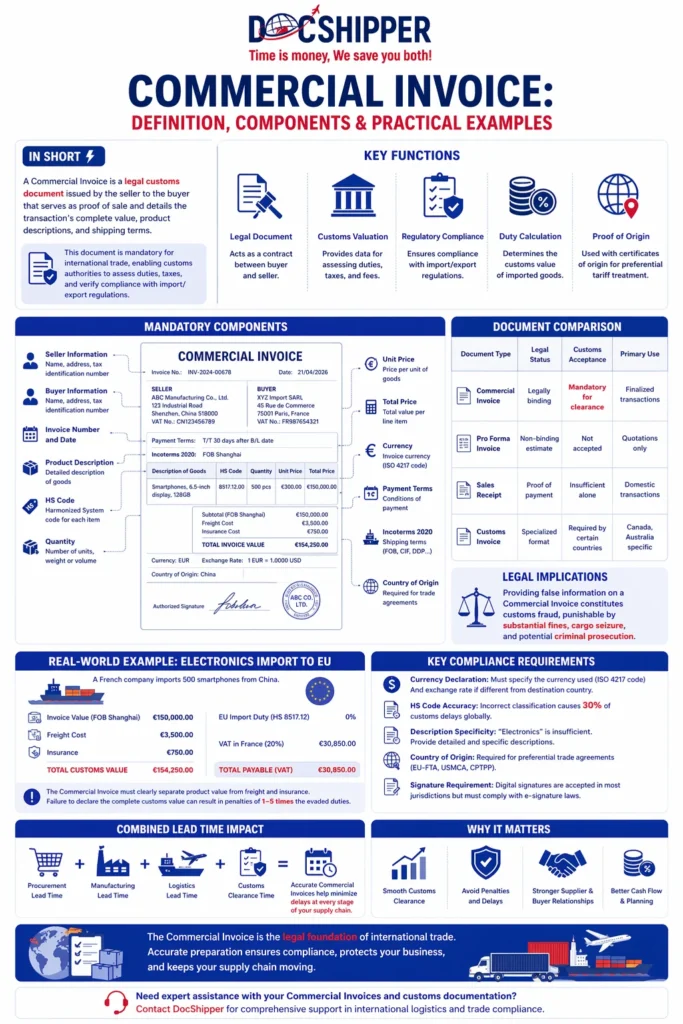
A Commercial Invoice is a legal customs document issued by the seller to the buyer that serves as proof of sale and details the transaction's complete value, product descriptions, and shipping terms. This document is mandatory for international trade, enabling customs authorities to assess duties, taxes, and verify compliance with import/export regulations.
Introduction
One of the most common errors in international shipping occurs when businesses confuse a Commercial Invoice with a simple sales receipt. This confusion can lead to customs delays, financial penalties, and shipment rejections at borders.
The Commercial Invoice is the cornerstone document in global trade. It serves multiple critical functions: it acts as a contract between buyer and seller, provides customs authorities with valuation data, and establishes the legal foundation for calculating import duties and taxes.
Key characteristics of a Commercial Invoice include:
- Legal binding document recognized by customs authorities worldwide
- Detailed product information including HS codes, quantities, and unit values
- Complete transaction terms covering Incoterms, payment conditions, and shipping details
- Basis for duty calculation determining the customs value of imported goods
- Proof of origin when combined with certificates of origin for preferential tariff treatment
In-Depth Analysis & Regulatory Framework
The Commercial Invoice must comply with international standards established by the World Customs Organization (WCO) and specific national customs regulations. Unlike pro forma invoices used for quotations, the Commercial Invoice represents a finalized, legally binding transaction.
Mandatory information elements include the seller’s and buyer’s complete details (names, addresses, tax identification numbers), invoice number and date, detailed product descriptions with corresponding Harmonized System (HS) codes, quantities, unit prices, total value, currency, shipping terms (Incoterms 2020), and payment conditions.
The valuation principle follows the WTO Customs Valuation Agreement, which requires the invoice to reflect the actual transaction value. Any discounts, rebates, or additional charges (freight, insurance) must be clearly itemized to ensure accurate duty assessment.
Legal implications are significant: providing false information on a Commercial Invoice constitutes customs fraud, punishable by substantial fines, cargo seizure, and potential criminal prosecution. Customs authorities cross-reference invoice data with shipping documents, packing lists, and certificates of origin to detect inconsistencies.
The documentary credit requirement in Letter of Credit transactions mandates that the Commercial Invoice matches exactly with the L/C terms. Banks will reject documents with discrepancies, causing payment delays and additional banking fees.
At DocShipper, we systematically verify all Commercial Invoices against customs requirements and shipping documentation to prevent clearance issues and ensure regulatory compliance across all jurisdictions.
Practical Examples & Data
Understanding how Commercial Invoices function in real-world scenarios helps businesses avoid costly mistakes and optimize customs clearance processes.
Comparative Analysis: Document Types
| Document Type | Legal Status | Customs Acceptance | Primary Use |
|---|---|---|---|
| Commercial Invoice | Legally binding | Mandatory for clearance | Finalized transactions |
| Pro Forma Invoice | Non-binding estimate | Not accepted | Quotations only |
| Sales Receipt | Proof of payment | Insufficient alone | Domestic transactions |
| Customs Invoice | Specialized format | Required by certain countries | Canada, Australia specific |
Case Study: Electronics Import to European Union
Scenario: A French company imports 500 smartphones from China valued at €150,000.
- Invoice Value: €150,000 (FOB Shanghai)
- Freight Cost: €3,500 (must be added to customs value)
- Insurance: €750 (must be added to customs value)
- Total Customs Value: €154,250
- EU Import Duty (smartphones – HS 8517.12): 0% (suspended duty)
- VAT (20% in France): €30,850
The Commercial Invoice must clearly separate the product value from freight and insurance. Failure to declare the complete customs value can result in penalties equal to 1-5 times the evaded duties.
Key Data Points for Compliance
- Currency declaration: Must specify the currency used (ISO 4217 code) and exchange rate if different from destination country
- Country of origin: Required for preferential trade agreements (EU-FTA, USMCA, CPTPP)
- HS Code accuracy: Incorrect classification causes 30% of customs delays globally
- Description specificity: “Electronics” is insufficient; “Lithium-ion battery smartphones, 6.5-inch display” meets requirements
- Signature requirement: Digital signatures are accepted in most jurisdictions but must comply with e-signature laws
Conclusion
The Commercial Invoice is not merely administrative paperwork—it is the legal foundation of international trade transactions. Accurate preparation ensures smooth customs clearance, compliance with international regulations, and protection against financial penalties.
Need expert assistance with your Commercial Invoices and customs documentation? Contact DocShipper for comprehensive support in international logistics and trade compliance.
📚 Quiz
Test Your Knowledge: Commercial Invoice
1. What is the primary legal purpose of a Commercial Invoice in international trade?
2. A French importer receives goods from China with an FOB value of €150,000. Freight costs €3,500 and insurance costs €750. What is the correct customs value to declare on the Commercial Invoice?
3. A logistics manager prepares a shipment of electronic goods and writes "Electronics" as the product description on the Commercial Invoice. Is this acceptable for customs clearance?
🎯 Your Result
📞 Free Quote in 24hFAQ | Commercial Invoice: Definition, Components & Practical Examples
A Commercial Invoice is a legally binding document for completed sales, while a Pro Forma Invoice is a preliminary quotation without legal obligation. Only Commercial Invoices are accepted by customs authorities for clearance.
While most countries accept standard Commercial Invoices, some nations like Canada and Australia require specific customs invoice formats with additional fields. Always verify destination country requirements before shipping.
Undervaluing goods can result in customs fraud charges, penalties ranging from 100-500% of evaded duties, cargo seizure, and potential criminal prosecution. Overvaluing may cause unnecessary duty payments.
While not always legally mandatory, including accurate HS codes (Harmonized System classification) significantly accelerates customs clearance and reduces the risk of misclassification penalties.
Show the full price per unit, then itemize discounts separately. The final customs value must reflect the actual transaction price after legitimate deductions, clearly documented to avoid valuation disputes.
Yes, but you must clearly state the currency used (USD, EUR, GBP, etc.) and the exchange rate if conversion is needed for customs purposes. Some countries require invoices in their local currency.
Most customs authorities accept electronic signatures compliant with e-signature legislation (EU eIDAS, US ESIGN Act). However, some countries still require wet signatures for specific high-value or regulated goods.
The applicable Incoterm (FOB, CIF, DDP, etc.) must be clearly stated as it determines who bears shipping costs, insurance, and customs duties—directly affecting the customs value calculation.
Most countries require businesses to keep Commercial Invoices for 5-10 years for tax audits and customs verification purposes. Digital archiving is acceptable if it meets legal storage standards.
Post-clearance amendments are possible through customs rectification procedures, but they require formal applications, supporting documentation, and may trigger audits. It's always preferable to ensure accuracy before submission.
Thresholds vary by country (EU: €150, US: $800, UK: £135). Below these de minimis values, simplified documentation may suffice, but a Commercial Invoice remains best practice for traceability.
The Commercial Invoice, combined with certificates of origin, enables preferential duty rates under FTAs (USMCA, EU-FTAs, CPTPP). It must contain origin declarations and meet specific FTA documentation requirements.
Need Help with
Logistics or Sourcing ?
First, we secure the right products from the right suppliers at the right price by managing the sourcing process from start to finish. Then, we simplify your shipping experience - from pickup to final delivery - ensuring any product, anywhere, is delivered at highly competitive prices.


Fill the Form
Prefer email? Send us your inquiry, and we’ll get back to you as soon as possible.
Contact us




