In Short ⚡
A Switch Bill of Lading is a type of bill of lading used in international trade that allows the transfer of ownership or control of goods to a new party. Issued by the carrier at the original consignee’s request, it contains standard shipment details plus the new party’s information, enabling legal transfer without moving the goods.International trade involves the movement of goods across borders, and proper documentation is crucial to ensure a smooth and legal shipping process.
One of the essential documents in international shipping is the bill of lading, which serves as a contract between the carrier and the shipper, detailing the type, quantity, and destination of the goods being shipped.
Among the different types of bills of lading used in international trade, the Switch Bill of Lading is crucial, as it facilitates the transfer of ownership or control of the goods to a third party.
What is a Switch Bill of Lading?
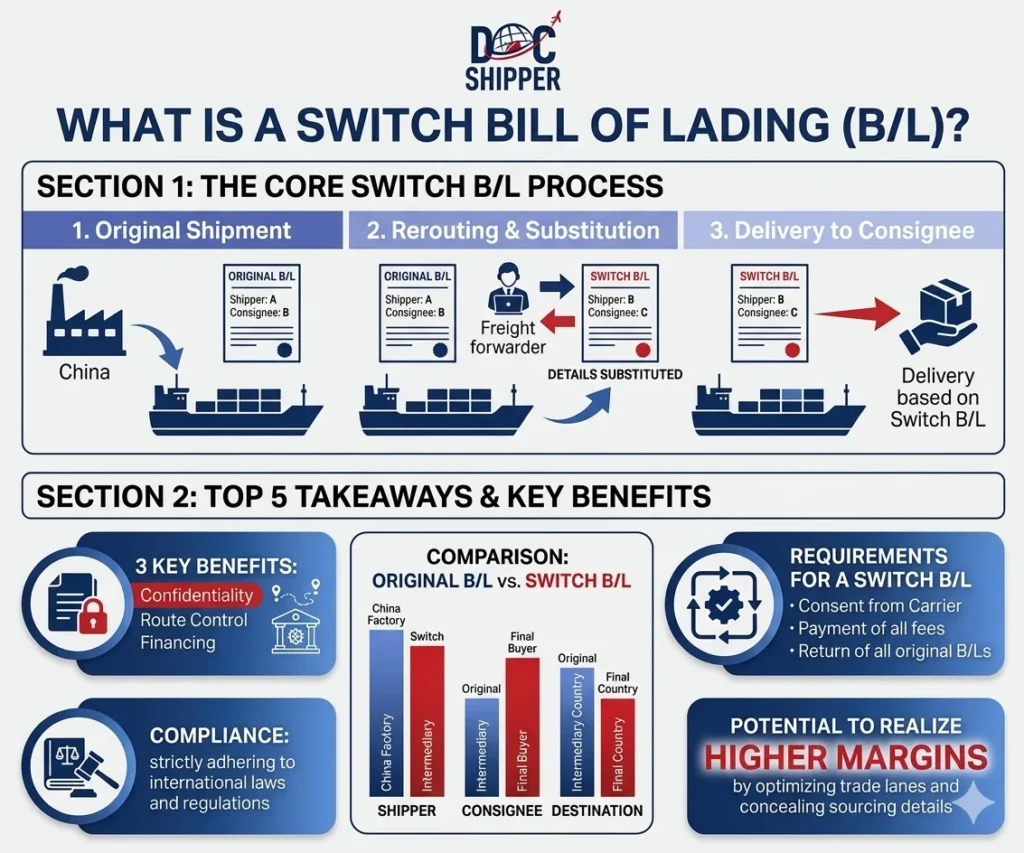
A Switch Bill of Lading is a type of bill of lading used in international trade that allows for the transfer of rights to the goods to a new party. It is typically used in situations where the original consignee of the goods wants to transfer ownership or control of t

The Switch Bill of Lading contains all the information that a standard bill of lading would have, such as details about the goods being shipped, the name of the consignee, and the destination of the goods. However, it also includes information about the new party to whom the rights to the
goods are being transferred.
To issue a Switch Bill of Lading, the original consignee must first notify the carrier that they want to transfer the rights to the goods to
a new party. The carrier will then issue a Switch Bill of Lading to the new party, which effectively transfers ownership or control of the goods to
them. The new party can then use the Switch Bill of Lading to take possession of the goods at the port of arrival.
It’s important to note that the use of a Switch Bill of Lading can have legal implications, as it effectively transfers ownership or control of the
goods to a new party. Therefore, it’s essential to understand the use and implications of this document to ensure a smooth and legal transfer of goods.
The Benefits of Using a Switch Bill of Lading
Using a Switch Bill of Lading can provide many benefits for both the shipper and the consignee, such as:
1: You get more ownership flexibility

One of the main benefits of using a Switch Bill of Lading is the flexibility it provides in terms of ownership. The original consignee of the goods
can transfer ownership to a new party without the need for the physical transfer of the
goods.
This can be useful in situations where the original consignee no longer needs the goods or wants to sell the goods to someone else.
2: You get your efficiency increased
The use of a Switch Bill of Lading can also increase efficiency in the shipping process. The process can be achieved more quickly and with less paperwork. This can save time and money for all parties involved.
3: You can reduce the risks of damage or loss
Another benefit of using a Switch Bill of Lading is that it can reduce the risk of damage or loss to the goods.
DocShipper Tip
DocShipper Advice: Simplify Your Shipping Process with DocShipper’s Switch Bill of Lading Service. Let us handle all your documentation needs, ensuring a smooth and hassle-free shipping experience. Contact us today to learn more.
The Risks Associated with Using a Switch Bill of Lading
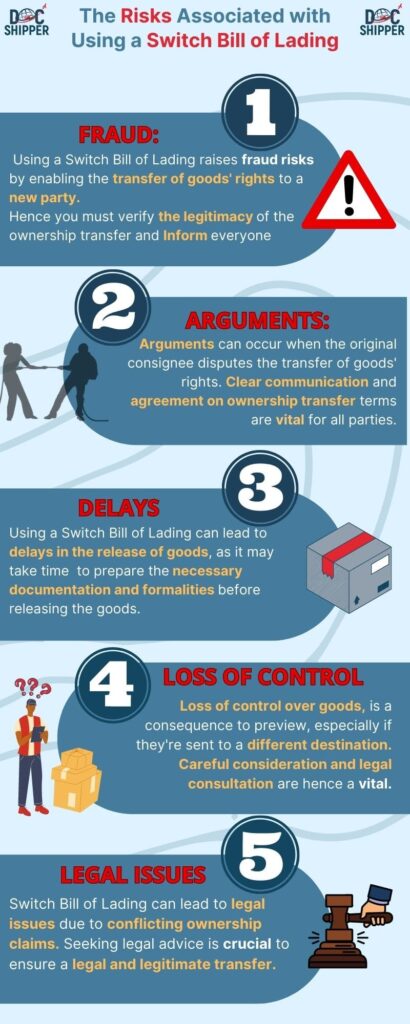
While the Switch Bill of Lading can provide many benefits, there are also some risks associated with its use.
DocShipper Alert
DocShipper Alert: Ensure Safe Transport with Us! Our Switch Bill of Lading service guarantees secure transportation for your goods. Trust our reliable carriers to handle your shipments with care. Contact us now to learn more!
When Should You Use a Switch Bill of Lading?
There are several situations where using a Switch Bill of Lading can be beneficial for all parties involved in the shipment. Here are some scenarios where you might consider using a Switch Bill of Lading:
1: When the original consignee wants to transfer the rights to the goods.
In some cases, the original consignee may want to transfer the rights to the goods to another party, such as a buyer or a bank. This can happen when the consignee decides not to take delivery of the goods or when they need to use the goods as collateral for a loan. In such a scenario, a Switch Bill of Lading can be used to transfer the rights to the goods to the new party.
2: When the buyer wants to keep the details of the supplier confidential
In some cases, the buyer may want to keep the details of the supplier confidential from the carrier or the consignee. This can happen when the buyer wants to maintain a competitive advantage or when the supplier is worried about their intellectual property being compromised. In such a scenario, a Switch Bill of Lading can be used to keep the details of the supplier confidential.
DocShipper Platform
Optimize Your Global Logistics with Cutting-Edge Solutions
Enhance efficiency, cut costs, and gain 24/7 visibility 
- Cut your shipping costs and maximize your margins
- Manage sourcing, freight, & customs on one platform
- Get real-time tracking and analytics
DocShipper info
DocShipper info: DocShipper info: At DocShipper, we can offer you our Switch Bill of Lading service to help protect the privacy of our clients. Our team can provide you with a Switch Bill of Lading that does not reveal the details of the supplier, ensuring that your business interests are protected. Contact us right now to take advantage of our services.
3: When there are multiple shipments involved in the transaction.

FAQ | What is a Switch Bill of Lading, and When is it used?
Yes, a Switch Bill of Lading is legally binding. It functions as a transport document and a title document, meaning it can transfer control or ownership of the goods to another party. However, you need to be careful: 1) The carrier must formally agree to issue the switched document. 2) The original bill of lading usually has to be surrendered before the switch is made. 3) Any inconsistencies between the original and switched versions can trigger legal disputes. Before using it, always confirm that all parties (shipper, consignee, carrier, bank if involved) approve the switch in writing.
In most cases, the consignee listed on the Switch Bill of Lading is responsible for freight charges. But in practice, it depends on: 1) The Incoterms agreed in the sales contract (FOB, CIF, DDP, etc.). 2) Whether the bill is marked “Freight Prepaid” or “Freight Collect.” 3) Any side agreements between trader, supplier, and final buyer. Never rely solely on the switched document. Always align freight responsibility with your commercial contract to avoid payment disputes at destination.
A Switch Bill of Lading adds flexibility—but also legal and fraud risks. To protect yourself: 1) Work only with reputable carriers or freight forwarders. 2) Ensure the original bill of lading is fully surrendered before issuing the switch. 3) Avoid altering critical shipment data (quantity, weight, description) unless legally justified. 4) Verify compliance with local customs regulations in both origin and destination countries. 5) Involve your bank early if the transaction is under a Letter of Credit. The key is documentation consistency. Any mismatch can delay customs clearance or trigger claims.
Yes, but this is a high-risk scenario. Banks are extremely strict with document compliance under a Letter of Credit. Before requesting a switch: 1) Check if the L/C explicitly allows switched bills of lading. 2) Ensure all data matches the L/C terms exactly (names, dates, ports, goods description). 3) Confirm with your bank that the switched document will remain compliant. Even small discrepancies can lead to payment refusal. Always coordinate the switch before document presentation.
While some commercial details can be updated (such as shipper or consignee), certain elements should never be altered without legal justification: 1) Cargo description (nature of goods). 2) Quantity, weight, or number of packages. 3) Port of loading and discharge (unless contractually amended). 4) Shipment date. Changing factual shipment data can be considered document falsification. The switch is meant to adjust commercial visibility—not rewrite the physical shipment reality.
The timeline depends on the carrier and documentation readiness. On average: 1) 1 to 3 business days if all original documents are surrendered and correct. 2) Longer if banks, multiple intermediaries, or compliance checks are involved. Delays usually happen because of:
- Missing original bills of lading.
- Discrepancies between original shipment data and requested changes.
- Late requests after vessel arrival.
To avoid operational disruption, request the switch well before the vessel reaches destination.
Yes, customs can question or reject a shipment if inconsistencies are detected. Common red flags include: 1) Mismatch between commercial invoice and switched bill of lading. 2) Different cargo descriptions across documents. 3) Suspicion of origin concealment or trade compliance issues. To prevent clearance delays:
- Ensure all commercial documents are aligned.
- Maintain transparency where legally required.
- Confirm that switching the bill does not violate import/export regulations in either country.
Read More
You might be interested in these articles
- Coronavirus (Covid-19) impacts on import/export business
- How does Coronavirus impact international supply chain?
- 💡How to find a good product to sell?
- How to find your reliable supplier for your business? [Fair Trade Guide]
- AliExpress | Use the Chinese panacea to sell your products online
- How a sourcing strategy can rocket your margin?
Need Help with
Logistics or Sourcing ?
First, we secure the right products from the right suppliers at the right price by managing the sourcing process from start to finish. Then, we simplify your shipping experience - from pickup to final delivery - ensuring any product, anywhere, is delivered at highly competitive prices.
Fill the Form
Prefer email? Send us your inquiry, and we’ll get back to you as soon as possible.
Contact us