



In short ⚡
Computer-Aided Engineering (CAE) is the use of specialized software to simulate, analyze, and optimize product designs and manufacturing processes. CAE encompasses finite element analysis (FEA), computational fluid dynamics (CFD), and multibody dynamics to predict performance before physical prototyping, reducing development costs and time-to-market.Introduction
Engineering teams face a critical challenge: how to validate complex designs without expensive physical prototypes. Traditional trial-and-error approaches consume months of development time and significant capital investment. Computer-Aided Engineering (CAE) transforms this paradigm by enabling virtual testing across structural, thermal, and fluid dynamics domains.
In international supply chains and manufacturing logistics, CAE directly impacts product feasibility, shipping specifications, and regulatory compliance. Components designed with CAE analysis reduce failure rates during transport and installation, minimizing costly logistics disruptions.
- Simulation accuracy: Predicts real-world behavior with 85-95% correlation to physical tests
- Development acceleration: Reduces prototype iterations by 40-60% in automotive and aerospace sectors
- Cost efficiency: Eliminates 30-50% of physical testing expenses through virtual validation
- Regulatory compliance: Provides documented evidence for safety certifications and transport approvals
- Supply chain integration: Optimizes packaging design and identifies potential transit vulnerabilities
Technical Framework & Engineering Applications
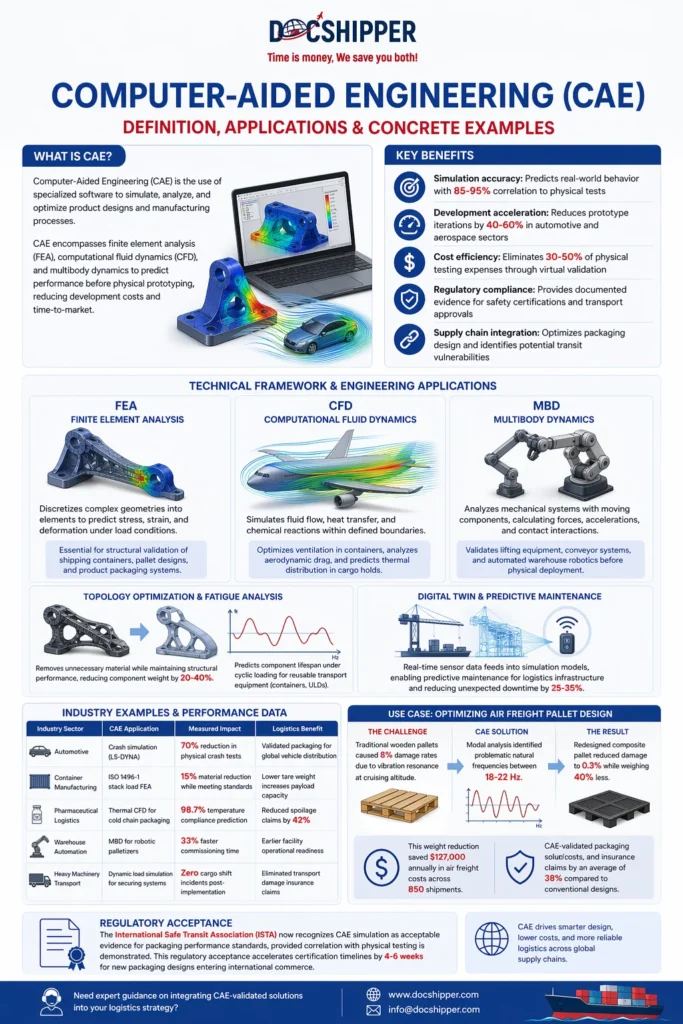
CAE encompasses three primary analysis methodologies that address distinct engineering challenges. Finite Element Analysis (FEA) discretizes complex geometries into manageable elements, solving partial differential equations to predict stress, strain, and deformation under load conditions. This technique proves essential for structural validation of shipping containers, pallet designs, and product packaging systems.
Computational Fluid Dynamics (CFD) simulates fluid flow, heat transfer, and chemical reactions within defined boundaries. Logistics applications include optimizing ventilation systems in refrigerated containers, analyzing aerodynamic drag on transport vehicles, and predicting thermal distribution in temperature-sensitive cargo holds. At DocShipper, we leverage CFD-validated container specifications to ensure pharmaceutical and perishable goods maintain required temperature ranges during international transit.
Multibody Dynamics (MBD) analyzes mechanical systems with moving components, calculating forces, accelerations, and contact interactions. This methodology validates lifting equipment, conveyor systems, and automated warehouse robotics before physical deployment. The European Union’s Machinery Directive 2006/42/EC specifically references simulation-based safety validation, which CAE directly supports (EUR-Lex Official Documentation).
Modern CAE platforms integrate topology optimization, which algorithmically removes unnecessary material while maintaining structural performance. This reduces component weight by 20-40%, directly lowering shipping costs and carbon emissions. Fatigue analysis predicts component lifespan under cyclic loading, critical for reusable transport equipment like ISO containers and aircraft Unit Load Devices (ULDs).
The digital twin concept extends CAE beyond design validation. Real-time sensor data feeds into simulation models, enabling predictive maintenance for logistics infrastructure. Port cranes, automated guided vehicles (AGVs), and warehouse robotics benefit from this continuous validation cycle, reducing unexpected downtime by 25-35% according to industry benchmarks.
Industry Examples & Performance Data
The aerospace sector demonstrates CAE’s transformative impact on logistics-critical components. Boeing’s 787 Dreamliner utilized over 800,000 hours of FEA simulation to validate composite fuselage panels. This virtual testing eliminated 12 physical test articles, saving approximately $18 million in prototyping costs and reducing development timeline by 14 months.
| Industry Sector | CAE Application | Measured Impact | Logistics Benefit |
|---|---|---|---|
| Automotive | Crash simulation (LS-DYNA) | 70% reduction in physical crash tests | Validated packaging for global vehicle distribution |
| Container Manufacturing | ISO 1496-1 stack load FEA | 15% material reduction while meeting standards | Lower tare weight increases payload capacity |
| Pharmaceutical Logistics | Thermal CFD for cold chain packaging | 98.7% temperature compliance prediction | Reduced spoilage claims by 42% |
| Warehouse Automation | MBD for robotic palletizers | 33% faster commissioning time | Earlier facility operational readiness |
| Heavy Machinery Transport | Dynamic load simulation for securing systems | Zero cargo shift incidents post-implementation | Eliminated transport damage insurance claims |
Use Case: Optimizing Air Freight Pallet Design
A medical device manufacturer needed to ship delicate diagnostic equipment via air freight. Traditional wooden pallets caused 8% damage rates due to vibration resonance at cruising altitude. CAE modal analysis identified problematic natural frequencies between 18-22 Hz, matching aircraft engine harmonics. The redesigned composite pallet, validated through harmonic response simulation, reduced damage to 0.3% while weighing 40% less than the original design. This weight reduction saved $127,000 annually in air freight costs across 850 shipments.
At DocShipper, we collaborate with packaging engineers who utilize CAE-validated designs for high-value cargo. Our experience shows that simulation-tested packaging solutions reduce insurance claims by an average of 38% compared to conventional designs, directly impacting total landed cost for our clients.
The International Safe Transit Association (ISTA) now recognizes CAE simulation as acceptable evidence for packaging performance standards, provided correlation with physical testing is demonstrated. This regulatory acceptance accelerates certification timelines by 4-6 weeks for new packaging designs entering international commerce.
Conclusion
Computer-Aided Engineering fundamentally reshapes product development and logistics planning by providing predictive insights before physical commitment. Organizations leveraging CAE methodologies achieve measurable advantages in cost control, timeline compression, and risk mitigation across global supply chains.
Need expert guidance on integrating CAE-validated solutions into your logistics strategy? Contact DocShipper for specialized consultation on engineering-optimized shipping solutions.
📚 Quiz
Test Your Knowledge: Computer-Aided Engineering (CAE)
1. What is the primary purpose of Computer-Aided Engineering (CAE)?
2. A common misconception about CAE is that it completely eliminates the need for physical prototypes. What does the article actually state?
3. A medical device manufacturer is shipping delicate diagnostic equipment by air and experiencing an 8% damage rate. Which CAE methodology would be most appropriate to identify and resolve vibration-related damage during transit?
🎯 Your Result
📞 Free Quote in 24hFAQ | Computer-Aided Engineering (CAE): Definition, Applications & Concrete Examples
Industry-standard platforms include ANSYS for FEA/CFD, Siemens Simcenter for multiphysics, Altair HyperWorks for optimization, and Dassault Systèmes SIMULIA for advanced nonlinear analysis. Selection depends on specific engineering requirements and industry compliance needs.
Properly calibrated CAE models achieve 85-95% correlation with physical tests. Accuracy depends on material property data quality, mesh refinement, and boundary condition definition. Critical applications require validation through selective physical testing.
No. CAE significantly reduces prototype iterations but cannot replace final validation testing. Regulatory frameworks like FDA 21 CFR Part 820 and ISO 13485 still require physical verification for medical devices and safety-critical components.
Organizations typically achieve positive ROI within 12-18 months. Initial investments include software licenses ($15,000-$150,000 annually) and engineer training. Cost savings materialize through reduced prototyping expenses and accelerated time-to-market.
Yes. CAE simulates ISTA test procedures including drop tests, vibration profiles, and compression loads. Results must correlate with physical validation tests to gain certification body acceptance. This hybrid approach reduces testing costs by 40-60%.
Topology optimization reduces material usage by 20-40% while maintaining performance. Lightweighting directly lowers fuel consumption and carbon emissions. CFD optimizes aerodynamics for transport vehicles, improving fuel efficiency by 5-12%.
Structural mechanics, thermal management, fluid dynamics, and vibration analysis show highest value. Industries with complex geometries (aerospace, automotive) or stringent safety requirements (medical devices, pressure vessels) gain maximum advantage.
Both models work. Large manufacturers maintain dedicated CAE teams. SMEs often outsource to specialized engineering consultancies, paying $120-$250 per hour for expert analysis. Hybrid approaches combine internal oversight with external specialized capabilities.
Modern CAE platforms offer API integrations with Product Lifecycle Management (PLM) systems like Siemens Teamcenter and PTC Windchill. Automated data exchange eliminates manual file transfers, reducing errors and maintaining design revision control across enterprise systems.
Complex simulations demand high-performance computing (HPC). Workstation configurations range from 32GB RAM with 8-core CPUs for basic FEA to 512GB RAM with 64+ cores for advanced CFD. Cloud-based CAE (AWS, Azure) offers scalable alternatives without capital investment.
Yes. Fatigue analysis predicts lifespan under cyclic loading conditions. ISO containers undergo 100,000+ loading cycles over 15-year service lives. CAE models simulate this degradation, informing maintenance schedules and retirement criteria for fleet management.
CAE reports support technical compliance declarations for regulated goods. EU customs accept simulation evidence for CE marking documentation. US CBP recognizes CAE in demonstrating product safety for tariff classification disputes. Proper documentation format is essential for acceptance.
Need Help with
Logistics or Sourcing ?
First, we secure the right products from the right suppliers at the right price by managing the sourcing process from start to finish. Then, we simplify your shipping experience - from pickup to final delivery - ensuring any product, anywhere, is delivered at highly competitive prices.


Fill the Form
Prefer email? Send us your inquiry, and we’ll get back to you as soon as possible.
Contact us




:%20Definition%20&%20Guide%20for%202026)