


In short ⚡
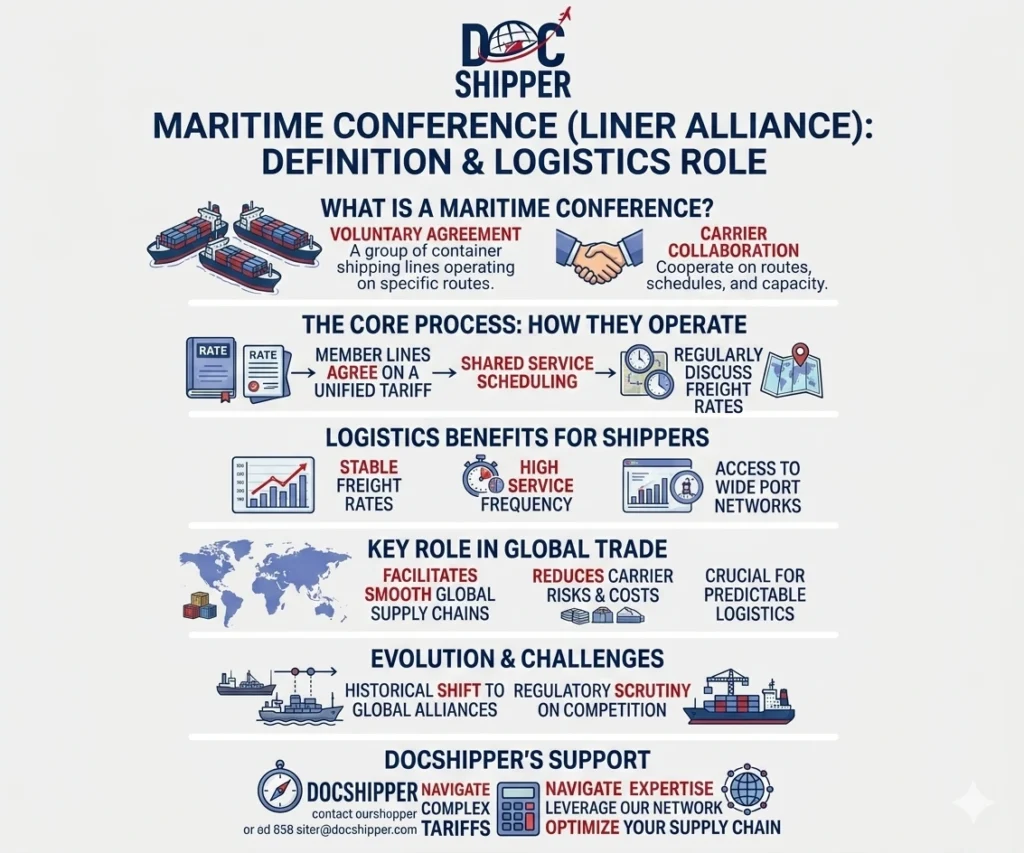
A conference in logistics refers to a formal meeting where industry stakeholders discuss operational standards, regulatory updates, or strategic partnerships. In maritime shipping, a shipping conference specifically designates an agreement between ocean carriers to establish uniform freight rates and service conditions on specific trade routes, ensuring market stability and predictable pricing structures.
Introduction
Many importers confuse industry conferences with shipping conferences—two distinct concepts that impact international trade differently. While industry gatherings facilitate knowledge exchange, shipping conferences directly affect freight costs and contractual terms.
Understanding conference structures is essential for businesses engaged in cross-border logistics. These frameworks influence pricing transparency, service reliability, and regulatory compliance across global supply chains.
- Standardization: Conferences establish uniform operational protocols across competing carriers
- Rate stability: Collective pricing agreements reduce volatility in freight markets
- Service quality: Member carriers commit to minimum service standards and schedule reliability
- Regulatory oversight: Antitrust authorities monitor conference activities to prevent market abuse
- Industry forums: Separate from shipping conferences, these events address technological innovation and regulatory changes
Mechanisms & Industry Expertise
Shipping conferences originated in the 19th century when ocean carriers formed alliances to stabilize freight rates on competitive routes. These agreements allowed members to collectively set tariffs, surcharges, and service terms while maintaining individual operational autonomy.
The legal framework governing conferences varies by jurisdiction. In the European Union, Regulation (EC) No 1419/2006 repealed the block exemption for liner conferences, effectively prohibiting collective price-fixing. The United States maintains limited antitrust immunity under the Shipping Act of 1984, though enforcement has tightened since 1998 reforms.
Operational mechanisms within conferences include freight rate committees, service contract templates, and dispute resolution procedures. Member carriers vote on rate adjustments, typically requiring supermajority approval. Independent action clauses allow individual carriers to deviate from conference rates under specific circumstances.
Modern alternatives to traditional conferences include vessel sharing agreements and strategic alliances. These structures permit operational cooperation without collective pricing, complying with stricter antitrust standards. Major alliances like 2M, Ocean Alliance, and THE Alliance control approximately 80% of global container capacity.
At DocShipper, we monitor conference agreements and alliance dynamics to secure optimal freight rates for our clients. Our expertise in carrier negotiations ensures compliance with regional regulations while maximizing cost efficiency.
For authoritative guidance on maritime conference regulations, consult the U.S. Federal Maritime Commission or the European Commission’s Directorate-General for Competition.
Practical Examples & Data
To illustrate conference impact, consider freight rate variations on the Asia-Europe trade lane. Before the EU repealed conference exemptions in 2008, rates fluctuated within 8-12% annually. Post-repeal volatility increased to 25-40% annual swings, reflecting pure market dynamics.
| Structure Type | Price Stability | Market Share Control | Regulatory Status |
|---|---|---|---|
| Traditional Conference | High (±10%) | 60-75% | Prohibited (EU), Limited (US) |
| Strategic Alliance | Moderate (±20%) | 75-85% | Permitted (operational only) |
| Spot Market | Low (±40%) | N/A | Fully competitive |
Use Case: A European electronics importer shipping 200 TEUs monthly from Shanghai to Rotterdam faced 18% rate increases in Q1 2023 due to alliance capacity management. By leveraging DocShipper’s carrier network and conference intelligence, the client secured a 12-month service contract at 9% below spot rates, demonstrating the value of expert negotiation in post-conference markets.
Industry conferences also serve as critical networking platforms. The TPM Conference (Trans-Pacific Maritime) attracts 2,500+ logistics professionals annually, facilitating partnerships that generate $4.2 billion in documented contract value. Similarly, the FIATA World Congress addresses multimodal transport standards affecting 40,000 freight forwarders globally.
Key data points:
- Conference-controlled routes showed 32% lower rate volatility (2000-2008 average)
- Alliance members reduced operational costs by 15-22% through vessel sharing
- Antitrust fines against conference violations totaled €1.8 billion (2000-2015)
- Industry conference attendance correlates with 28% higher supplier diversification rates
- Post-conference deregulation increased carrier bankruptcy rates by 40% (2008-2016)
Conclusion
Conferences remain pivotal in shaping logistics pricing structures and operational standards, whether through historical shipping agreements or modern industry gatherings. Understanding these mechanisms enables strategic procurement and regulatory compliance.
Need expert guidance navigating conference dynamics or securing optimal freight agreements? Contact DocShipper for tailored logistics solutions.
📚 Quiz
Test Your Knowledge: Shipping Conference
Q1 — What does a shipping conference specifically refer to in international logistics?
Q2 — Since 2008, what is the legal status of traditional shipping conferences in the European Union?
Q3 — A European importer is facing high freight rate volatility after the EU banned shipping conferences. Which modern structure best replaces conferences while remaining legally compliant?
🎯 Your Result
📞 Free Quote in 24hFAQ | Conference: Definition, Types & Practical Examples in International Logistics
A shipping conference is a carrier agreement to set collective freight rates, while an industry conference is a professional event for networking and knowledge sharing. The former affects pricing; the latter facilitates business development.
Shipping conferences are prohibited in the EU since 2008. The US permits limited antitrust immunity under the Shipping Act, though enforcement has tightened. Most carriers now use strategic alliances instead.
Traditional conferences stabilized rates through collective pricing agreements, reducing volatility to ±10%. Modern alliance structures create moderate stability (±20%) through operational cooperation without price-fixing.
Vessel sharing agreements and strategic alliances replaced traditional conferences. These structures allow operational cooperation (slot exchanges, joint services) without collective rate-setting, complying with competition law.
The three dominant alliances are 2M (Maersk, MSC), Ocean Alliance (CMA CGM, COSCO, OOCL, Evergreen), and THE Alliance (Hapag-Lloyd, ONE, Yang Ming). Together they control 80% of container capacity.
Yes. Independent action clauses historically allowed carriers to deviate from conference rates. Today, all rates are individually negotiated, though alliance members coordinate capacity and schedules.
Industry conferences provide regulatory updates, technology insights, and supplier networking opportunities. Attendees report 28% higher diversification rates and access to exclusive service contracts.
Deregulation increased rate volatility by 30% but improved service innovation. Carrier bankruptcy rates rose 40% between 2008-2016 as weaker operators exited consolidated markets.
Air freight never developed formal conferences like ocean shipping. Airlines coordinate through IATA but set rates independently. Cargo alliances focus on handling agreements rather than pricing.
Alliances must avoid price coordination and market allocation. EU and US authorities impose strict monitoring, with fines exceeding €1.8 billion historically for conference-related violations.
Traditional conference agreements adjusted rates quarterly. Modern alliance agreements review capacity and service terms semi-annually, with individual carrier rates fluctuating monthly based on market conditions.
DocShipper leverages alliance intelligence and carrier relationships to secure competitive rates outside standard conference structures. Our procurement team monitors regulatory changes and capacity trends to optimize client shipping costs.
Need Help with
Logistics or Sourcing ?
First, we secure the right products from the right suppliers at the right price by managing the sourcing process from start to finish. Then, we simplify your shipping experience - from pickup to final delivery - ensuring any product, anywhere, is delivered at highly competitive prices.


Fill the Form
Prefer email? Send us your inquiry, and we’ll get back to you as soon as possible.
Contact us




