


In short ⚡
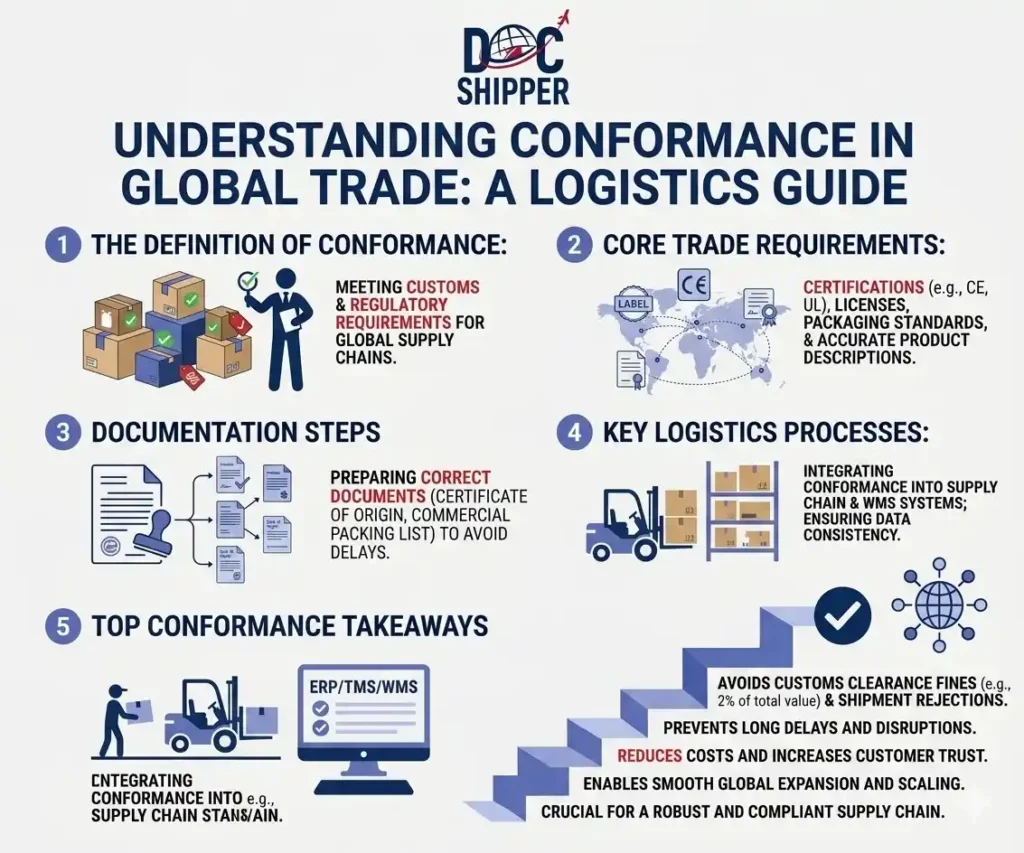
Conformance is the degree to which a product, service, or process adheres to specified requirements, standards, or regulations. In international logistics, conformance ensures shipments meet destination country regulations, quality standards, and contractual specifications, preventing customs delays, penalties, and market rejection.Introduction
Many importers discover conformance issues only when shipments are blocked at customs. This costly mistake stems from misunderstanding the difference between compliance and conformance.
Conformance verification is the cornerstone of successful international trade. It determines whether goods can legally enter a market, affects insurance validity, and impacts brand reputation.
Key characteristics of conformance in logistics include:
- Regulatory alignment: Meeting destination country legal requirements and safety standards
- Quality specifications: Adhering to contractual agreements between buyer and seller
- Documentation accuracy: Ensuring certificates, labels, and declarations match physical goods
- Testing protocols: Conducting pre-shipment inspections to verify conformance claims
- Continuous monitoring: Maintaining conformance throughout the supply chain lifecycle
Understanding Conformance Mechanisms & Regulatory Framework
Conformance operates through multiple verification layers. The process begins with product design assessment against target market requirements. Manufacturers must understand destination regulations before production begins.
The certification process involves third-party testing laboratories that evaluate products against specific standards. For example, CE marking in the European Union requires conformance to applicable directives. The European Commission maintains comprehensive guidelines on conformity assessment procedures.
Declaration of Conformity (DoC) is a formal document where manufacturers declare their products meet all applicable requirements. This legally binding statement transfers responsibility to the manufacturer. At DocShipper, we systematically verify DoC authenticity and completeness to prevent customs detention.
The technical file requirement mandates maintaining documentation proving conformance. This includes test reports, design specifications, risk assessments, and manufacturing process descriptions. Files must remain accessible for regulatory authorities for specified periods, typically 10 years.
Market surveillance mechanisms enforce conformance post-import. Authorities conduct random inspections, investigate complaints, and can withdraw non-conforming products. Penalties range from fines to criminal prosecution for serious violations endangering public safety.
Practical Examples & Compliance Data
Understanding conformance through real-world scenarios clarifies its practical impact on international shipments.
Comparative Conformance Requirements by Market
| Market | Primary Conformance Mark | Key Standards | Average Clearance Time (Non-Conforming) |
|---|---|---|---|
| European Union | CE Marking | EN Standards, REACH, RoHS | 15-30 days (with detention) |
| United States | FCC, UL, FDA (product-specific) | CPSC, ASTM, ANSI | 7-21 days (with FDA hold) |
| China | CCC (China Compulsory Certificate) | GB Standards | 10-45 days (with rejection risk) |
| Australia | RCM (Regulatory Compliance Mark) | AS/NZS Standards | 5-14 days (with border intervention) |
Use Case: Electronics Shipment Conformance Failure
A European importer ordered 5,000 Bluetooth speakers from an Asian manufacturer. The shipment value was €75,000. The manufacturer provided CE marking but failed to conduct proper EMC (Electromagnetic Compatibility) testing.
Outcome breakdown:
- Customs detention: 23 days
- Required third-party testing: €4,200
- Storage fees during detention: €1,850
- Lost sales during peak season: estimated €18,000
- Total conformance failure cost: €24,050 (32% of shipment value)
Key Conformance Data Points
- 68% of customs detentions involve documentation or conformance issues according to World Customs Organization reports
- Average cost of non-conformance: 15-40% of shipment value when including all delays and corrections
- Pre-shipment inspection reduces conformance failures by 87% based on industry quality control data
- Technical barrier notifications increased 23% globally between 2019-2023, reflecting stricter conformance enforcement
- Product recalls due to conformance failures: over 2,200 cases annually in the EU Safety Gate system
Conclusion
Conformance is not optional—it’s the legal gateway to international markets. Proactive verification prevents costly delays, protects brand reputation, and ensures regulatory compliance across jurisdictions.
Need expert guidance on conformance requirements for your shipments? Contact DocShipper for comprehensive compliance assessment and documentation support.
📚 Quizz
Test Your Knowledge: Conformance
Q1 — What does "conformance" mean in the context of international logistics?
Q2 — A manufacturer provides CE marking on an electronics shipment but skips EMC testing. Which statement is correct?
Q3 — An importer wants to verify a supplier's conformance claims before placing a large order. What is the most reliable approach?
🎯 Your Result
📞 Free Quote in 24hFAQ | Conformance: Definition, Importance & Practical Examples in International Trade
Need Help with
Logistics or Sourcing ?
First, we secure the right products from the right suppliers at the right price by managing the sourcing process from start to finish. Then, we simplify your shipping experience - from pickup to final delivery - ensuring any product, anywhere, is delivered at highly competitive prices.


Fill the Form
Prefer email? Send us your inquiry, and we’ll get back to you as soon as possible.
Contact us




