


In short ⚡
Conrail (Consolidated Rail Corporation) was a government-sponsored freight railroad corporation that operated from 1976 to 1999 across the northeastern United States. Created to rescue failing private railroads, Conrail revolutionized American rail logistics before its privatization and division between CSX and Norfolk Southern in 1999.Introduction
The northeastern United States faced a rail crisis in the 1970s. Multiple bankrupt railroads threatened regional commerce and manufacturing supply chains. The federal government’s response created one of the most significant logistics transformations in American history.
Conrail emerged as a solution to prevent complete collapse of freight rail infrastructure. Its legacy continues to shape modern intermodal logistics and international freight routing through major US ports.
Understanding Conrail’s role is essential for logistics professionals managing:
- East Coast port connections – Philadelphia, Baltimore, New York/New Jersey terminals
- Intermodal container routing – Rail-to-truck transfer points established during Conrail era
- Industrial corridor access – Manufacturing hubs in Pennsylvania, Ohio, and New York
- Cross-border freight – Canadian connections through Buffalo and Detroit gateways
- Legacy infrastructure – Track rights and terminal agreements still in effect today
Historical Context & Operational Expertise
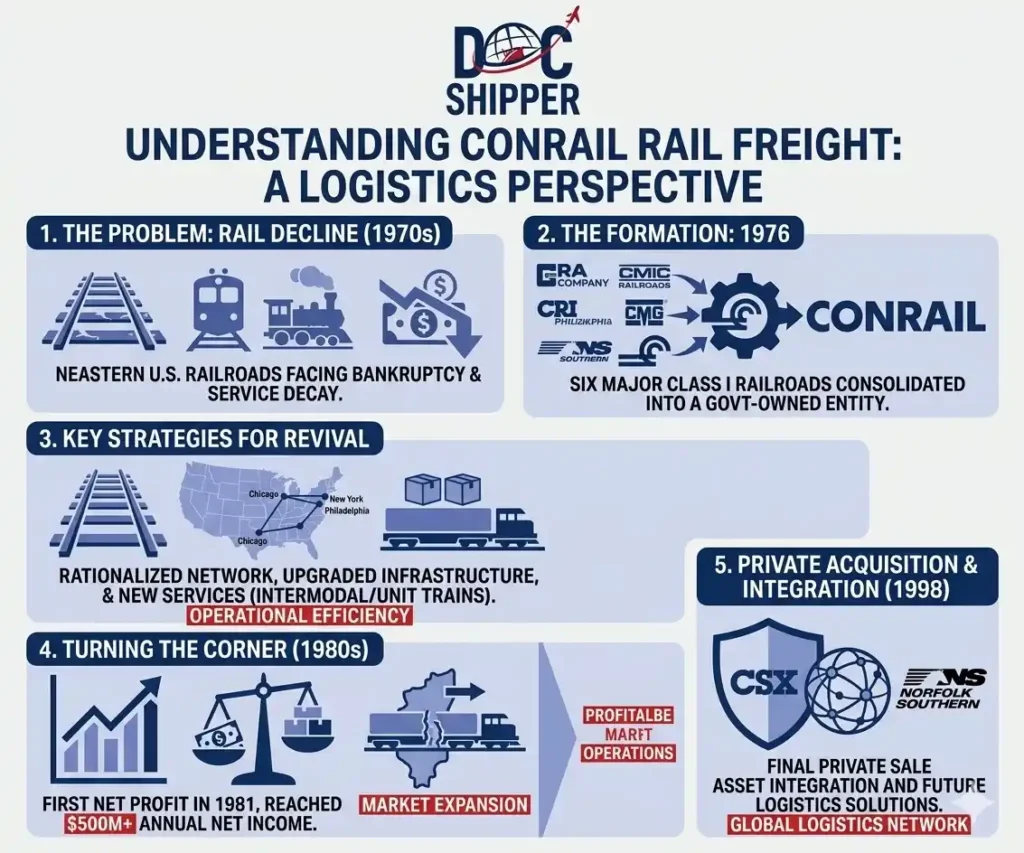
The Regional Rail Reorganization Act of 1973 created the framework for Conrail after Penn Central Railroad’s bankruptcy—the largest corporate failure in US history at that time. Six bankrupt northeastern railroads merged into Conrail on April 1, 1976, with $7 billion in federal funding.
Conrail’s operational territory spanned 15,000 route miles across 14 states and two Canadian provinces. The network connected critical import/export gateways including the Port of New York/New Jersey, Philadelphia, and Baltimore with inland manufacturing centers.
Operational restructuring focused on abandoning unprofitable branch lines while modernizing main corridors. Between 1976 and 1981, Conrail eliminated 4,400 miles of track but invested heavily in intermodal terminals and double-stack container service—innovations that became industry standards.
The Staggers Rail Act of 1980 deregulated freight railroads, allowing Conrail to negotiate competitive rates and service contracts. This legislative change proved crucial for profitability, enabling the railroad to compete effectively against trucking companies for time-sensitive cargo.
At DocShipper, we recognize how Conrail’s infrastructure investments created today’s efficient rail corridors. Our logistics planning accounts for these historical routing patterns when optimizing multimodal shipments through northeastern terminals.
By 1984, Conrail achieved profitability—a remarkable turnaround. The Conrail Privatization Act of 1986 enabled the largest initial public offering in US history at that time, returning $1.65 billion to federal coffers and demonstrating successful government intervention in critical infrastructure.
The railroad’s final chapter began in 1997 when CSX Transportation and Norfolk Southern proposed a joint acquisition. Approved by the Surface Transportation Board in 1999, the division created the current duopoly serving the eastern United States, with both carriers inheriting Conrail’s modernized infrastructure and operational practices.
For international freight forwarders, understanding this division matters. Shipments routed through Philadelphia or New York terminals may involve either CSX or Norfolk Southern depending on final destination, affecting transit times and interline agreements.
Reference: Surface Transportation Board maintains historical documentation on railroad mergers and operational authorities.
Concrete Impact & Industry Data
Conrail’s transformation demonstrates quantifiable logistics improvements. Comparing 1976 baseline data with 1998 pre-division metrics reveals the operational revolution:
| Metric | 1976 (Formation) | 1998 (Pre-Division) | Change |
|---|---|---|---|
| Route Miles | 15,000 | 10,600 | -29% (efficiency focus) |
| Annual Revenue | $2.1 billion | $3.7 billion | +76% |
| Employees | 95,000 | 23,600 | -75% (automation) |
| Intermodal Volume | Minimal | 2.8M containers/year | Industry leader |
| On-Time Performance | 62% | 89% | +27 points |
Use Case: Port of New York/New Jersey Container Movement
A manufacturing company importing automotive parts from Germany through Newark faced 8-day transit delays to Cleveland in 1978 due to deteriorating Conrail infrastructure. By 1995, the same route averaged 52 hours with double-stack container service and priority scheduling.
This improvement reduced inventory carrying costs by 23% and enabled just-in-time manufacturing adoption. DocShipper leverages these modern rail efficiencies when designing supply chain solutions for clients importing through northeastern gateways.
Key operational innovations introduced by Conrail:
- Centralized traffic control systems – Real-time tracking reduced congestion by 34%
- Unit train operations – Dedicated coal and grain trains improved bulk commodity efficiency
- Intermodal hubs – Philadelphia, Pittsburgh, and Cleveland terminals became national models
- Maintenance standardization – Reduced equipment failures by 41% between 1980-1990
- Customer service integration – Electronic data interchange (EDI) adoption ahead of industry standards
The 1999 division between CSX and Norfolk Southern preserved competitive balance. Both carriers inherited approximately equal route mileage and traffic density, preventing monopolistic control while maintaining service quality improvements achieved during the Conrail era.
Conclusion
Conrail’s 23-year existence transformed northeastern rail logistics from crisis to competitiveness. Its infrastructure investments and operational practices continue benefiting international freight movements through major East Coast ports and industrial corridors.
Understanding this historical context helps logistics professionals optimize routing decisions and anticipate service capabilities when managing imports through the region. Need assistance navigating complex rail freight routing or intermodal solutions? Contact DocShipper for expert guidance.
📚 Quiz
Test Your Knowledge: Conrail
1. What does "Conrail" stand for, and what was its primary purpose at creation?
2. A common misconception is that Conrail's reduction of route miles (from 15,000 to 10,600) signaled operational failure. What does this change actually reflect?
3. A freight forwarder is routing automotive parts imported through the Port of Newark to a manufacturing plant in Cleveland. Which statement best applies knowledge of Conrail's legacy?
🎯 Your Result
📞 Free Quote in 24hFAQ | Conrail: Definition, History & Impact on US Rail Freight
Conrail was established through federal legislation to consolidate six bankrupt northeastern railroads, preventing complete collapse of regional freight infrastructure critical to manufacturing and port operations.
Conrail is an abbreviation of Consolidated Rail Corporation, reflecting its formation through merger of multiple failing railroad companies into a single government-sponsored entity.
Conrail ceased independent operations on June 1, 1999, when CSX Transportation and Norfolk Southern completed their joint acquisition and division of the railroad's assets and routes.
Six bankrupt railroads formed Conrail: Penn Central, Erie Lackawanna, Lehigh Valley, Reading Company, Central Railroad of New Jersey, and Lehigh & Hudson River Railway.
Profitability resulted from abandoning unprofitable routes, investing in intermodal infrastructure, benefiting from 1980 deregulation, and implementing modern operational technologies including centralized traffic control.
Conrail operated across 14 northeastern and midwestern states plus Ontario and Quebec, connecting major ports in New York, Philadelphia, and Baltimore with inland manufacturing centers.
CSX Transportation and Norfolk Southern divided Conrail's network in 1999. Both carriers share trackage rights in certain corridors, particularly around Philadelphia and northern New Jersey.
Conrail pioneered double-stack container service and developed modern intermodal terminals, setting industry standards that enabled efficient port-to-inland freight movement still used today.
The government invested approximately $7 billion in Conrail's formation and early operations. The 1987 privatization returned $1.65 billion, with remaining investment offset by preserved economic activity.
The Conrail Privatization Act of 1986 authorized the sale of government-owned shares through public offering, completing the transition from federal rescue operation to private enterprise.
Some locomotives retain Conrail livery as heritage units operated by CSX and Norfolk Southern. Conrail Shared Assets Operations continues using the Conrail name for jointly-owned terminal operations.
Modern rail routing through the Northeast follows infrastructure patterns established during Conrail's optimization efforts. Understanding these legacy routes helps logistics planners anticipate transit times and carrier capabilities.
Need Help with
Logistics or Sourcing ?
First, we secure the right products from the right suppliers at the right price by managing the sourcing process from start to finish. Then, we simplify your shipping experience - from pickup to final delivery - ensuring any product, anywhere, is delivered at highly competitive prices.


Fill the Form
Prefer email? Send us your inquiry, and we’ll get back to you as soon as possible.
Contact us




