


In short ⚡
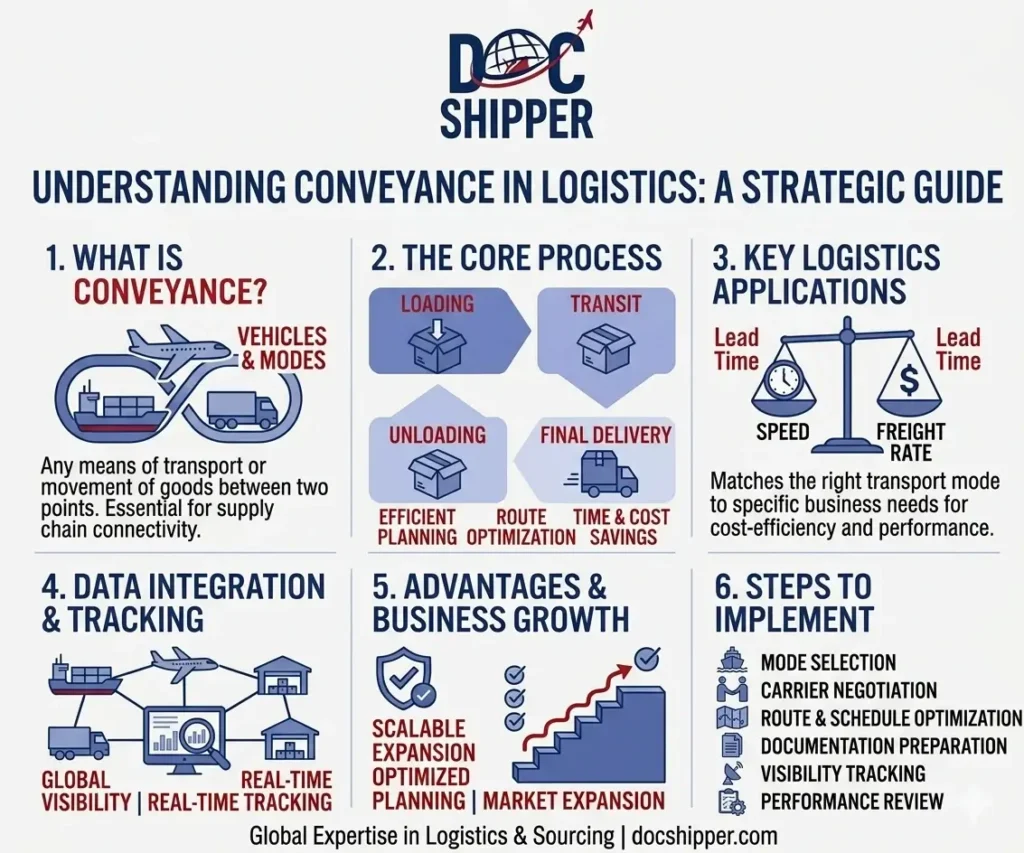
Conveyance is the legal transfer of property ownership from one party to another through a formal document. In international logistics, it refers to both the physical transportation of goods and the legal transfer of title during shipment, ensuring clear ownership rights throughout the supply chain.
Introduction
Confusion often arises between physical transportation and legal ownership transfer in international trade. When goods cross borders, understanding who holds legal title at each stage prevents costly disputes and customs delays.
Conveyance plays a dual role in global logistics. It governs both the movement of cargo and the transfer of property rights. This distinction becomes critical when goods are damaged, lost, or seized during transit.
Key characteristics of conveyance in international logistics:
- Dual nature: Physical transport and legal ownership transfer
- Documentation requirements: Bills of lading, certificates of title, transfer deeds
- Risk allocation: Determines liability during different shipping stages
- Customs implications: Affects duty payment obligations and clearance procedures
- Incoterms integration: Works alongside international commercial terms to define responsibilities
Legal Framework & Documentation
The legal aspects of conveyance are governed by multiple jurisdictions. International conventions like the Hague-Visby Rules and the Rotterdam Rules establish frameworks for carrier liability during transport. National laws then determine how property title transfers between parties.
A bill of lading serves as the primary conveyance document in maritime shipping. It functions as a receipt, contract of carriage, and document of title simultaneously. When endorsed and transferred, it legally conveys ownership rights to the consignee or subsequent holder.
The moment of conveyance varies based on the agreed Incoterms. Under FOB terms, ownership transfers when goods cross the ship’s rail at the port of loading. Under DDP terms, transfer occurs only upon delivery at the final destination. This timing directly impacts insurance coverage and risk exposure.
Transfer documentation must comply with both origin and destination country requirements. The European Union mandates specific customs declarations under the Union Customs Code, while the United States requires Electronic Export Information filing through the Automated Export System.
At DocShipper, we systematically verify all conveyance documents before shipment to ensure legal compliance across jurisdictions. Our team coordinates with customs authorities to prevent ownership-related clearance issues that could delay delivery.
Digital conveyance is transforming traditional practices. Electronic bills of lading, recognized under the UNCITRAL Model Law on Electronic Transferable Records, now enable faster ownership transfers while maintaining legal validity. Blockchain-based solutions provide immutable records of title changes throughout the supply chain.
Practical Applications & Case Studies
Understanding conveyance through real-world scenarios clarifies its operational impact. The following table compares ownership transfer points under different trade terms:
| Incoterm | Conveyance Point | Risk Transfer | Documentation Required |
|---|---|---|---|
| EXW | Seller’s premises | Immediate upon pickup | Delivery receipt |
| FOB | Port of loading | When goods cross ship’s rail | Bill of lading, export declaration |
| CIF | Port of loading | When goods cross ship’s rail | Bill of lading, insurance certificate, invoice |
| DDP | Final destination | Upon delivery to buyer’s location | Complete import clearance documentation |
Case Study: A German automotive parts manufacturer ships components to a US assembly plant under CIF terms. Legal conveyance occurs when goods are loaded onto the vessel in Hamburg. However, the seller arranges insurance to the destination port. When containers are damaged during ocean transit, the buyer files the insurance claim as the legal owner, while the seller assists with documentation.
Key operational considerations for conveyance management:
- Title retention clauses: Sellers may retain ownership until full payment, requiring specific documentation
- Customs valuation: Declared value must reflect the conveyance point and included costs
- Insurance timing: Coverage must align with ownership transfer to avoid gaps in protection
- Document endorsement: Proper bill of lading endorsement enables legal transfer to third parties or banks
- Regulatory compliance: Export controls may restrict conveyance to certain entities or countries
In multimodal transport, conveyance becomes more complex. A shipment from Shanghai to Paris via sea and rail involves multiple carriers. The through bill of lading maintains continuous legal coverage, while the fiduciary transfer document ensures ownership clarity at each modal transition.
Conclusion
Conveyance represents the intersection of physical logistics and legal ownership transfer. Mastering its documentation and timing prevents disputes, ensures regulatory compliance, and protects financial interests throughout international shipments.
Need expert guidance on conveyance documentation for your shipments? Contact DocShipper for comprehensive logistics support tailored to your trade requirements.
📚 Quiz
Test Your Knowledge: Conveyance
1. What does "conveyance" mean in the context of international logistics?
2. Under FOB (Free On Board) terms, when does legal conveyance of ownership take place?
3. A German exporter ships goods to a US buyer under CIF terms. During ocean transit, the containers are damaged. Who is responsible for filing the insurance claim?
🎯 Your Result
📞 Free Quote in 24hFAQ | Conveyance: Definition, Legal Framework & Practical Examples
Transportation refers solely to the physical movement of goods. Conveyance encompasses both transport and the legal transfer of ownership rights through proper documentation.
Under FOB (Free On Board), conveyance and risk transfer occur when goods cross the ship's rail at the named port of shipment, as documented in the bill of lading.
Yes, an order bill of lading can be endorsed and transferred to multiple parties, with each endorsement representing a legal conveyance of ownership rights to the new holder.
Customs authorities require proof of legal ownership through conveyance documents. The importer of record must demonstrate legal title to clear goods and pay applicable duties.
Lost original bills of lading require indemnity bonds and bank guarantees to release cargo. Electronic bills of lading eliminate this risk through secure digital transfer systems.
No, insurance must be specifically assigned or arranged by the new owner. CIF terms require the seller to provide insurance, but coverage terms must match ownership transfer timing.
These clauses delay legal ownership transfer until payment conditions are met, despite physical delivery. They require specific documentation and registration in some jurisdictions.
Banks require proper conveyance documents (typically bills of lading) to release payment. The document must show clean title transfer and match letter of credit terms exactly.
Yes, electronic bills of lading are recognized under UNCITRAL rules and increasingly accepted by carriers and customs authorities worldwide, though adoption varies by country.
Air waybills are non-negotiable and do not convey ownership like ocean bills of lading. Ownership transfer in air freight relies on separate commercial documents and payment terms.
Customs seizure suspends normal conveyance. The legal owner (as shown in conveyance documents) must resolve compliance issues before goods can be released or ownership transferred.
Yes, digital signatures are legally valid under most jurisdictions' electronic commerce laws. Major carriers now offer blockchain-based platforms for secure digital conveyance documentation.
Need Help with
Logistics or Sourcing ?
First, we secure the right products from the right suppliers at the right price by managing the sourcing process from start to finish. Then, we simplify your shipping experience - from pickup to final delivery - ensuring any product, anywhere, is delivered at highly competitive prices.


Fill the Form
Prefer email? Send us your inquiry, and we’ll get back to you as soon as possible.
Contact us




