


In short ⚡
Countertrade is a reciprocal trade arrangement where goods or services are exchanged directly between parties without using traditional currency. This mechanism enables international transactions when foreign exchange is scarce, credit unavailable, or trade barriers exist, representing 15-20% of global trade volume.
Introduction
Many businesses face a critical challenge: how to access foreign markets when currency restrictions, limited credit lines, or political risks make traditional payment methods impossible. Countertrade solves this by creating alternative exchange mechanisms that bypass conventional monetary systems.
In international logistics and import/export operations, countertrade has become essential for companies operating in emerging markets, sanctioned countries, or regions with currency volatility. Understanding these arrangements is crucial for maintaining supply chain continuity and accessing strategic markets.
- Currency-free transactions: Eliminates foreign exchange risk and dependency on banking systems
- Market access tool: Opens doors to countries with trade restrictions or limited hard currency
- Risk mitigation: Reduces political and economic exposure through balanced trade obligations
- Competitive advantage: Enables deals competitors cannot structure through traditional financing
- Inventory optimization: Converts excess production capacity or surplus goods into valuable imports
Mechanisms & Strategic Expertise
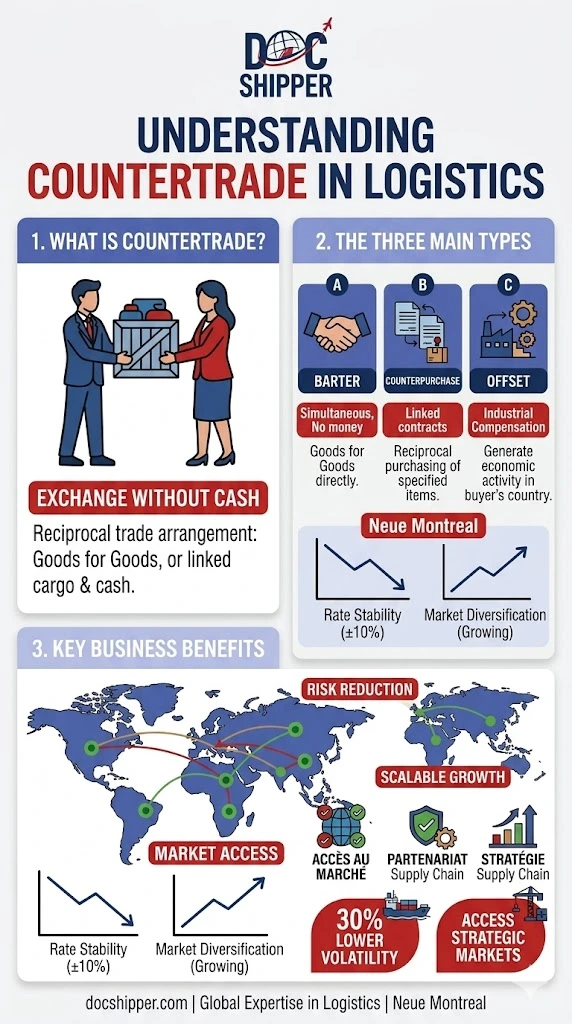
Countertrade encompasses several distinct mechanisms, each suited to specific commercial and geopolitical contexts. The five primary forms include barter (direct goods-for-goods exchange), counterpurchase (reciprocal purchasing agreements), offset (industrial compensation), buyback (compensation through production output), and switch trading (triangular arrangements involving third parties).
Barter arrangements represent the simplest form, where two parties exchange goods of equivalent value without monetary settlement. This mechanism dominated ancient trade and has resurged in modern contexts involving sanctioned nations or currency-restricted economies. The valuation challenge requires expert assessment to ensure equivalence.
Counterpurchase agreements involve two separate contracts: the primary export sale paid in currency, coupled with a commitment to purchase goods from the buyer’s country within a specified timeframe. This mechanism typically requires 20-100% reciprocal purchasing, creating balanced trade flows that satisfy government requirements while maintaining commercial flexibility.
Offset arrangements are mandatory in defense, aerospace, and infrastructure sectors, where exporters must generate economic activity in the importing country. Direct offsets involve production sharing or technology transfer, while indirect offsets include unrelated industrial investments. According to the World Trade Organization, offset requirements affect over $100 billion in annual trade.
Buyback agreements enable technology or equipment suppliers to receive payment through the output produced by their machinery. This mechanism is prevalent in natural resource extraction, manufacturing plant construction, and agricultural development projects. The supplier essentially finances the project through deferred product payments, aligning incentives between parties.
At DocShipper, we structure countertrade arrangements by coordinating multiple logistics streams, ensuring regulatory compliance across jurisdictions, and managing the complex documentation required for non-monetary transactions. Our expertise covers valuation assessments, third-party trading arrangements, and customs clearance for reciprocal shipments.
Concrete Examples & Data
Countertrade mechanisms vary significantly in structure and value. The following comparative analysis illustrates typical arrangements across industries:
| Mechanism | Typical Value Range | Common Sectors | Average Duration | Complexity Level |
|---|---|---|---|---|
| Barter | $500K – $50M | Commodities, Agriculture | Immediate – 6 months | Low |
| Counterpurchase | $2M – $500M | Manufacturing, Consumer Goods | 1 – 5 years | Medium |
| Offset | $50M – $10B | Defense, Aerospace, Infrastructure | 5 – 20 years | High |
| Buyback | $10M – $2B | Energy, Mining, Manufacturing | 3 – 15 years | High |
| Switch Trading | $1M – $100M | Various (Triangular Trade) | 6 months – 3 years | Very High |
Case Study: Agricultural Equipment Buyback — A European manufacturer supplied $25 million in farming machinery to an African nation with limited foreign currency reserves. The agreement structured payment through 40% cash and 60% buyback of agricultural products (cotton and cashews) over five years. The manufacturer partnered with commodity traders to monetize the products, achieving 92% value recovery while establishing long-term market presence.
Defense Offset Scenario: A $3.2 billion fighter aircraft sale required 100% offset obligations. The exporter established local assembly facilities, created 1,200 jobs, transferred specific technologies, and sourced $800 million in components from domestic suppliers. This 15-year program satisfied government requirements while building strategic partnerships.
Energy Sector Example: An oil-producing nation lacking refining capacity exchanged 50,000 barrels daily of crude oil for refined petroleum products from an international trader. This perpetual barter arrangement eliminated currency transactions while ensuring domestic fuel supply and export revenue optimization.
Key Success Factors: Effective countertrade requires precise valuation methodologies, robust legal frameworks addressing multiple jurisdictions, logistics coordination for simultaneous or sequential shipments, quality control mechanisms for received goods, and exit strategies for underperforming arrangements. Market research indicates countertrade success rates of 73% when properly structured versus 41% for improvised arrangements.
Conclusion
Countertrade represents a sophisticated alternative to conventional trade financing, enabling transactions that would otherwise be impossible due to currency restrictions, credit limitations, or political constraints. Mastering these mechanisms provides competitive advantages in emerging and restricted markets.
Need assistance structuring a countertrade arrangement or managing complex reciprocal shipments? Contact DocShipper for expert guidance on international trade solutions.
📚 Quiz
Test Your Knowledge: Countertrade
Q1 — What is the core definition of countertrade?
Q2 — A common misconception about barter and counterpurchase is that they are identical. What is the key difference?
Q3 — A European manufacturer sells $25M in farming machinery to a country with limited foreign currency reserves. Payment is structured as 40% cash and 60% agricultural products over five years. Which countertrade mechanism does this represent?
🎯 Your Result
📞 Free Quote in 24hFAQ | Countertrade: Definition, Mechanisms & Concrete Examples
Barter involves direct simultaneous exchange of goods without money, while counterpurchase consists of two separate contracts—one paid in currency with a commitment to purchase goods later from the buyer's country.
Yes, though the WTO discourages trade-distorting practices. Countertrade is permissible when not discriminatory or used to circumvent tariff commitments. Transparency and non-discrimination principles must be observed.
Valuation typically uses international market prices, independent appraisals, commodity exchange rates, or negotiated equivalencies. Third-party valuation experts often mediate disputes to ensure fairness and tax compliance.
Tax authorities treat countertrade as taxable transactions at fair market value. Both parties must report deemed sales and purchases, with potential VAT/GST obligations. Transfer pricing rules apply to related-party countertrade.
Indonesia, Malaysia, Brazil, India, and many Middle Eastern and African nations mandate countertrade in defense, infrastructure, and resource sectors. Requirements range from 30% to 100% of contract value.
Duration varies by type: barter is immediate to six months, counterpurchase spans one to five years, while offset and buyback arrangements extend five to twenty years depending on project complexity.
Yes, though complexity increases with smaller volumes. Trading houses and countertrade specialists facilitate participation by aggregating small transactions, providing market access, and managing logistics for fees of 5-15%.
Primary risks include valuation disputes, quality issues with received goods, market price fluctuations, logistics coordination failures, currency conversion losses on partial cash components, and counterparty default.
Customs authorities require detailed documentation proving equivalency, including valuation certificates, quality specifications, and contractual agreements. Special declarations may be necessary to demonstrate non-monetary transaction legitimacy.
Switch trading involves a third party purchasing countertrade obligations at a discount (typically 10-30%) when the original exporter cannot utilize received goods. This creates liquidity for otherwise illiquid commitments.
Specialized trade finance banks and export credit agencies provide countertrade financing through structured products. Financing costs are typically 2-5% higher than conventional trade finance due to complexity.
Countertrade focuses on reciprocal goods exchange, while offsets emphasize industrial development, technology transfer, and job creation in the buyer's country. Offsets are mandatory in many government procurement contracts.
Need Help with
Logistics or Sourcing ?
First, we secure the right products from the right suppliers at the right price by managing the sourcing process from start to finish. Then, we simplify your shipping experience - from pickup to final delivery - ensuring any product, anywhere, is delivered at highly competitive prices.


Fill the Form
Prefer email? Send us your inquiry, and we’ll get back to you as soon as possible.
Contact us




