


In short ⚡
Customer satisfaction is a key performance indicator measuring how well a company's products or services meet client expectations. In international logistics, it directly impacts retention, referrals, and competitive positioning across global supply chains.
Introduction
Many logistics providers claim to prioritize customer satisfaction, yet fail to measure it systematically. This gap creates service inconsistencies, delays, and costly misunderstandings in cross-border operations.
In international freight forwarding, customer satisfaction determines whether clients renew contracts or switch providers. A single missed shipment deadline can cascade into inventory shortages, production halts, and damaged business relationships.
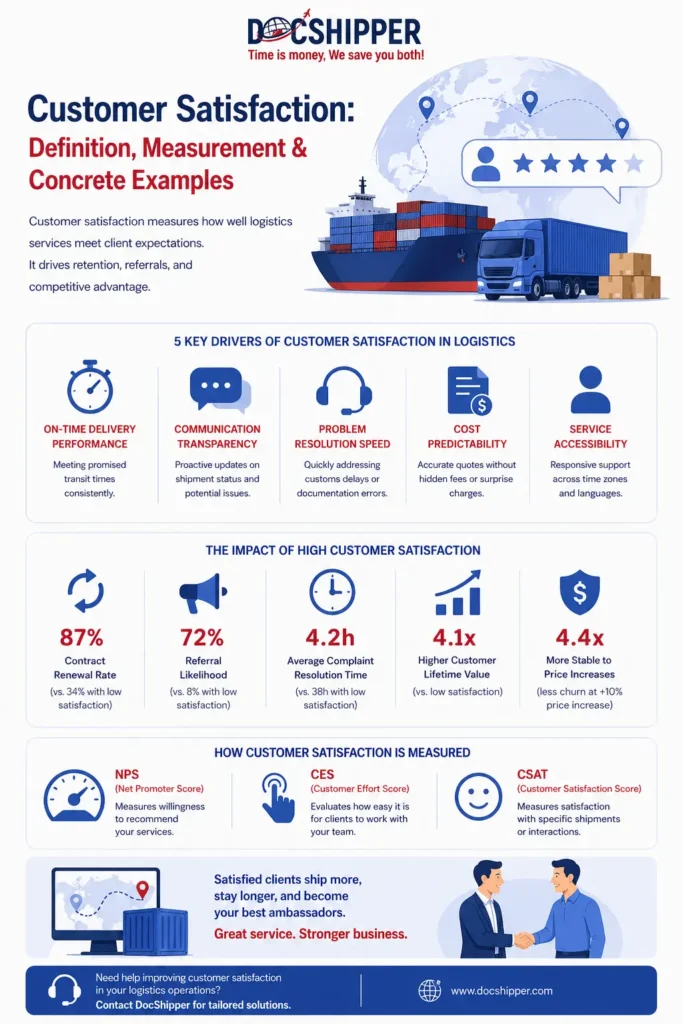
Key characteristics of customer satisfaction in logistics include:
- On-time delivery performance – Meeting promised transit times consistently
- Communication transparency – Proactive updates on shipment status and potential issues
- Problem resolution speed – How quickly customs delays or documentation errors are addressed
- Cost predictability – Accurate quotes without hidden fees or surprise charges
- Service accessibility – Responsive support across time zones and languages
In-Depth Analysis & Expertise
Customer satisfaction in logistics operates through multiple measurement frameworks. The Net Promoter Score (NPS) gauges willingness to recommend services. The Customer Effort Score (CES) evaluates ease of interaction. The Customer Satisfaction Score (CSAT) measures immediate transaction satisfaction.
Each metric serves distinct purposes. NPS predicts long-term loyalty and growth potential. CES identifies friction points in booking, tracking, or documentation processes. CSAT captures real-time reactions to specific shipments or support interactions.
The service recovery paradox reveals a counterintuitive truth: clients whose problems are resolved quickly often become more loyal than those who never experienced issues. This principle transforms complaint handling from cost center to competitive advantage.
Regulatory frameworks also influence satisfaction measurement. The European Union Consumer Protection Directive mandates transparency in service terms, directly impacting how logistics providers communicate delays or damage claims.
At DocShipper, we implement touchpoint mapping to identify critical satisfaction moments: quote request, booking confirmation, customs clearance, delivery notification, and post-delivery follow-up. Each stage undergoes continuous quality monitoring to prevent service degradation.
The expectation-perception gap drives most dissatisfaction. When promised 7-day ocean freight takes 10 days due to port congestion, the 3-day variance matters more than absolute speed. Managing expectations through realistic timelines and contingency communication prevents this gap from widening.
Concrete Examples & Data
Industry research quantifies satisfaction’s financial impact. According to Bain & Company, a 5% increase in customer retention boosts profitability by 25-95%. In logistics, where switching costs are relatively low, this retention premium becomes critical.
| Metric | High Satisfaction | Low Satisfaction | Impact |
|---|---|---|---|
| Contract Renewal Rate | 87% | 34% | 53% difference |
| Referral Likelihood | 72% | 8% | 64% difference |
| Average Complaint Resolution Time | 4.2 hours | 38 hours | 9x slower |
| Customer Lifetime Value | $127,000 | $31,000 | 4.1x higher |
| Price Sensitivity | Low (14% churn on 10% price increase) | High (61% churn on 10% price increase) | 4.4x more stable |
Use Case: Electronics Importer
A European electronics retailer shipped 40ft containers monthly from Shenzhen to Rotterdam. Initial satisfaction scores averaged 6.2/10 due to inconsistent delivery windows. After implementing predictive tracking and automated delay notifications, scores rose to 8.9/10 within six months. The client increased shipment volume by 35% and signed a three-year contract.
Use Case: Fashion Brand
A New York fashion company faced 23% damage claims on garment shipments from Bangladesh. DocShipper introduced quality inspection protocols at origin and upgraded packaging standards. Damage rates dropped to 2.1%, and CSAT scores jumped from 5.8 to 9.1. The brand expanded its product line with confidence in supply chain reliability.
Key satisfaction drivers in international logistics include:
- Real-time visibility – 78% of shippers rank tracking transparency as top priority
- Customs expertise – 64% cite clearance delays as primary frustration source
- Cost accuracy – 82% demand quotes within 5% of final invoice
- Proactive communication – 71% prefer early problem alerts over post-facto explanations
- Single point of contact – 69% value dedicated account management over call centers
Conclusion
Customer satisfaction in logistics transcends service delivery—it builds competitive moats through retention, referrals, and premium pricing power. Systematic measurement and rapid response mechanisms transform satisfaction from abstract goal to quantifiable business driver.
Need support optimizing your logistics satisfaction metrics? Contact DocShipper for tailored supply chain solutions.
📚 Quiz
Test Your Knowledge: Customer Satisfaction
Q1 — What does customer satisfaction primarily measure in international logistics?
Q2 — According to the "service recovery paradox," what happens when a logistics problem is resolved quickly and effectively?
Q3 — A European electronics retailer's satisfaction score rose from 6.2 to 8.9 out of 10. What was the primary driver of this improvement?
🎯 Your Result
📞 Free Quote in 24hFAQ | Customer Satisfaction: Definition, Measurement & Concrete Examples
Satisfaction measures immediate contentment with a transaction, while loyalty reflects long-term commitment and repeat business behavior. High satisfaction doesn't guarantee loyalty without consistent performance.
Post-transaction CSAT surveys should occur after each shipment. Quarterly NPS assessments track relationship health. Annual in-depth interviews uncover strategic improvement opportunities.
Industry benchmarks show CSAT scores above 8/10, NPS above +30, and CES below 3/7 indicate strong performance. Top-tier providers achieve NPS scores exceeding +50.
Absolutely. Communication quality, problem resolution speed, and service reliability often outweigh cost considerations. Transparency and proactive updates frequently drive higher satisfaction than discounts.
Digital tracking platforms, automated notifications, and self-service portals reduce friction and increase perceived control. However, technology must complement—not replace—human expertise in complex situations.
Customs issues rank among top dissatisfaction drivers. Clear communication about documentation requirements and proactive delay management mitigate negative impacts significantly.
Clients whose problems are resolved quickly and effectively often become more loyal than those who never experienced issues. Exceptional recovery transforms complaints into trust-building opportunities.
Highly satisfied clients demonstrate 4-5x lower price sensitivity. They accept premium rates for reliable service, reducing the need for competitive bidding and margin erosion.
Unexpected delays (42%), hidden fees (31%), poor communication (27%), damage/loss (19%), and customs complications (38%) represent primary frustration sources across global trade.
Both serve purposes. Anonymous surveys yield honest feedback on systemic issues. Attributed responses enable personalized follow-up and relationship strengthening. Balanced programs use both approaches.
Air freight clients prioritize speed and reliability. Ocean freight customers value cost predictability and documentation accuracy. Road transport users emphasize flexibility and last-mile performance.
Industry leaders respond to routine queries within 2 hours and urgent issues within 30 minutes. After-hours support availability significantly boosts satisfaction for time-sensitive shipments.
Need Help with
Logistics or Sourcing ?
First, we secure the right products from the right suppliers at the right price by managing the sourcing process from start to finish. Then, we simplify your shipping experience - from pickup to final delivery - ensuring any product, anywhere, is delivered at highly competitive prices.


Fill the Form
Prefer email? Send us your inquiry, and we’ll get back to you as soon as possible.
Contact us




