


In short ⚡
Customer segmentation is a strategic marketing process that divides a company's customer base into distinct groups based on shared characteristics such as demographics, purchasing behavior, geographic location, or psychographic traits. This classification enables businesses to tailor their logistics, communication, and service offerings to meet specific needs, optimize resource allocation, and maximize customer satisfaction and profitability.
Introduction
Many businesses struggle with delivering the right service to the right customer at the right time. Without proper customer segmentation, companies often apply a one-size-fits-all approach that leads to wasted resources, missed opportunities, and dissatisfied clients.
In international trade and logistics, customer segmentation becomes even more critical. Different customer groups require vastly different shipping methods, documentation processes, customs clearance procedures, and communication protocols. Understanding these distinctions directly impacts operational efficiency and competitive advantage.
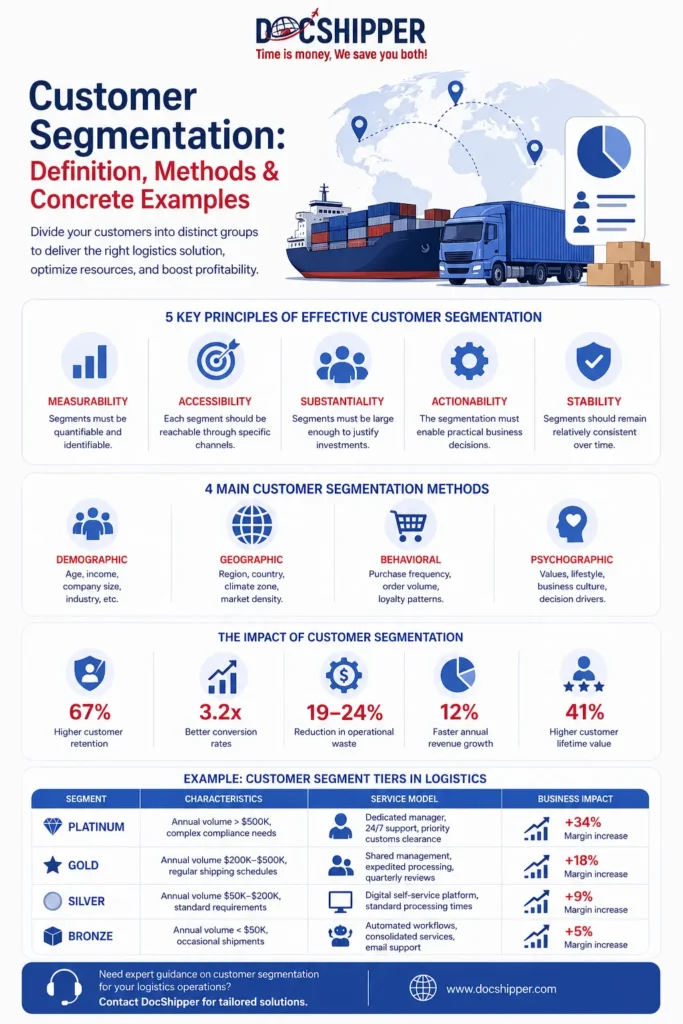
Key characteristics of effective customer segmentation include:
- Measurability: Segments must be quantifiable and identifiable through concrete data points
- Accessibility: Each segment should be reachable through specific marketing and logistics channels
- Substantiality: Segments must be large enough to justify differentiated strategies and resource allocation
- Actionability: The segmentation must enable practical, implementable business decisions
- Stability: Segments should remain relatively consistent over time to ensure strategy continuity
In-Depth Analysis & Strategic Expertise
Customer segmentation operates through multiple classification frameworks, each serving distinct strategic purposes. The most common approaches include demographic segmentation (age, income, company size), geographic segmentation (region, country, climate zone), behavioral segmentation (purchase frequency, order volume, loyalty patterns), and psychographic segmentation (values, lifestyle, business culture).
In logistics and international trade, value-based segmentation proves particularly effective. This method classifies customers according to their lifetime value, transaction frequency, and profitability margins. High-value clients importing luxury goods from Europe to Asia require white-glove service, expedited customs clearance, and dedicated account management. Conversely, mid-tier customers shipping bulk commodities benefit from cost-optimized consolidation services and standardized documentation processes.
The RFM model (Recency, Frequency, Monetary) provides a quantitative framework widely adopted in logistics operations. Recency measures how recently a customer made a purchase, Frequency tracks transaction volume over a defined period, and Monetary calculates total spending. This tri-dimensional analysis enables precise resource allocation and service differentiation. According to the World Customs Organization, companies applying RFM segmentation in cross-border operations achieve 23% higher customer retention rates compared to non-segmented approaches.
Needs-based segmentation focuses on the specific requirements customers express regarding shipping timelines, packaging standards, insurance coverage, and regulatory compliance. A pharmaceutical company importing temperature-sensitive vaccines demands cold-chain logistics, real-time tracking, and comprehensive documentation for health authorities. An e-commerce retailer sourcing consumer electronics prioritizes cost efficiency, flexible warehousing, and rapid last-mile delivery.
At DocShipper, we systematically apply multi-criteria segmentation to customize our service offerings. Our client classification system combines order volume, destination complexity, product category, and compliance requirements to assign appropriate service levels and communication protocols, ensuring optimal resource deployment across our global network.
Concrete Examples & Data-Driven Insights
Practical application of customer segmentation in international logistics demonstrates measurable performance improvements. Consider a freight forwarder managing 500 active clients across manufacturing, retail, and technology sectors. Without segmentation, the company allocated resources uniformly, resulting in service inefficiencies and margin erosion.
After implementing a four-tier segmentation model, the company restructured its operations:
| Segment | Characteristics | Service Model | Revenue Impact |
|---|---|---|---|
| Platinum | Annual volume >$500K, complex compliance needs | Dedicated account manager, 24/7 support, priority customs clearance | +34% margin increase |
| Gold | Annual volume $200K-$500K, regular shipping schedules | Shared account management, expedited processing, quarterly reviews | +18% margin increase |
| Silver | Annual volume $50K-$200K, standard requirements | Digital self-service platform, standard processing times | +9% margin increase |
| Bronze | Annual volume <$50K, occasional shipments | Automated workflows, consolidated services, email support | +5% margin increase |
This segmentation strategy delivered a 22% overall profitability improvement within 18 months, while customer satisfaction scores increased by 31% among Platinum and Gold segments.
Use Case: E-commerce Retailer Expansion
A European fashion retailer expanding into Asian markets segmented its customer base by purchase behavior and geographic density. The company identified three primary segments: urban millennials preferring fast fashion with 2-3 day delivery, suburban families purchasing seasonal collections with flexible timelines, and rural customers accepting 7-10 day shipping for discounted rates. By tailoring warehouse locations, carrier partnerships, and inventory allocation to each segment, the retailer reduced logistics costs by 17% while improving delivery performance by 28%.
Key data points supporting segmentation effectiveness:
- Customer retention: Segmented approaches achieve 67% higher retention rates than generic strategies
- Marketing ROI: Targeted campaigns based on segmentation deliver 3.2x better conversion rates
- Operational efficiency: Resource allocation aligned with segment needs reduces waste by 19-24%
- Revenue growth: Companies with mature segmentation models experience 12% faster revenue growth annually
- Customer lifetime value: Properly segmented customers demonstrate 41% higher CLV over five-year periods
Conclusion
Customer segmentation represents a fundamental strategic tool in modern logistics and international trade. By categorizing clients according to meaningful criteria, businesses optimize service delivery, enhance profitability, and build sustainable competitive advantages in increasingly complex global markets.
Need expert guidance on implementing customer segmentation strategies for your international logistics operations? Contact DocShipper for personalized consultation and tailored solutions.
📚 Quiz
Test Your Knowledge: Customer Segmentation
Q1 — What is the primary purpose of customer segmentation in logistics?
Q2 — A common misconception about customer segmentation is that it is the same as market segmentation. What is the key difference?
Q3 — A freight forwarder has a pharmaceutical client importing temperature-sensitive vaccines and an e-commerce retailer sourcing consumer electronics. Which segmentation approach best addresses their differing needs?
🎯 Your Result
📞 Free Quote in 24hFAQ | Customer Segmentation: Definition, Methods & Concrete Examples
Customer segmentation enables logistics companies to deliver differentiated services based on specific client needs, optimize resource allocation, and maximize profitability by matching service levels with customer value and requirements.
Most effective segmentation models use 3-5 distinct segments. Too few segments fail to capture meaningful differences, while too many create operational complexity and dilute strategic focus. The optimal number depends on business size and market diversity.
Essential data includes transaction history, order frequency, revenue per customer, product categories, shipping destinations, service requirements, payment terms, and communication preferences. Advanced models incorporate behavioral analytics and predictive indicators.
Market segmentation divides potential customers into groups before acquisition, while customer segmentation classifies existing clients to optimize ongoing service delivery. Customer segmentation uses actual behavioral data rather than demographic assumptions.
Yes, customers frequently migrate between segments based on business growth, changing needs, or purchasing patterns. Effective segmentation systems include regular review cycles (quarterly or semi-annually) to reclassify customers and adjust service levels accordingly.
RFM (Recency, Frequency, Monetary) analysis scores customers based on how recently they purchased, how often they buy, and how much they spend. This quantitative method identifies high-value customers deserving premium service and resources.
Segmentation enables logistics providers to assign specialized customs brokers to high-complexity clients, automate documentation for standard shipments, and prioritize clearance processing based on customer tier and urgency requirements, reducing delays and costs.
Modern CRM systems, data analytics platforms, and AI-powered tools automate segment identification, track customer migration patterns, predict future behavior, and enable real-time personalization of logistics services based on segment characteristics.
Yes, value-based pricing aligned with segmentation maximizes revenue. Premium segments pay higher rates for expedited services and dedicated support, while volume-focused segments receive competitive pricing through standardized, efficient processes.
Segmentation influences inventory placement, picking priorities, packaging standards, and shipping schedules. High-value segments receive prime storage locations and expedited processing, while cost-sensitive segments benefit from consolidated, optimized workflows.
Frequent errors include creating too many segments, using irrelevant criteria, failing to update segments regularly, not aligning operations with segment strategies, and neglecting to communicate segment-specific value propositions to customers.
Key performance indicators include customer retention rates by segment, profitability per segment, customer lifetime value growth, service level achievement, operational cost reduction, and revenue concentration in target segments compared to baseline periods.
Need Help with
Logistics or Sourcing ?
First, we secure the right products from the right suppliers at the right price by managing the sourcing process from start to finish. Then, we simplify your shipping experience - from pickup to final delivery - ensuring any product, anywhere, is delivered at highly competitive prices.


Fill the Form
Prefer email? Send us your inquiry, and we’ll get back to you as soon as possible.
Contact us




