


In short ⚡
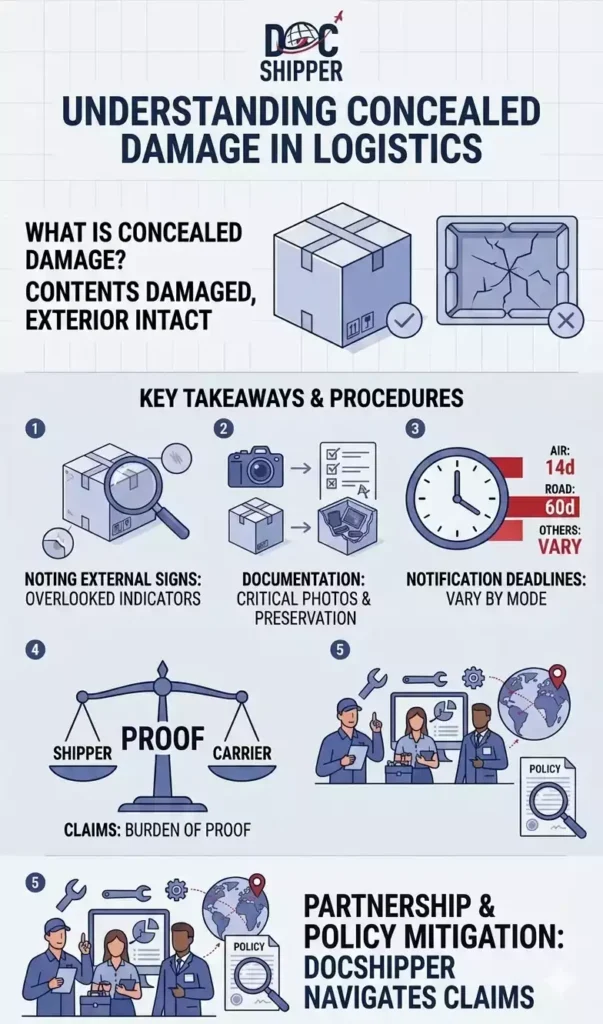
Concealed damage refers to freight damage not visible during initial delivery inspection but discovered later when unpacking or using goods. This hidden deterioration occurs during transit, handling, or storage, often masked by intact outer packaging, creating liability disputes between carriers, shippers, and consignees.Introduction
A shipment arrives with pristine packaging. The delivery receipt is signed. Three days later, unpacking reveals crushed electronics inside. This scenario represents one of the most challenging issues in international logistics: concealed damage claims often face rejection due to timing disputes and evidence gaps.
In global trade, concealed damage accounts for 15-20% of all cargo claims, yet recovery rates remain below 40%. Understanding detection protocols and notification deadlines is critical for protecting your business interests.
- Invisibility at delivery: External packaging shows no signs of impact or mishandling
- Discovery delay: Damage becomes apparent only during unpacking or product testing
- Burden of proof: Consignee must demonstrate damage occurred in transit, not post-delivery
- Time-sensitive claims: Strict notification windows (typically 3-15 days) govern liability
- Documentation requirements: Photographic evidence, inspection reports, and witness statements become essential
Detection Mechanisms & Legal Framework
Concealed damage detection requires systematic inspection protocols beyond visual examination of outer packaging. The Carriage of Goods by Sea Act (COGSA) and CMR Convention establish specific timeframes for reporting hidden defects—typically 3 days for sea freight and 7 days for road transport.
The prima facie evidence rule assumes goods were delivered in good condition if no notation appears on the delivery receipt. This legal presumption shifts the burden of proof to the consignee, who must demonstrate the damage predated delivery through circumstantial evidence or expert analysis.
Immediate notification protocols are essential. Upon discovering concealed damage, consignees should contact the carrier within hours and request a joint inspection. Documentation must include timestamped photographs showing packaging layers, damaged items, and any internal protective materials that failed.
The reasonable care standard evaluates whether packaging was adequate for the goods’ nature and transport mode. Courts examine whether shock-sensitive electronics received foam inserts, whether moisture barriers protected hygroscopic materials, and whether fragile items had “This Side Up” markings.
Survey reports from independent inspectors carry significant weight in claims disputes. At DocShipper, we coordinate third-party surveys within 24 hours of damage notification, ensuring neutral documentation that satisfies both carrier and cargo insurer requirements. These reports analyze packaging integrity, load securing methods, and whether damage patterns align with transit incidents versus post-delivery handling.
For authoritative guidance on international liability frameworks, consult the ICC Incoterms® rules, which define risk transfer points affecting concealed damage claims.
Practical Examples & Claims Data
Real-world scenarios illustrate how concealed damage manifests across different cargo types and transport modes. Industry data reveals patterns that help shippers implement preventive measures and strengthen claims when damage occurs.
Comparative Analysis: Concealed Damage by Cargo Type
| Cargo Category | Concealed Damage Rate | Common Causes | Detection Window |
|---|---|---|---|
| Electronics | 22% | Shock damage, moisture infiltration | 1-3 days (power-on testing) |
| Machinery Parts | 18% | Vibration stress, corrosion | 5-10 days (installation phase) |
| Textiles/Garments | 12% | Water damage, mold growth | 2-7 days (unpacking inspection) |
| Glassware/Ceramics | 28% | Micro-cracks from compression | Immediate to 3 days |
| Food Products | 15% | Temperature abuse, contamination | 1-5 days (quality testing) |
Use Case: Electronics Shipment from Shenzhen to Hamburg
Scenario: A consignee receives 200 cartons of LED monitors. Outer packaging appears intact, and the delivery receipt is signed without reservations. Four days later, during retail distribution, 35 units exhibit cracked screens not visible through protective film.
Challenge: The carrier argues damage occurred post-delivery. The 3-day notification window under COGSA has expired.
Resolution Strategy: The consignee commissioned an independent surveyor who identified a packaging design flaw—insufficient corner protection allowed stacking pressure to transfer directly to screens. Analysis of container stowage photos revealed the shipment was positioned beneath heavy machinery. The claim succeeded based on evidence that packaging was inadequate for declared stowage conditions, establishing carrier liability despite the delayed discovery.
Key takeaways:
- Photographic documentation of packaging layers proved critical
- Container loading plans demonstrated excessive stacking weight
- Expert testimony on packaging standards shifted liability
- Notification within 7 days (extended window) preserved claim rights
- Coordination with DocShipper’s claims team accelerated the surveyor appointment, preventing evidence degradation
Conclusion
Concealed damage represents a persistent challenge in international freight, requiring proactive inspection protocols and immediate response mechanisms. Understanding legal notification deadlines and evidence preservation techniques directly impacts claim success rates.
Need expert guidance on cargo inspection procedures or claims management? Contact DocShipper for specialized support protecting your shipments from concealed damage risks.
📚 Quiz
Test Your Knowledge: Concealed Damage
Q1 — What best defines "concealed damage" in international freight?
Q2 — A consignee signs a clean delivery receipt with no reservations. Can they still file a concealed damage claim?
Q3 — A shipment of LED monitors arrives with intact packaging. Four days later, 35 units show cracked screens. Under COGSA (sea freight), what is the most accurate assessment of this situation?
🎯 Your Result
📞 Free Quote in 24hFAQ | Concealed Damage: Definition, Detection & Practical Examples
Need Help with
Logistics or Sourcing ?
First, we secure the right products from the right suppliers at the right price by managing the sourcing process from start to finish. Then, we simplify your shipping experience - from pickup to final delivery - ensuring any product, anywhere, is delivered at highly competitive prices.


Fill the Form
Prefer email? Send us your inquiry, and we’ll get back to you as soon as possible.
Contact us




