


In short ⚡
The Consignee Mark is a unique identification symbol or code placed on shipping packages to identify the recipient of goods in international trade. This marking system ensures accurate delivery, facilitates customs clearance, and enables efficient cargo handling throughout the supply chain from origin to final destination.
Introduction
In international shipping, cargo often travels through multiple handlers, terminals, and countries before reaching its destination. Without clear identification, packages risk misdelivery, delays, or loss. The consignee mark solves this fundamental challenge by providing a visual reference system that transcends language barriers.
This marking convention has evolved from simple handwritten labels to sophisticated coded systems. Today, it remains essential for import/export operations, particularly for containerized cargo, break-bulk shipments, and less-than-container-load (LCL) freight.
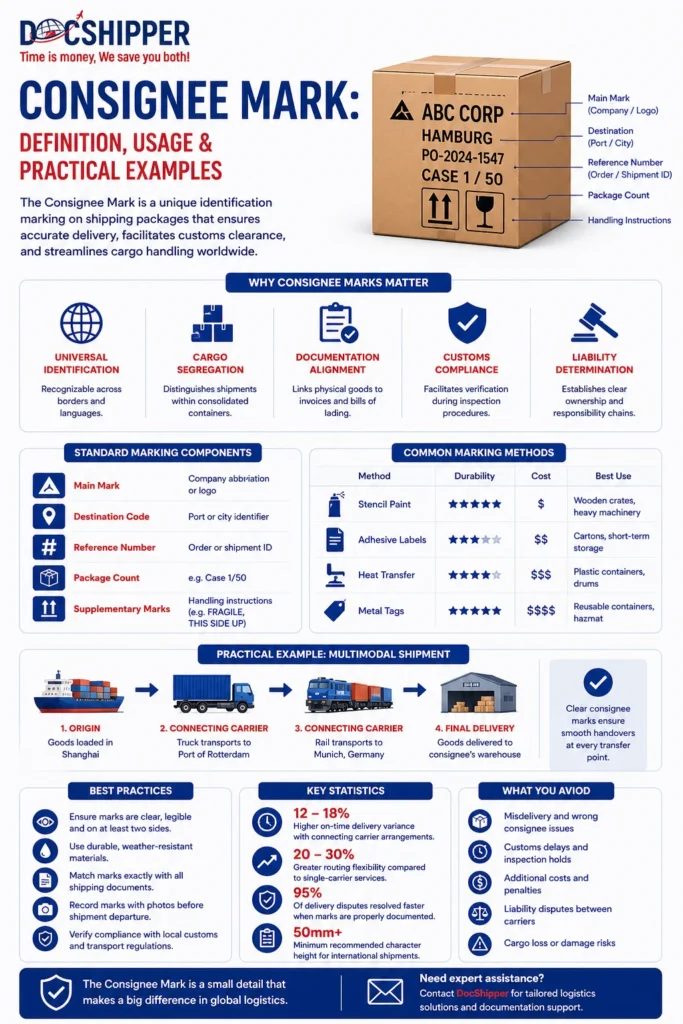
- Universal identification: Recognizable across borders and languages
- Cargo segregation: Distinguishes shipments within consolidated containers
- Documentation alignment: Links physical goods to commercial invoices and bills of lading
- Customs compliance: Facilitates verification during inspection procedures
- Liability determination: Establishes clear ownership and responsibility chains
Technical Framework & Regulatory Context
The consignee mark typically consists of three components: a main mark (company abbreviation or logo), a destination code (port or city identifier), and a reference number (order or shipment ID). This combination creates a unique identifier for each shipment batch.
International standards, while not strictly mandated, follow conventions established by the International Chamber of Commerce (ICC) and shipping line requirements. The mark must be clearly visible, weather-resistant, and placed on at least two sides of each package.
Regulatory considerations vary by jurisdiction. U.S. Customs and Border Protection requires marks to correspond exactly with documentation. The European Union emphasizes traceability under EORI regulations. Asian markets often mandate specific positioning and size requirements.
Technical specifications include minimum character height (typically 50mm for international shipments), contrast requirements (dark marks on light backgrounds), and durability standards. Stenciling, stamping, or adhesive labels must withstand maritime conditions including salt spray, humidity, and handling abrasion.
Digital integration is transforming traditional marking systems. Modern practices incorporate QR codes and RFID tags alongside conventional marks. These technologies enable real-time tracking while maintaining the visual reference system that warehouse personnel rely upon.
At DocShipper, we systematically verify that consignee marks align with shipping documents before cargo leaves our warehouses, preventing costly delays at destination customs checkpoints.
Practical Applications & Case Studies
Understanding consignee mark implementation through concrete scenarios demonstrates its operational importance. The following examples illustrate common configurations and their strategic purposes.
Standard Marking Configuration
| Component | Example | Purpose |
|---|---|---|
| Main Mark | ABC Corp / Triangle Logo | Company identification |
| Destination | HAMBURG | Port/city routing |
| Reference Number | PO-2024-1547 | Order linkage |
| Package Count | Case 1/50 | Quantity verification |
| Supplementary | “FRAGILE” / “THIS SIDE UP” | Handling instructions |
Case Study: Electronics Import
A European retailer importing 500 cartons of consumer electronics from Shenzhen faced segregation challenges in a consolidated container. By implementing a hierarchical marking system—primary mark for the retailer, secondary marks for product categories—the consignee reduced sorting time by 60% at the destination warehouse.
Key implementation factors:
- Color-coded marks by product line (blue for laptops, red for tablets)
- Sequential numbering within each category
- Barcode integration for automated inventory scanning
- Weatherproof laminated labels surviving 28-day ocean transit
- Pre-clearance documentation matching exact mark specifications
Comparative Analysis: Marking Methods
| Method | Durability | Cost | Best Use |
|---|---|---|---|
| Stencil Paint | Excellent | Low | Wooden crates, heavy machinery |
| Adhesive Labels | Moderate | Medium | Cartons, short-term storage |
| Heat Transfer | Very Good | Medium-High | Plastic containers, drums |
| Metal Tags | Excellent | High | Reusable containers, hazmat |
DocShipper’s quality control teams photograph all consignee marks before shipment departure, creating a digital archive that resolves 95% of delivery disputes without physical inspection.
Conclusion
The consignee mark remains an indispensable tool in international logistics, bridging physical cargo handling with documentary compliance. Proper implementation reduces delivery errors, accelerates customs clearance, and establishes clear accountability throughout the supply chain.
Need guidance on marking requirements for your next shipment? Contact DocShipper for expert assistance tailored to your specific trade lanes and cargo types.
📚 Quiz
Test Your Knowledge: Consignee Mark
Q1 — What is the primary purpose of a Consignee Mark on a shipping package?
Q2 — A shipper reuses the exact same consignee mark — including the reference number — for two different shipments sent simultaneously. Is this acceptable practice?
Q3 — A European retailer is importing 500 cartons of electronics in a consolidated (LCL) container from Shenzhen. Which marking approach best prevents cross-delivery errors at the destination warehouse?
🎯 Your Result
📞 Free Quote in 24hFAQ | Consignee Mark: Definition, Usage & Practical Examples
These terms are often used interchangeably. Technically, "consignee mark" emphasizes the recipient identification aspect, while "shipping mark" is a broader term encompassing all package identification including port marks and handling symbols.
While not universally mandated by international law, most shipping lines, freight forwarders, and customs authorities require proper marking. Specific regulations vary by country and commodity type, particularly for hazardous materials.
The main mark may remain consistent, but reference numbers must be unique for each shipment. This ensures traceability and prevents confusion when multiple orders are in transit simultaneously.
Unmarked cargo faces delays, additional inspection fees, storage charges, and potential refusal of entry. Customs may require re-marking at the importer's expense before releasing the goods.
International standards recommend minimum 50mm character height for overseas shipments. Marks should occupy at least 10% of the package face area and be clearly legible from 1 meter distance.
Yes, though air cargo often uses smaller, more detailed labels due to faster transit times. Air waybill numbers frequently serve as the primary reference, supplemented by consignee identification marks.
While local language marks are acceptable, English remains the international standard for maritime shipping. Using both languages (bilingual marking) is recommended for markets with specific linguistic requirements.
Avoid including sensitive commercial details like pricing, profit margins, or proprietary manufacturing data. Marks should identify, not reveal confidential business information to competitors or unauthorized parties.
Modern logistics integrates physical marks with digital tracking. Barcodes and QR codes encoded with mark information enable automated scanning while maintaining human-readable backup identification.
Yes, LCL and groupage cargo require particularly clear marking to distinguish multiple consignees' goods within shared containers. Each shipper's cargo must have distinct, non-conflicting marks to prevent cross-delivery errors.
For non-standard items like machinery or oversized equipment, attach durable metal tags or use multiple marking locations. Ensure at least two visible faces display complete consignee information regardless of stacking orientation.
Marks must survive the entire journey duration plus reasonable storage time—typically 90 days minimum. Marine-grade materials resist saltwater, UV exposure, temperature extremes, and mechanical abrasion throughout this period.
Need Help with
Logistics or Sourcing ?
First, we secure the right products from the right suppliers at the right price by managing the sourcing process from start to finish. Then, we simplify your shipping experience - from pickup to final delivery - ensuring any product, anywhere, is delivered at highly competitive prices.


Fill the Form
Prefer email? Send us your inquiry, and we’ll get back to you as soon as possible.
Contact us




