


In short ⚡
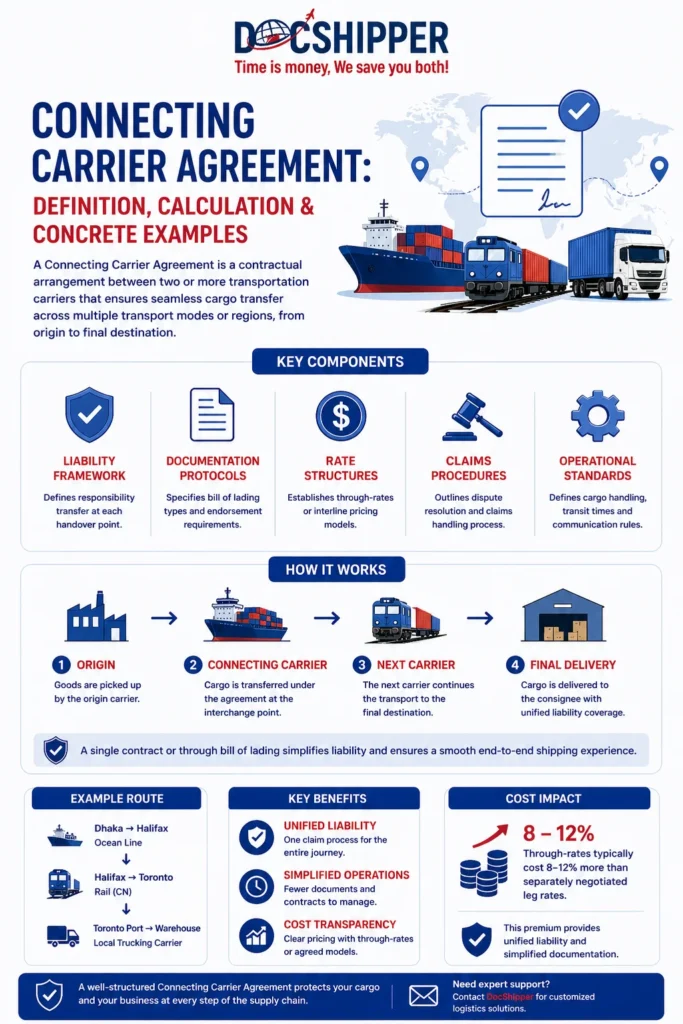
A Connecting Carrier Agreement is a contractual arrangement between two or more transportation carriers that enables seamless cargo transfer across different transport modes or geographic regions. This agreement establishes liability, documentation requirements, and operational protocols when shipments transit through multiple carriers, ensuring uninterrupted delivery from origin to final destination without requiring separate contracts for each leg.
Introduction
International shipments rarely involve a single carrier from door to door. When your cargo moves from Shanghai to Chicago via ocean freight, then rail, then truck, who bears responsibility if damage occurs during the rail segment? This confusion creates significant risk exposure for shippers.
Connecting Carrier Agreements solve this problem by creating a unified liability framework across multiple transportation providers. These contracts are fundamental to multimodal logistics, particularly for complex international supply chains requiring coordination between ocean lines, rail operators, and trucking companies.
- Liability transfer mechanisms that define responsibility at each handover point
- Documentation protocols specifying bill of lading types and endorsement requirements
- Rate structures establishing through-rates versus interline pricing models
- Claims procedures outlining dispute resolution when cargo incidents occur
- Operational standards defining cargo handling, transit times, and communication protocols
In-Depth Analysis & Expertise
Connecting Carrier Agreements operate under two primary legal frameworks: through bill of lading arrangements and interline agreements. Under through bills, the originating carrier assumes end-to-end liability, issuing a single contract covering the entire journey. Conversely, interline agreements segment liability, with each carrier responsible only for their transport leg.
The Carmack Amendment in U.S. domestic transport and the Montreal Convention for international air cargo establish baseline liability standards that these agreements must reference. According to the Federal Maritime Commission, ocean carriers entering connecting agreements must file tariffs specifying their liability limitations, typically capped at $500 per package unless higher value is declared.
Liability transition points represent the most critical element. Agreements must explicitly define when responsibility transfers—typically at the moment cargo physically leaves one carrier’s custody and enters another’s. Ambiguous handover definitions create legal gaps exploited during claims disputes.
The interchange receipt serves as the transfer document, signed by both the delivering and receiving carriers. This receipt must note any visible damage or discrepancies; failure to document exceptions can shift liability unexpectedly. At DocShipper, we verify interchange documentation at every modal transition to protect our clients from unrecorded damage claims.
Rate calculation methodologies vary significantly. Through-rates offer shippers a single price for the entire journey, with carriers privately apportioning revenue. Joint rates involve published divisions where each carrier’s portion is transparent. Proportional rates divide charges based on distance or handling complexity, common in rail-truck combinations.
Concrete Examples & Data
Consider a textile shipment from Dhaka, Bangladesh to Toronto, Canada. The cargo moves via ocean freight to Halifax, then CN Rail to Toronto, with final delivery by local trucking. Without a Connecting Carrier Agreement, the shipper would need three separate contracts and face three different liability regimes.
| Transport Leg | Carrier Type | Liability Limit | Transit Time |
|---|---|---|---|
| Dhaka–Halifax | Ocean Line | $500/package (Hague-Visby) | 28 days |
| Halifax–Toronto | Rail (CN) | $100/CWT (Carmack) | 4 days |
| Toronto Port–Warehouse | Local Trucker | $0.50/lb (Provincial) | Same day |
Under a through Connecting Carrier Agreement, the ocean carrier issues a combined transport bill of lading covering all three legs. If damage occurs during the rail segment, the shipper files a single claim with the ocean line, which then pursues recovery from CN Rail per their backend agreement. This simplifies claims management dramatically.
Cost implications: Industry data shows through-rates typically cost 8–12% more than separately negotiated leg rates, but this premium buys unified liability and simplified documentation. For a $50,000 shipment, this translates to $4,000–$6,000 additional cost versus the administrative burden of managing three contracts and potential claim complications.
Real-world scenario: A European automotive parts supplier shipping to Mexico discovered this value when a container fell from a rail car in Texas. Their Connecting Carrier Agreement with Maersk meant filing one claim in Rotterdam rather than navigating U.S. rail carrier procedures, Texas state law, and cross-border legal complexities. Settlement occurred in 45 days versus an estimated 6–9 months for independent claims.
DocShipper structures Connecting Carrier Agreements for clients moving high-value electronics from Asia to Europe, ensuring seamless transitions between ocean, rail, and final-mile delivery while maintaining comprehensive insurance coverage across all modal shifts.
Conclusion
Connecting Carrier Agreements transform fragmented multimodal logistics into unified transport solutions, reducing legal complexity and claim management burdens. For shippers managing international supply chains, these contracts provide essential liability protection and operational simplicity.
Need expert guidance structuring carrier agreements for your supply chain? Contact DocShipper for customized multimodal logistics solutions.
📚 Quiz
Test Your Knowledge: Connecting Carrier Agreement
Q1 — What is the primary purpose of a Connecting Carrier Agreement?
Q2 — Under a through bill of lading arrangement, if cargo is damaged during the rail segment of a multimodal journey, who does the shipper file the claim with?
Q3 — A shipper is told that using a Connecting Carrier Agreement means they no longer need separate cargo insurance since the agreement provides full replacement value coverage. Is this correct?
🎯 Your Result
📞 Free Quote in 24hFAQ | Connecting Carrier Agreement: Definition, Calculation & Concrete Examples
A standard freight contract covers a single carrier's service, while a Connecting Carrier Agreement binds multiple carriers across different transport modes, establishing liability transfer protocols and unified documentation for the entire journey.
The primary carrier (usually the ocean line or main rail operator) initiates these agreements with connecting carriers. Large shippers with consistent volumes may also negotiate customized connecting agreements directly with carrier consortiums.
No, but without them shippers must contract separately with each carrier, accept segmented liability, and manage multiple claims processes. Most international logistics providers use connecting agreements as standard practice for efficiency.
Connecting Carrier Agreements simplify insurance by creating a single liability chain. However, carrier liability limits remain low ($500/package typically), so shippers still need separate cargo insurance for full replacement value coverage.
The primary carrier remains liable under through bill arrangements. For interline agreements, liability may terminate at the bankrupt carrier's leg, creating coverage gaps. This risk highlights the importance of carrier financial vetting.
Large-volume shippers can negotiate liability limits, transit time guarantees, and priority handling. Small shippers typically accept standard agreement terms published in carrier tariffs filed with regulatory authorities.
Agreements specify which carrier manages customs documentation at border crossings. Typically, the carrier controlling the import leg handles clearance, with costs either included in through-rates or billed separately as ancillary charges.
The through bill of lading or master airway bill references the agreement. Shippers should request copies of filed tariffs or backend carrier agreements to understand full liability terms before shipping.
Most agreements include reasonable storage at interchange points (24–72 hours). Extended storage due to customs delays or carrier scheduling issues may incur demurrage charges unless specifically covered in the agreement terms.
Incoterms define buyer-seller responsibilities, while Connecting Carrier Agreements govern carrier-to-carrier relationships. Under DDP terms, for example, the seller must ensure connecting agreements cover delivery to the final destination, not just the port.
Backend carrier-to-carrier agreements often run 1–3 years with automatic renewal clauses. Individual shipment coverage under these agreements applies for the specific transport duration, typically 30–90 days depending on routing complexity.
Yes, but specialized connecting agreements are required due to unique handling needs. These agreements include engineered routing, specialized equipment provisions, and enhanced liability coverage for high-value industrial cargo exceeding standard dimensions.
Need Help with
Logistics or Sourcing ?
First, we secure the right products from the right suppliers at the right price by managing the sourcing process from start to finish. Then, we simplify your shipping experience - from pickup to final delivery - ensuring any product, anywhere, is delivered at highly competitive prices.


Fill the Form
Prefer email? Send us your inquiry, and we’ll get back to you as soon as possible.
Contact us




