


In short ⚡
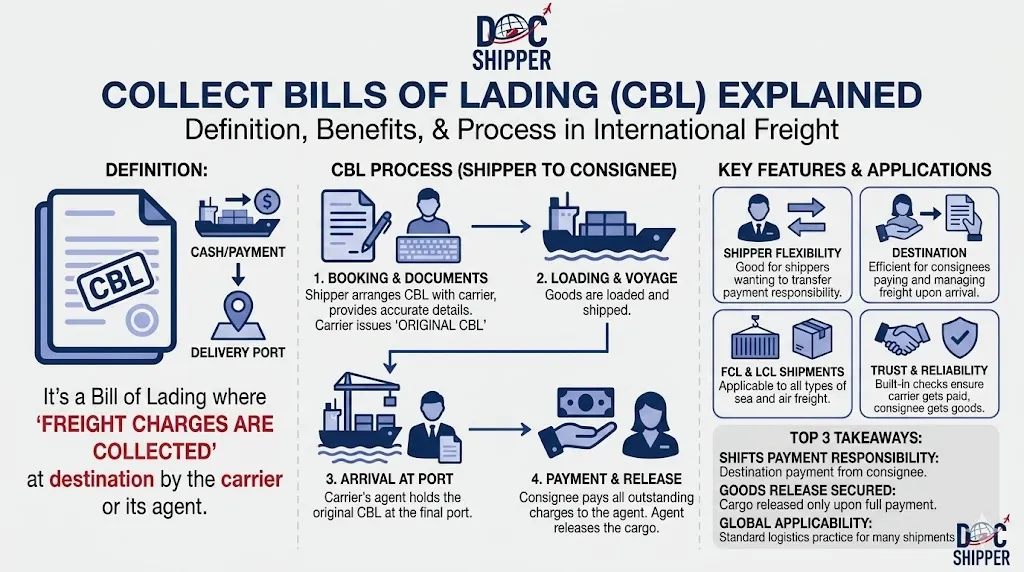
CBB (Collect Bills of Lading) is a payment term where freight charges are payable at destination by the consignee upon cargo delivery. This arrangement transfers payment responsibility from shipper to receiver, commonly used when buyers control freight or negotiate better carrier rates.Introduction
International shipments generate confusion around who pays freight charges and when. The CBB designation on bills of lading determines this critical aspect of logistics cost allocation.
In global trade, payment timing affects cash flow, relationships between parties, and delivery speed. Misunderstanding CBB terms leads to cargo holds, unexpected expenses, and strained business partnerships.
Key characteristics of CBB arrangements include:
- Payment at destination: Consignee settles freight charges upon cargo arrival
- Shipper relief: Exporter avoids upfront logistics costs
- Carrier risk mitigation: Payment required before cargo release
- Incoterms alignment: Compatible with CFR, CIF, DAP terms where buyer controls freight
- Documentation clarity: Bill of lading explicitly states “Freight Collect” or “Charges Collect”
Understanding CBB Mechanisms & Legal Framework
The CBB system operates under maritime law principles established by international conventions. The carrier retains a legal lien on cargo until freight charges are paid, protecting their commercial interests.
Under Incoterms 2020, CBB aligns with buyer-controlled freight scenarios. When CFR (Cost and Freight) or CIF (Cost, Insurance and Freight) terms apply, the seller arranges transport but the buyer assumes costs at destination. This creates natural CBB applications.
The bill of lading notation serves as binding contract evidence. “Freight Collect” or “Charges Collect” clauses legally obligate the consignee to payment before cargo release. Carriers enforce this through cargo holds and demurrage charges for non-payment.
Customs clearance implications require careful coordination. Many countries demand proof of freight payment before releasing imported goods. CBB arrangements can delay clearance if consignees lack immediate payment capacity or dispute charges.
The liability transfer mechanism shifts financial risk from shipper to receiver. This benefits exporters with limited working capital but requires trust that consignees will settle promptly. At DocShipper, we verify CBB arrangements during documentation review to prevent delivery complications and ensure all parties understand their payment obligations.
According to International Chamber of Commerce guidelines, clear communication of freight payment terms prevents 73% of delivery disputes in international trade.
Practical Examples & Cost Comparisons
CBB applications vary significantly across trade scenarios. Understanding real-world implementations helps businesses optimize cash flow and negotiate better terms.
Comparative Cost Analysis: Prepaid vs. Collect
| Payment Term | Freight Cost | Payment Timing | Cash Flow Impact | Risk Level |
|---|---|---|---|---|
| Prepaid | $2,800 | Before shipment | Immediate shipper burden | Low (carrier paid) |
| CBB (Collect) | $2,950 | At destination | Deferred 30-45 days | Medium (consignee reliability) |
| Third-party billing | $2,700 | Net 30 terms | Optimal for both parties | Low (account holder liable) |
Use Case: Electronics Importer in Hamburg
A German retailer imports consumer electronics from Shenzhen using CFR Hamburg terms. The supplier arranges ocean freight but specifies CBB on the bill of lading.
Scenario breakdown:
- Shipment value: €85,000
- Ocean freight (CBB): €3,200 payable at Hamburg port
- Transit time: 28 days
- Cash flow advantage: Retailer delays freight payment until cargo arrives and sells
- Risk mitigation: Retailer inspects goods before final freight payment, reducing quality dispute exposure
This arrangement provided the German buyer with €3,200 working capital for nearly one month, improving inventory financing without upfront logistics costs.
Key Data Points
- Premium differential: CBB typically costs 3-7% more than prepaid freight due to carrier collection risk
- Payment delay average: 32 days between shipment and freight settlement in CBB transactions
- Dispute rate: 12% of CBB shipments experience payment delays exceeding 48 hours at destination
- Industry adoption: 38% of Asia-Europe trade uses collect billing, highest in retail and electronics sectors
- Demurrage exposure: Average $150/day storage fees when consignees delay CBB freight payment beyond free time
Conclusion
CBB billing of lading arrangements strategically shift freight payment responsibility to destination parties, optimizing cash flow for exporters while requiring careful coordination to prevent cargo delays. Understanding legal frameworks and cost implications ensures smooth international transactions.
Need expert guidance on freight payment terms and documentation? Contact DocShipper for comprehensive logistics support tailored to your trade requirements.
📚 Quiz
Test Your Knowledge: CBB (Collect Bills of Lading)
Q1 — What does CBB (Collect Bills of Lading) mean in international freight?
Q2 — A consignee refuses to pay CBB freight charges. What can the carrier legally do?
Q3 — A German retailer imports electronics from Shenzhen under CFR Hamburg terms. Which payment arrangement best fits this trade scenario?
🎯 Your Result
📞 Free Quote in 24hFAQ | CBB (Collect Bills of Lading): Definition, Calculation & Concrete Examples
Prepaid means the shipper pays freight charges before departure, while collect (CBB) requires the consignee to pay upon cargo arrival at destination. This affects cash flow timing and party responsibilities.
Yes. Carriers hold a legal lien on cargo until freight charges are settled. Non-payment results in cargo holds, storage fees, and potential demurrage charges until the consignee pays.
CFR, CIF, CPT, and CIP terms align naturally with CBB since the buyer controls freight arrangements. FOB and EXW typically use prepaid freight as the buyer arranges transport directly.
Yes. Many customs authorities require proof of freight payment before releasing imported goods. CBB can delay clearance if consignees lack immediate payment capacity or dispute charges with carriers.
Carriers assume collection risk and administrative costs when billing at destination. The 3-7% premium compensates for potential non-payment, delayed settlement, and additional invoicing efforts.
No. Payment terms must be established before cargo loading and documented on the original bill of lading. Post-shipment changes require formal amendments that most carriers resist due to liability concerns.
The carrier retains cargo and may auction it to recover freight charges after legal notification periods. The shipper remains ultimately liable unless the sales contract explicitly transfers all freight obligations to the buyer.
Freight charges often incur VAT or GST in the destination country. Consignees must budget for both the freight amount and applicable taxes when calculating total landed costs under CBB terms.
Forwarders coordinate with carriers to ensure proper bill of lading notation, notify consignees of pending charges, and facilitate payment before cargo release. They often advance payments to prevent delays if authorized by clients.
Yes. Air waybills can specify "Freight Collect" terms identical to ocean bills of lading. The same principles apply, though air cargo moves faster, reducing the cash flow advantage period.
Carriers issue freight receipts or stamped delivery orders confirming payment. Customs authorities accept these documents alongside commercial invoices and packing lists during import clearance procedures.
Yes. If market conditions change or consignees face financial difficulties, they may abandon cargo rather than pay collect charges. This risk is higher with volatile commodities or distressed buyers.
Need Help with
Logistics or Sourcing ?
First, we secure the right products from the right suppliers at the right price by managing the sourcing process from start to finish. Then, we simplify your shipping experience - from pickup to final delivery - ensuring any product, anywhere, is delivered at highly competitive prices.


Fill the Form
Prefer email? Send us your inquiry, and we’ll get back to you as soon as possible.
Contact us




:%20Definition,%20Calculation%20&%20Concrete%20Examples)