


In short ⚡
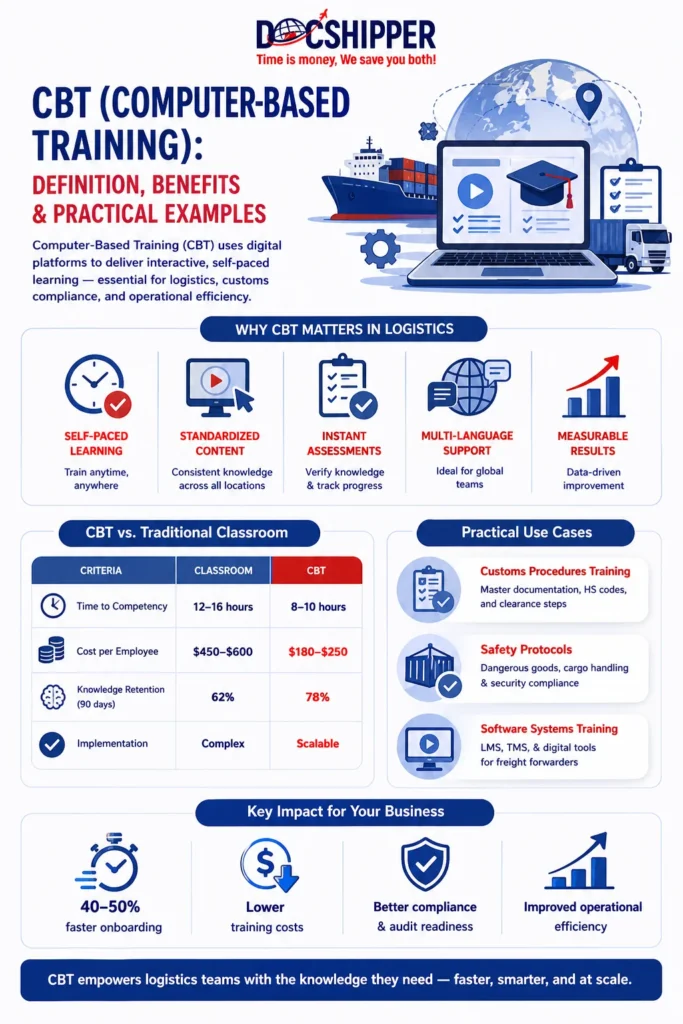
Computer-Based Training (CBT) is a self-paced learning method that uses digital platforms to deliver educational content, assessments, and interactive modules. In logistics and international trade, CBT enables companies to train employees on customs procedures, safety protocols, and software systems efficiently without disrupting operations.Introduction
Many logistics companies struggle with inconsistent employee training across multiple locations. Traditional classroom sessions disrupt workflows and create scheduling conflicts. Computer-Based Training solves this by delivering standardized, scalable education directly to employees’ workstations.
In the fast-paced world of international shipping and customs compliance, CBT has become essential. It allows freight forwarders, warehouse staff, and customs brokers to learn complex regulations at their own pace while maintaining operational continuity.
Key characteristics of effective CBT in logistics:
- Self-paced learning modules that accommodate different shift schedules
- Interactive simulations for customs documentation and cargo handling
- Instant assessment feedback to verify knowledge retention
- Multi-language support for international teams
- Progress tracking systems for compliance documentation
CBT Mechanisms & Expertise
Computer-Based Training operates through Learning Management Systems (LMS) that host multimedia content, quizzes, and certification tracks. These platforms track completion rates, test scores, and time spent on each module—critical data for regulatory audits.
In international trade, CBT addresses specific compliance requirements. The World Customs Organization recommends digital training for Harmonized System (HS) code classification, a complex skill that directly impacts duty calculations. According to WCO guidelines, standardized training reduces classification errors by up to 40%.
Modern CBT incorporates microlearning techniques—breaking complex topics like Incoterms or dangerous goods regulations into 5-10 minute modules. This approach improves retention rates compared to traditional four-hour classroom sessions.
The technology enables scenario-based learning where employees navigate virtual customs declarations or simulate cargo inspections. These interactive experiences build practical skills without the cost of physical training facilities or merchandise samples.
At DocShipper, we integrate CBT modules into our client onboarding process, ensuring partners understand documentation requirements and communication protocols before their first shipment. This reduces processing delays by an average of 30%.
Compliance tracking is another critical function. CBT systems automatically document when employees complete mandatory training on topics like IATA dangerous goods regulations or CTPAT security protocols—evidence required during customs audits or certification renewals.
Practical Examples & Data
Real-world implementation demonstrates CBT’s impact on logistics operations. Consider these comparative scenarios:
| Training Method | Time to Competency | Cost per Employee | Knowledge Retention (90 days) |
|---|---|---|---|
| Traditional Classroom | 12-16 hours | $450-$600 | 62% |
| Computer-Based Training | 8-10 hours | $180-$250 | 78% |
| Blended (CBT + Practical) | 10-12 hours | $320-$400 | 85% |
Use Case: Customs Broker Certification
A mid-sized freight forwarder with 45 employees implemented CBT for customs broker exam preparation. Previously, they hired external trainers for three-day workshops costing $28,000 annually. After switching to a CBT platform:
- Training costs dropped to $9,200 per year (platform subscription + content licensing)
- Exam pass rates increased from 68% to 82%
- Employees completed training 35% faster due to self-pacing options
- The company eliminated travel and accommodation expenses
Key Implementation Factors:
- Content quality: Modules must reflect current regulations and real documentation
- Technical accessibility: Mobile-responsive design for warehouse floor access
- Assessment rigor: Certification tests should mirror actual job requirements
- Update frequency: Quarterly content reviews to match regulatory changes
- Integration capability: API connections with HR systems for automatic enrollment
Industry data shows that logistics companies using CBT reduce onboarding time by 40-50% compared to traditional methods. For DocShipper’s network of partners, this translates to faster ramp-up for new team members handling international shipments.
Conclusion
Computer-Based Training transforms logistics education by delivering consistent, cost-effective, and measurable learning experiences. Its flexibility and scalability make it indispensable for companies managing complex international operations.
Need help implementing training systems for your logistics team? Contact DocShipper to discuss customized solutions for your operational needs.
📚 Quiz
Test Your Knowledge: Computer-Based Training (CBT)
Q1 — What best defines Computer-Based Training (CBT) in a logistics context?
Q2 — A logistics manager argues that CBT can fully replace hands-on warehouse training, including forklift operation. Is this correct?
Q3 — A freight forwarder needs to train 45 employees on customs broker exam preparation while minimizing costs and operational disruption. Which approach best leverages CBT?
🎯 Your Result
📞 Free Quote in 24hFAQ | CBT (Computer-Based Training): Definition, Benefits & Practical Examples
CBT specifically refers to software-based training installed on computers, while e-learning encompasses all online education including web-based courses, webinars, and mobile apps. CBT is a subset of e-learning focused on interactive, self-paced modules.
Most logistics CBT modules range from 15 to 45 minutes. Complex topics like customs valuation may require 60-90 minutes. Microlearning approaches break content into 5-10 minute segments for better retention.
CBT works best for theoretical knowledge and procedures. Physical skills like forklift operation or cargo securing require practical training. A blended approach combining CBT theory with supervised practice delivers optimal results.
CBT systems must meet SCORM or xAPI standards for content compatibility. For dangerous goods training, IATA and IMDG regulations specify content requirements. ISO 9001 quality systems often require documented training records that CBT platforms provide automatically.
Regulatory content requires updates whenever rules change—typically quarterly for customs procedures. Technical software training needs updates with each system version. Best practice is quarterly content reviews with immediate updates for critical regulatory changes.
Companies typically see 200-300% ROI within 18 months through reduced training costs, faster onboarding, and fewer compliance errors. Initial platform costs range from $5,000-$25,000 depending on user count and customization needs.
Yes. Modern LMS platforms provide detailed analytics including module completion rates, assessment scores, time spent per section, and certification status. This data supports performance reviews and compliance audits.
Minimum viable languages include English, Spanish, Mandarin, French, and German. Companies with Asian operations should add Japanese, Korean, and Vietnamese. Quality translation requires industry-specific terminology, not just automated tools.
Advanced CBT uses simulation environments where learners complete virtual customs forms, generate bills of lading, or calculate duties. The system evaluates accuracy against predefined criteria, providing immediate feedback on errors.
Most platforms require modern web browsers (Chrome, Firefox, Safari), stable internet connection (minimum 5 Mbps), and devices less than five years old. Mobile access typically needs iOS 12+ or Android 8+ with responsive design support.
Yes. Enterprise LMS platforms offer API integrations with systems like SAP SuccessFactors, Workday, or BambooHR. This enables automatic user provisioning, training assignment based on job roles, and synchronization of completion records.
Standard protections include SSL encryption for data transmission, role-based access controls, secure authentication (often with SSO), and content watermarking. GDPR-compliant platforms also provide data residency options and audit trails for access logs.
Need Help with
Logistics or Sourcing ?
First, we secure the right products from the right suppliers at the right price by managing the sourcing process from start to finish. Then, we simplify your shipping experience - from pickup to final delivery - ensuring any product, anywhere, is delivered at highly competitive prices.


Fill the Form
Prefer email? Send us your inquiry, and we’ll get back to you as soon as possible.
Contact us




:%20Definition%20&%20Guide%20en%202026)